
How to Identify Cucumber Beetle Damage Before Vines Wilt
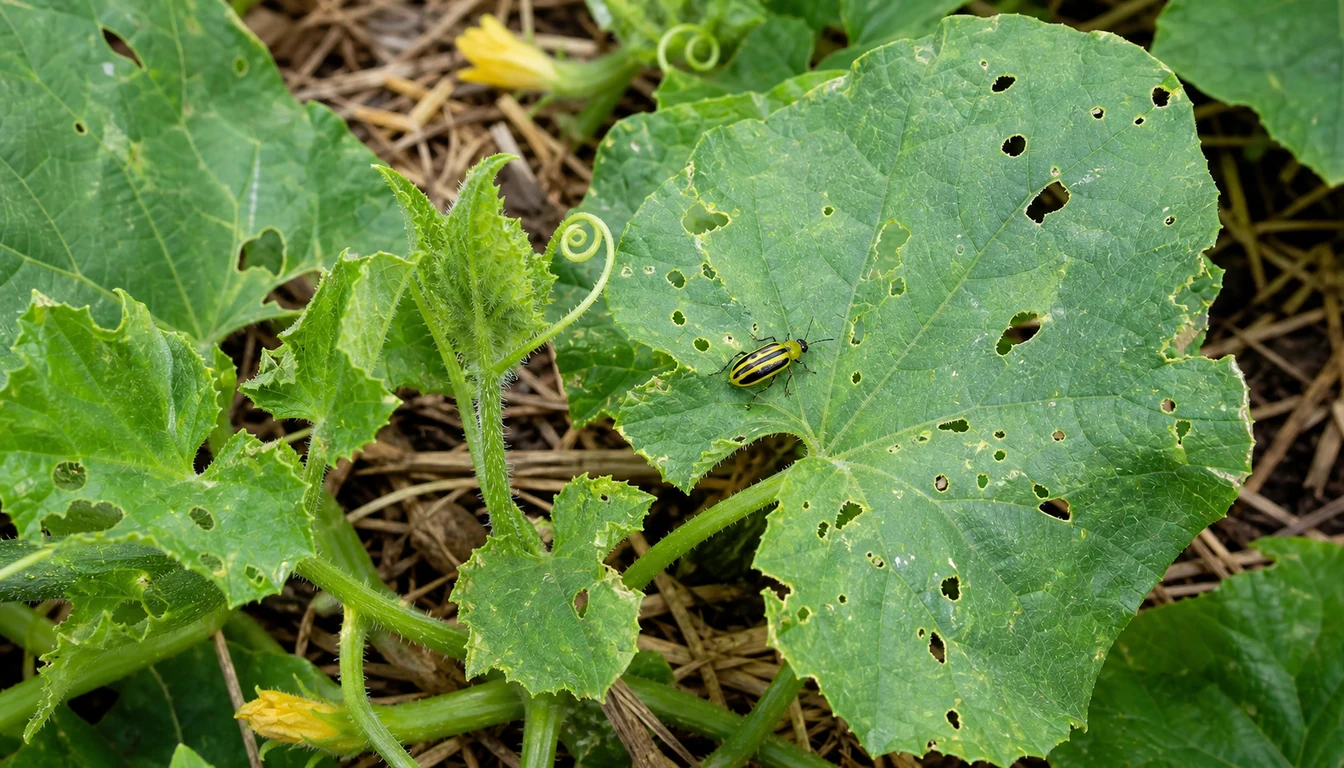
Cucumber beetle damage starts with holes in cotyledons and young leaves, chewed blossoms, or shallow scars on fruit.
Find out whether the vine has only lost tissue or has begun to wilt, because direct feeding can stop while bacterial wilt continues inside the plant.
Quick diagnosis
Check the beetle, plant stage, and wilt pattern together
A quarter-inch yellow beetle with three black stripes or twelve black spots beside fresh holes supports cucumber beetle feeding.
If one runner stays limp in moist soil or fails to recover overnight, move from leaf-damage control to a bacterial wilt check.
Open the full diagnosisWhat You Are Seeing
Cucumber seedlings are most vulnerable from emergence through the first three true leaves because they have little spare foliage. A few beetles can stall or strip a small plant before its root system and growing point are established.
An older vine may tolerate scattered holes, yet cucumbers remain vulnerable to bacterial wilt after they can outgrow leaf loss. That difference makes beetle pressure more important on cucumber and muskmelon than on a mature pumpkin or squash vine with the same amount of chewing.
Inspect cotyledons, leaf undersides, stem bases, open flowers, and the shaded underside of young fruit. Cucumber beetles fly or drop when disturbed, so hold a tray or container beneath the plant before moving the foliage.
Fresh chewing has green edges and missing tissue. White surface growth, bordered leaf spots, fine stippling, or irregular bites with slime or caterpillar frass point to a different problem even when the leaf also has holes.
Common Causes
01 High likelihood
Adult beetles feeding on seedlings and leaves
Striped and spotted cucumber beetle adults chew cotyledons, tender leaves, stems, and growing points. Feeding on a one-to-three-leaf cucumber can remove enough tissue to stop establishment, while the same holes on a vigorous older vine may be mostly tolerable.
How to identify it
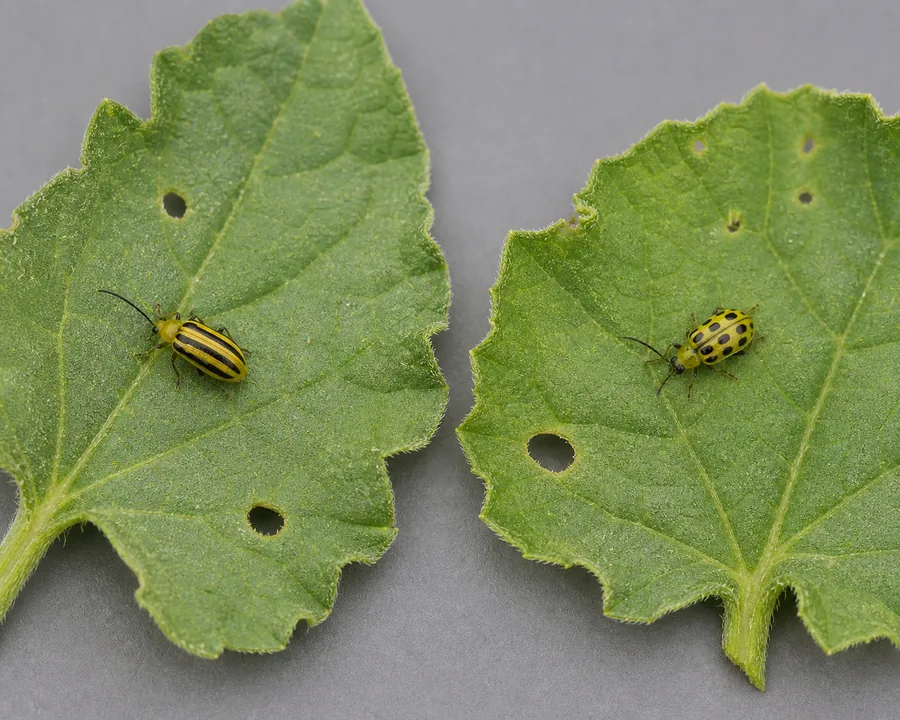
- Yellow beetles about one-quarter inch long sit on or near fresh feeding damage.
- Striped cucumber beetles carry three lengthwise black stripes on yellow wing covers.
- Spotted cucumber beetles carry twelve separate black spots on yellow-green wing covers.
- Cotyledons and first true leaves develop small round holes, ragged margins, or clipped growing points.
- A heavily attacked seedling stalls, loses most of its leaf area, or dies before it begins to run.
What to do
- Check seedlings every few days after emergence and count beetles before damage becomes extensive.
- Knock a small number into soapy water or remove them by hand when the planting is small enough to inspect closely.
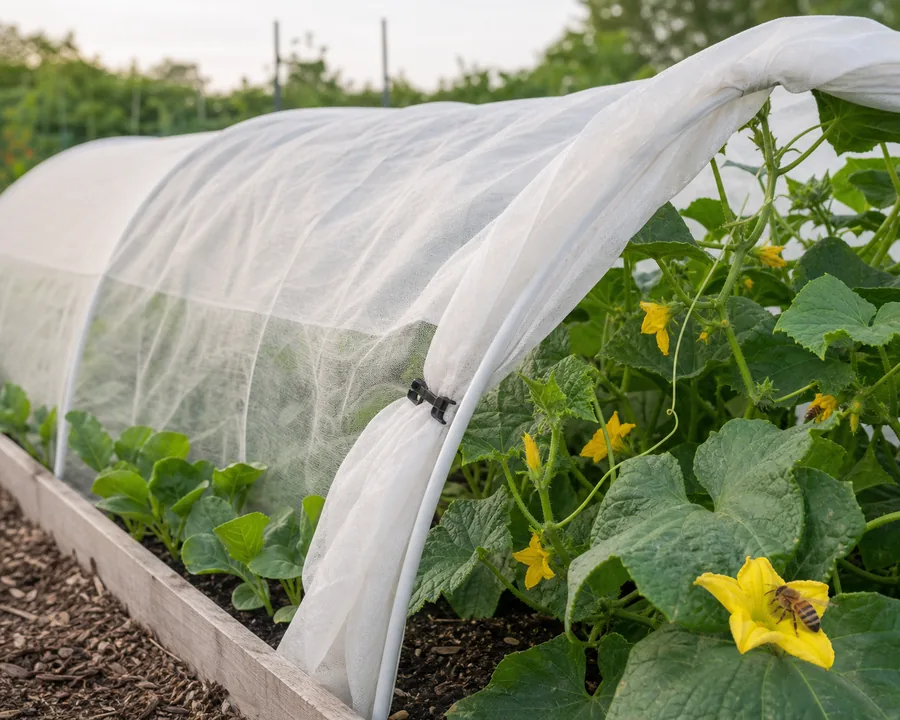
- Place a floating row cover over beetle-free seedlings and seal the edges against the soil.
- Replace a seedling whose growing point is gone when enough warm season remains for a new plant to produce.
- Use a pesticide only when cucumber and cucumber beetles both appear on the label, then follow pollinator, harvest, and application directions exactly.
02 Medium likelihood
Bacterial wilt transmitted during beetle feeding
Striped and spotted cucumber beetles can carry Erwinia tracheiphila into feeding wounds. The bacteria multiply inside the water-conducting tissue, so a runner can collapse days or weeks after the feeding event even though the root zone is moist.
How to identify it
- One leaf or runner wilts first, then the limp area advances along the vine.
- The plant may recover at night early in the disease and then stop recovering as blockage increases.
- Soil near the active root zone is moist enough that drought does not explain the collapse.
- Recent cucumber beetle feeding or beetles on nearby cucurbits provide a path for infection.
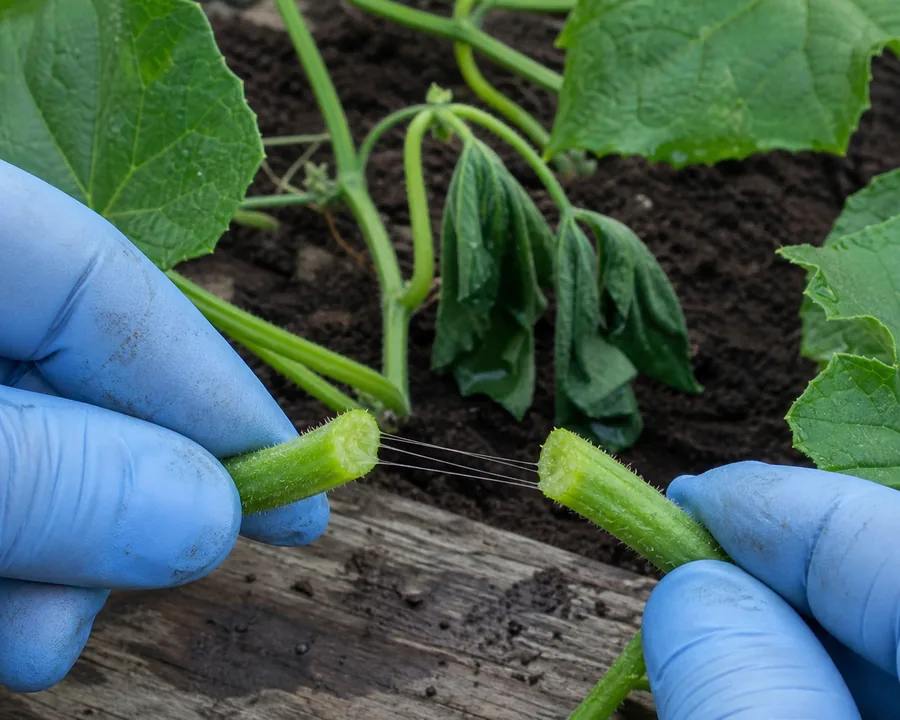
- Fresh cut stem surfaces may form fine sticky strands after they are pressed together and slowly pulled apart.
What to do
- Check soil moisture across the active root zone and inspect the stem base before cutting a runner so drought, breakage, and crown injury are not ignored.
- Remove a vine with progressive wilt that persists in moist soil because there is no treatment that clears a systemic bacterial infection.
- Bag or discard the affected vine rather than leaving it where beetles can feed and move to healthy plants.
- Lower beetle pressure on nearby cucumbers immediately, even if those vines still look healthy.
- Submit a fresh stem and disease history to a plant diagnostic service when the evidence conflicts or several vines collapse without visible beetles.
03 Medium likelihood
Flower feeding and cosmetic fruit scarring
Adults often move into yellow cucurbit flowers once bloom begins and may later feed on soft fruit skin. A few beetles in blossoms may not reduce yield, but a large population can injure flowers, stems, and young fruit or keep spreading disease among vines.
How to identify it
- Beetles hide in open flowers and become coated with yellow pollen.
- Petals or flower parts show fresh chewing while most mature foliage remains functional.
- Young fruit develops shallow pits, rough corky scars, or surface feeding on the shaded side.
- The fruit continues enlarging beneath superficial scars instead of softening from rot.
- No sunken dark blossom end or powdery leaf coating explains the visible damage.
What to do
- Inspect flowers early in the day when beetles and pollinators are easiest to see.
- Hand-remove beetles from a small planting without damaging the flower or trapping bees inside a cover.
- Leave shallow cosmetic scars alone when the fruit remains firm and continues to size normally.
- Remove badly scarred fruit only when damage opens a path for decay or the fruit stops developing.
- Avoid spraying open flowers while bees are active and follow every pollinator restriction on a labeled product.
04 Low likelihood
Striped cucumber beetle larvae feeding below ground
Striped cucumber beetle larvae hatch near cucurbit stems and feed on roots and underground stem tissue. This hidden injury can add stunting or poor anchorage, but it does not explain fresh holes because those are made by adults above ground.
How to identify it
- A plant remains stunted after adult feeding has been excluded from the foliage.
- Fine roots or tissue near the crown show localized chewing when a failed plant is lifted.
- Small pale larvae with darker head capsules occur close to damaged cucurbit roots.
- The bed has carried cucurbits and heavy striped beetle pressure in repeated seasons.
- Nearby protected plants with intact roots grow more strongly under the same water and soil conditions.
What to do
- Lift only a failed plant for inspection because root disturbance can injure a cucumber that might otherwise recover.
- Do not diagnose larval feeding from stunting alone when compaction, cold soil, root rot, or transplant damage is also plausible.
- Remove spent cucurbit vines and volunteer plants that support another beetle cycle.
- Rotate the next cucurbit planting away from the previous bed while remembering that flying adults can still find the new site.
- Use a soil treatment only when larvae are confirmed and both the pest and edible crop appear on the product label.
05 Low likelihood and regional
Squash mosaic virus after beetle activity
Cucumber beetles can also transmit squash mosaic virus, which is a more important beetle-borne concern than bacterial wilt in some western areas. The clue is patterned, distorted new growth rather than a vine that simply loses water pressure and collapses.
How to identify it
- New leaves develop light and dark green mottling, rings, or a mosaic pattern.
- Blades become puckered, narrow, curled, or smaller than normal as they expand.
- Fruit may become mottled, bumpy, misshapen, or slow to size.
- Symptoms continue in new growth after adult beetle feeding has been reduced.
- Local extension guidance lists squash mosaic as a cucumber beetle risk in the region.
What to do
- Photograph the youngest symptomatic leaves because old damaged foliage preserves less diagnostic detail.
- Ask a local extension office or plant clinic whether squash mosaic is active and testable in the area.
- Remove a confirmed virus-infected vine because damaged tissue will not return to healthy growth.
- Control beetle movement among remaining cucurbits and remove volunteer hosts around the bed.
- Start future crops with reputable seed and locally recommended resistant or tolerant cultivars when they are available.
The beetle pattern tells you what happened next
The striped cucumber beetle has three crisp black stripes, a dark abdomen, and a stronger association with early cucumber injury in many northern gardens.
The spotted cucumber beetle has twelve black spots and often arrives later, though regional timing and pressure vary.
A leaf hole records direct feeding, while wilt and mosaic growth record what may have followed.
Beetle control can prevent more wounds and transmission, but it cannot rebuild vascular tissue blocked by bacteria or cure a systemically infected vine.
Heat wilt normally eases after temperatures fall when roots have enough water. Bacterial wilt may improve overnight at first, yet it returns and spreads along a runner despite moist soil.
The stem string test is supporting evidence rather than a perfect home diagnosis. A positive result matters most when progressive wilt, moist soil, susceptible cucumber, and recent beetle activity all occur together.
Plant stage changes the value of the same amount of feeding. Lost cotyledons can end a seedling, while a few late holes or shallow fruit scars may leave a mature crop productive.
When Cucumber Beetle Damage Needs Action
Use beetle pressure and crop stage together rather than spraying every hole. Minnesota guidance uses about one-half beetle per cucumber seedling and one beetle per older cucumber plant as action thresholds because this crop remains susceptible to bacterial wilt.
A threshold starts a control decision instead of naming one mandatory product. Hand removal, immediate exclusion, reduced weeds, and physical barriers can lower pressure before a labeled pesticide is justified, while an early trap crop may support that plan.
- Cotyledons to three true leaves
- Act near one-half beetle per plant or sooner when the growing point is being lost.
- Established cucumber vine
- Act near one beetle per plant, especially where bacterial wilt is common.
- First open flowers
- Fold back or remove exclusion cover so pollinators can reach blooms, then scout flowers directly.
- Progressive wilt in moist soil
- Remove a likely infected vine and protect neighboring plants instead of adding water or fertilizer.
- Late cosmetic holes or scars
- Monitor when vines and fruit keep growing and beetle pressure remains below the local threshold.
Row cover works best when it goes over beetle-free plants before adults arrive and its edges stay sealed. Once flowers need insect pollination, expose them during bloom or use a managed cover schedule supported by local guidance.
Recovery Plan
Stop fresh feeding and check every wilted runner
Remove reachable beetles, protect unflowered plants, and mark the newest holes so later feeding is easy to see. Check soil moisture and overnight recovery before deciding that a limp runner has bacterial wilt.
Judge the new growth instead of old holes
A recoverable vine opens firm leaves and extends its growing tip after beetle pressure falls, although old holes and fruit scars remain. Progressive wilt in moist soil or new mosaic distortion means the problem has moved beyond cosmetic feeding.
Reduce the next early beetle flush
Remove spent vines, volunteers, weeds, and leaf litter that shelter adults, then choose a rotated bed and prepare exclusion before seedlings emerge. An early Blue Hubbard trap crop or reflective mulch can support that plan where local guidance recommends it.
Prevent severe cucumber beetle damage by starting with frequent seedling checks, sealed row cover before adults arrive, clean bed edges, and a plan for first bloom. Remove progressively wilted vines, keep beetles from moving among cucurbits, and combine rotation with early exclusion because adults can fly to a new bed.
Sources
- Cucumber Beetles, University of Minnesota Extension
- Growing Cucumbers in Home Gardens, University of Minnesota Extension
- Bacterial Wilt of Cucurbits, University of Illinois Extension
- Cucumber Beetles, Utah State University Extension
- Deterring Striped Cucumber Beetles in Organic Cucurbit Production Systems, Penn State Extension