
Find Cabbage Worms Before They Feed Into the Head
Turn over leaves on cabbage and other brassicas to find the larva, fresh frass, and new feeding.
Movement and body shape separate imported cabbageworm, cabbage looper, and diamondback moth, while crop stage determines whether to hand-pick, monitor, exclude adults, or use a labeled caterpillar treatment.
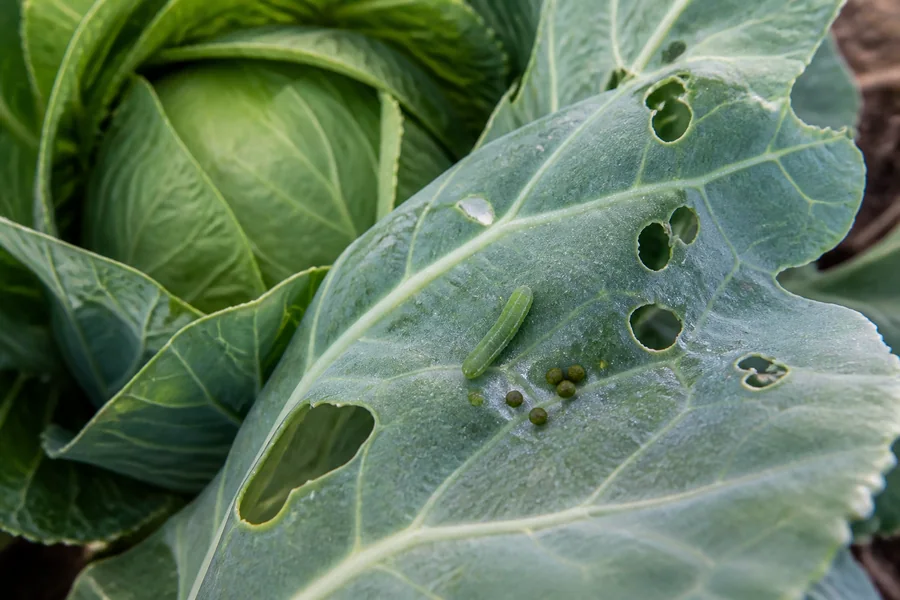
Quick diagnosis
Identify the larva by movement before choosing a control
A slow velvety green larva is usually imported cabbageworm, a larva that arches its middle is a cabbage looper, and a tiny tapered larva that wriggles or drops on silk is diamondback moth. Fresh moist frass and tender hole edges show that feeding is active; old dry holes without larvae may need monitoring rather than treatment.
Open the full diagnosisWhat You Are Seeing
The adults do not chew the crop. White butterflies and small moths warn that eggs may be arriving, but the caterpillars on leaf undersides and inside loose head leaves cause the harvest damage.
Young transplants have little leaf area to spare, while an older leafy crop can tolerate some outer-leaf feeding. Once cabbage begins cupping or broccoli and cauliflower form heads, larvae and frass near the marketable portion deserve closer attention.
Check several plants across the bed rather than choosing the worst leaf. A fixed route reveals whether the infestation is isolated, widespread, increasing, or already inactive.
Common Causes
01 Most common garden species
Imported cabbageworm moves slowly on the leaf
The white cabbage butterfly lays single upright yellow eggs on brassica leaves. Its larva becomes velvety green with faint yellow lines and feeds steadily between larger veins.
How to identify it
- White butterflies with dark wing marks patrol brassicas during daylight.
- Single yellow oblong eggs stand on upper or lower leaf surfaces.
- The larva looks velvety rather than glossy and moves sluggishly when disturbed.
- Larger larvae leave ragged holes and obvious green-brown frass.
- Larvae may move toward protected inner leaves as the head forms.
What to do
- Crush single eggs and hand-pick larvae during a complete scouting pass.
- Check the inner wrapper leaves before a cabbage head tightens.
- Use insect mesh before egg laying when the planting begins clean.
- If treatment is warranted, choose a product labeled for the crop and caterpillar and target small active larvae.
- Preserve parasitoids by avoiding an unnecessary broad-spectrum spray.
02 Common in warm periods
Cabbage looper arches as it crawls
Loopers lack legs through part of the abdomen, so they draw the rear body forward in an arch. Pale side stripes and this measuring motion distinguish them from the slower imported cabbageworm.
How to identify it
- The pale green body forms a high loop during movement.
- Narrow white lines run along the sides and may occur along the back.
- Eggs occur singly, often beneath lower leaves.
- Small larvae make surface windows before larger larvae open ragged holes.
- Large larvae and moist droppings may hide deep in heading crops.
What to do
- Turn lower leaves over and watch the larva move before removing it.
- Hand-pick manageable numbers and inspect folds for additional larvae.
- Direct any labeled small-larva treatment to feeding surfaces beneath leaves.
- Recheck developing heads because a missed large larva can contaminate the harvest.
- Do not spray solely because an adult moth was seen at night.
03 Small but persistent
Diamondback larva wriggles and may hang on silk
Diamondback moth larvae stay much smaller than the other common species. They are tapered at both ends, react vigorously to touch, and may drop from the leaf on a silk thread.
How to identify it
- The light green larva is small and narrow with a forked-looking rear end.
- It wriggles rapidly when the leaf is touched.
- A disturbed larva may dangle briefly from a silk thread.
- Early feeding leaves translucent windowpanes where the upper surface remains.
- Small slender moths rest with pale diamond markings along folded wings.
What to do
- Look closely along leaf veins and around windowpane damage.
- Count these small larvae separately because they are easy to overlook.
- Treat only with an option labeled for diamondback moth on the named brassica crop.
- Use mode-of-action and resistance guidance from local extension recommendations.
- Destroy crop residue after harvest so larvae and pupae do not continue in abandoned plants.
04 Regional or occasional
An egg mass produced a cluster of young larvae
Cross-striped cabbageworm, armyworms, and other moths may lay eggs in masses. Newly hatched larvae feed together, so one plant or one section can be stripped while nearby leaves remain untouched.
How to identify it
- Many same-size larvae occupy one leaf or neighboring leaves.
- An egg mass, webbing, or empty egg shells remain near the feeding patch.
- Young larvae skeletonize a concentrated area before spreading.
- Color bands, spots, or head markings do not match the three common green larvae.
- Damage jumps from a clean area to a heavily occupied cluster.
What to do
- Remove the occupied leaf or crush the egg mass when crop size allows.
- Photograph an individual larva and the egg arrangement for local identification.
- Search adjacent plants for another cluster rather than assuming the whole bed is uniform.
- Confirm that any selected product lists the crop and identified caterpillar.
- Shorten the next scouting interval because grouped young larvae can disperse quickly.
Fresh Feeding Matters More Than Old Holes
A hole remains after a larva is gone.
Active feeding adds moist frass, tender green cut margins, small surface windows, new damage on inner leaves, or a live larva beside the injury.
Bacillus thuringiensis subsp. kurstaki, often shortened to Btk, must be eaten by susceptible caterpillars. It performs best while larvae are small and actively feeding on treated foliage; it does not repair existing holes or control slugs, flea beetles, and aphids.
Natural enemies can suppress later generations.
Parasitized caterpillars or clusters of wasp cocoons should not be crushed, and flowering habitat for beneficial insects supports adults that need nectar.
Scout a Fixed Sample, Not the Worst Leaf
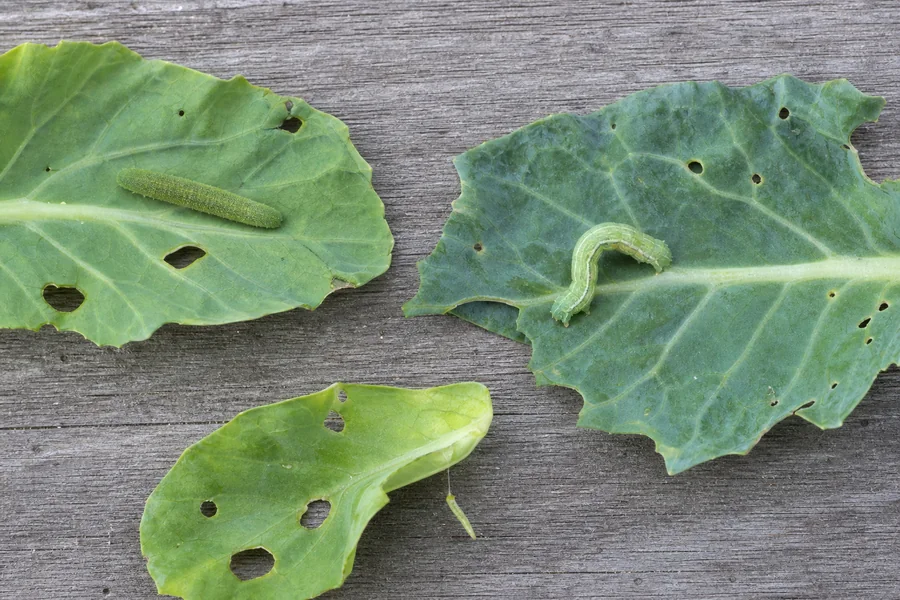
Choose a route that crosses the planting and inspect the same number of plants each time. Include bed edges and the center, because adults may concentrate eggs along one boundary.
On each plant, turn over an outer leaf, inspect the newest accessible leaves, and look inside the loose cup without damaging the head. Record live larvae, approximate size, fresh frass, egg type, and whether feeding has reached the harvestable portion.
- Start with a clean container or sheet beneath the first plant.
- Inspect upper and lower leaf surfaces and gently tap the plant over the sheet.
- Touch one larva lightly and watch whether it crawls slowly, loops, wriggles, or drops on silk.
- Separate fresh moist frass and green-edged holes from old dry damage.
- Repeat across the bed instead of stopping after the first caterpillar.
- Write down crop stage and the share of sampled plants with active larvae.
Use current local extension guidance to interpret that sample because action levels differ by species, crop, growth stage, and harvest standard. Inspect the same sequence of plants after hand-picking or treatment so the comparison means something.
Match the Response to Crop Stage
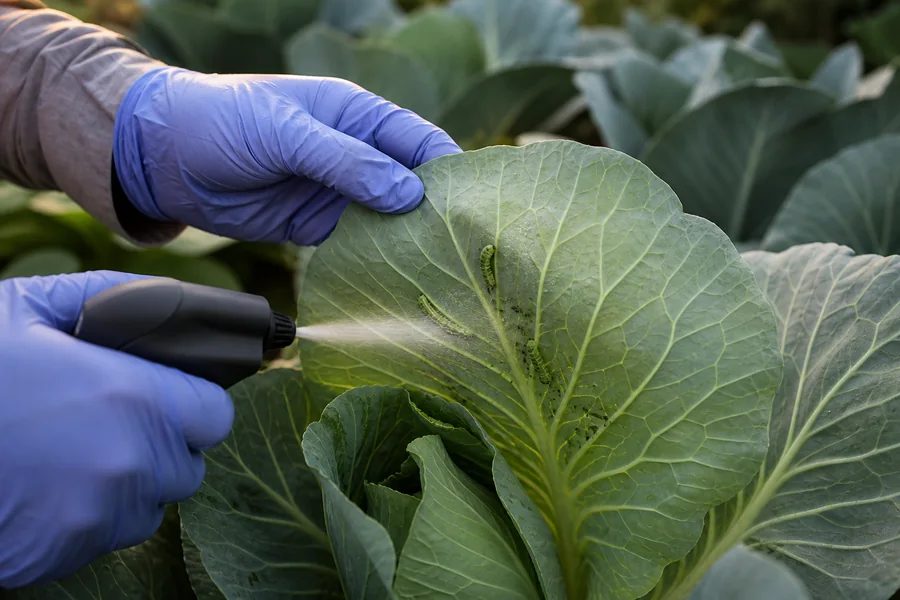
The same number of larvae can mean different risk. A seedling can lose its growing point, a kale plant may lose an outer leaf, and a nearly finished cabbage can become contaminated when one larva enters the head.
- Seedlings and transplants
- Protect the growing point and limited leaf area. Remove larvae promptly and repair exclusion gaps.
- Leafy harvest before heavy damage
- Hand-pick and monitor when active feeding is scattered and clean leaves remain available.
- Cupping or early head formation
- Inspect inner wrappers closely because shelter and contamination risk are increasing.
- Near harvest
- Remove larvae and frass, assess whether feeding entered the marketable portion, and obey every preharvest interval.
- Large clustered hatch
- Remove the cluster where practical and identify it before it disperses across the planting.
Hand removal is often enough for a small garden when scouting is consistent. If a selective caterpillar product is justified, reach the leaf undersides and small larvae without spraying open flowers or allowing runoff.
Avoid treating butterflies alone or using a broad-spectrum product as insurance. The selective pest-control framework helps preserve predators and parasitoids while targeting the organism actually present.
Keep the Next Hatch Outside the Crop
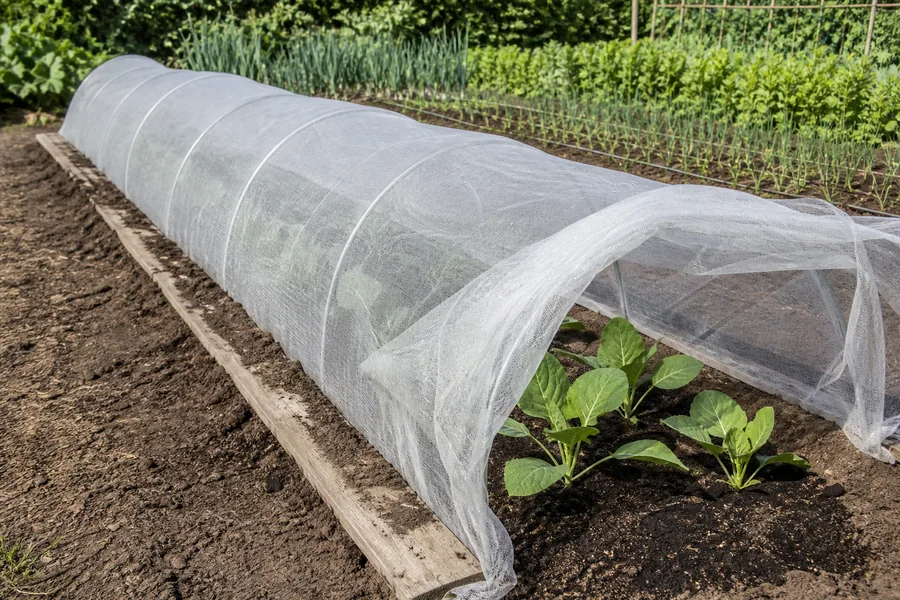
Install fine insect mesh at transplanting or immediately after a clean inspection. Seal the full perimeter with soil, boards, pins, or weights and leave enough slack for leaf growth.
Cover does not kill larvae already present. Check transplants, crush eggs, and remove caterpillars first, then reopen the tunnel only long enough for inspection and weeding.
Cabbage, kale, broccoli, and cauliflower grown for leaves or heads do not require insect pollination for that harvest. Plants kept for seed must flower and exchange pollen, so their access plan differs.
After harvest, remove exhausted brassica residue and volunteers that keep caterpillars feeding. Rotation helps with soil-borne problems but cannot by itself stop flying moths and butterflies from finding a new bed.
Recovery Plan
Remove larvae and mark active plants
Hand-pick visible caterpillars and egg masses, record species and size, and note whether fresh feeding is on outer leaves or inside the developing head.
Repeat the same plant sample
Recheck undersides and inner wrappers for small larvae missed as eggs. Compare active plants with the first pass instead of judging success from old holes.
Inspect and clean the edible portion
Peel damaged outer wrappers, rinse loose-leaf crops carefully, and open suspect folds to remove larvae and frass. Discard tissue with rot or extensive contamination rather than hiding it inside storage.
Start clean under sealed mesh
Inspect transplants, remove brassica volunteers, install cover before adult activity, and support natural enemies around the bed without spraying their flowers.
Scout brassicas from transplanting onward, start insect mesh over clean plants, remove crop residue promptly, and keep a record of the first adults, eggs, and larvae. If a cabbage head opens cleanly without chewing or frass, use the split-head diagnosis rather than treating for insects.