yard
KnowTheYard

databasePlant Database

Browse by category

potted_plant

Houseplants

Indoor & tropical species

nutrition

Vegetables

Edible garden crops

spa

Herbs

Culinary & medicinal

local_florist

Flowers

Ornamental blooms

water_drop

Succulents

Drought-tolerant species

park

Trees

Arboreal species

forest

Shrubs

Bushes & hedges

nature

Perennials

Garden flowers

grass

Lawn Grasses

Turf varieties

local_dining

Fruits

Fruit-bearing plants

Best Indoor Plantsarrow_forwardBest Shade Plantsarrow_forward

menu_bookGarden Guides

Step-by-step guides by task type

grass

Lawn Care

Seasonal checklists and year-round maintenance guides for a championship lawn.

yard

Planting

When, where, and how to plant — from seed to transplant for every garden type.

water_drop

Watering

Deep-watering techniques, schedules by plant type, and drought management.

compost

Fertilizing

Feeding schedules, NPK ratios, and organic vs synthetic options by plant.

pest_control

Pest Control

Identify, prevent, and treat common garden pests without harming beneficial insects.

content_cut

Pruning

Pruning timing, techniques, and tools for trees, shrubs, and flowering plants.

Popular Guides

parkFall Lawn Carelocal_floristSpring Lawn Carecalendar_monthFull Calendar
All Guidesarrow_forwardLawn Care Hubarrow_forward
ToolsCompareRegional GuidesPlant ProblemsPet SafetyAbout
searchPlant Finder
yardKnowTheYard

Published plant profiles, practical care guides, problem diagnosis pages, and side-by-side comparisons for home gardeners.

chatphoto_camera

databaseBrowse Plants

  • arrow_forwardHouseplants
  • arrow_forwardVegetables
  • arrow_forwardHerbs
  • arrow_forwardFlowers
  • arrow_forwardTrees

menu_bookResources

  • arrow_forwardGarden Tools
  • arrow_forwardRegional Guides
  • arrow_forwardPlant Problems
  • arrow_forwardPet Safety
  • arrow_forwardCare Calendar
  • arrow_forwardPlant Finder

infoCompany

  • arrow_forwardAbout Us
  • arrow_forwardOur Team
  • arrow_forwardMethodology
  • arrow_forwardEditorial Policy
  • arrow_forwardContact Us

mailEmail Updates

Join the list for new guides, seasonal notes, and launch updates.

No spam. Request removal anytime.

fact_check

Reviewed Pages

77 pages currently attributed to public review lanes

public

USDA Zone Coverage

Zone-aware recommendations and regional growing context

database

230 Published Plant Profiles

555 public pages across profiles, guides, comparisons, and problem pages

© 2026 KnowTheYard. All rights reserved.

Privacy PolicyTerms of ServiceContactSitemap
Home/vegetables/Zucchini: Productive Summer Squash Workhorse/Powdery Mildew Zucchini
scienceEditorial DiagnosisUpdated Feb 20, 2026

Powdery Mildew on Zucchini

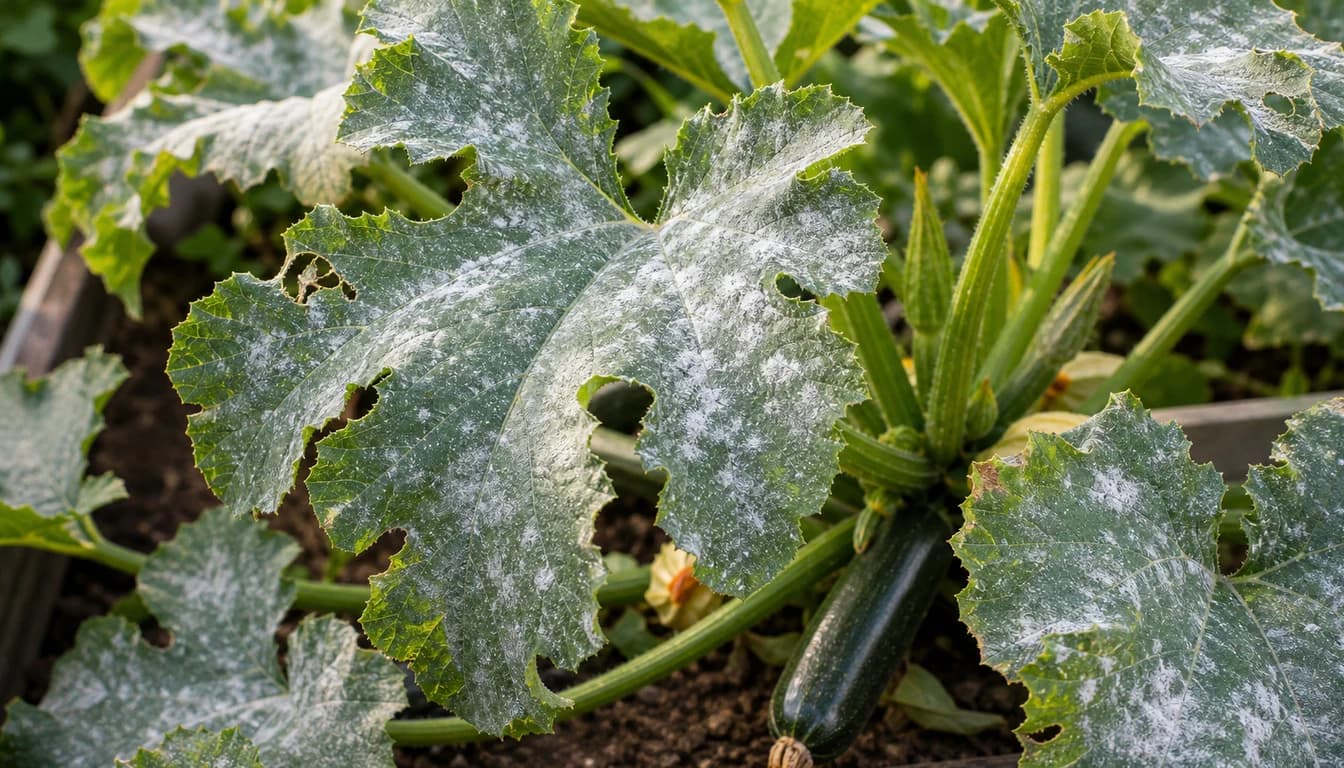
White, powdery fungal growth on **Zucchini** leaves and stems caused mainly by Podosphaera xanthii; manage with improved airflow, sanitation, and labeled fungicides for cucurbits to protect yield.

Zucchini leaves with white powdery mildew patches in a vegetable garden

Zucchini leaves with white powdery mildew patches in a vegetable garden

lightbulb
bolt

Quick Diagnosis

Most Likely Cause: Powdery mildew (Podosphaera xanthii) on Cucurbita pepo.

Start by checking whether the oldest leaves are carrying a floury film or just their normal silver mottling. On Zucchini, powdery mildew spreads across leaf surfaces and petioles, while varietal leaf variegation stays flat, patterned, and clean-edged; if you want a second visual comparison, see powdery mildew on Cucumber.

Jump to fix steps arrow_downward

Powdery mildew is one of the most predictable late-season problems on Zucchini, especially once dense zucchini foliage traps humid air overnight. The disease does not need soaking foliage to move, so a bed can look dry and still let the infection build fast.

The pathogen most often responsible on squash and Zucchini is Podosphaera xanthii, a member of the Erysiphales. Outbreaks are widespread across North America zones 3-11, and severity correlates with canopy density, local humidity, and how wet foliage becomes during irrigation.

Successful management blends cultural controls (spacing, pruning, staking), sanitation, and fungicides labeled for cucurbits when needed. We focus on practical, garden-scale tactics you can use now and next season to reduce spread and protect fruit.

pest_control
Plant Problem - See AlsoBlossom End Rot on Zucchini
chevron_right
psychology

How powdery mildew works and how it differs from downy mildew

Powdery mildew fungi produce dry, powder-like colonies on the upper leaf surface and do not require prolonged free water to infect. This contrasts with downy mildew, which often causes angular yellow or brown lesions with fuzzy sporulation on the underside of leaves and needs surface moisture to spread.

A quick field test: if the white growth wipes off with your finger and is mostly on the upper surface, it’s powdery mildew. Downy mildew shows distinctive underside growth and leaf tissue collapse; if unsure, compare symptoms to common cucumber-family diseases or other cucurbit problem pages for visual clues.

Environmental cues help diagnosis-powdery mildew peaks in warm days and cool nights with moderate to high humidity, while persistent leaf wetness and prolonged rain favor downy mildew.

thermostat

Environmental Baseline

Before diagnosing specific failures, confirm your Zucchini: Productive Summer Squash Workhorse's environment matches its core care requirements.

forestZucchini: Productive Summer Squash Workhorse Care Needs

  • Light: Full sun (6–8+ hours)
  • Water: Consistently moist, never soggy
  • Temp: Best between **65–85°F**

homeTypical Indoor Home

  • Humidity: 30-50% (Low)
  • Temp: 65-72°F variable
  • Light: Often too dim or direct
biotech

Possible Causes

Sorted by likelihood

1. Fungal infection by Podosphaera xanthii

Likelihood: High

Powdery mildew on Zucchini is primarily caused by fungi in the order Erysiphales, with Podosphaera xanthii the usual species on cucurbits. Spores land on leaves and germinate when humidity is moderate to high and temperatures are in the range of 65-85°F (18-29°C).

Identification

  • remove_circle_outlineWhite, powdery patches on the upper leaf surface; may spread to stems and petioles.
  • remove_circle_outlineLeaves become chlorotic, then brown and brittle if infection is heavy.
  • remove_circle_outlineGrowth concentrated in shady, dense canopies and lower leaves near soil level.
  • remove_circle_outlineOccurs during warm days and cool nights; visible without magnification.

The Fix

  1. 1Remove and destroy heavily infected leaves to lower inoculum; do not compost infected material unless heated.
  2. 2Improve airflow by pruning and spacing; stake or trellis vines to reduce canopy density.
  3. 3Apply protective fungicides labeled for cucurbits at first sign, following label for preharvest intervals and rotation to avoid resistance.
  4. 4Use preventive sprays on susceptible varieties during high-risk weather windows.
  5. 5Avoid overhead watering and water early in the day to let foliage dry quickly.

2. Dense canopy and poor air circulation

Likelihood: High

Thick, sprawling growth traps moisture and raises local humidity in the canopy, making it easy for powdery mildew spores to survive and spread between leaves.

Identification

  • remove_circle_outlineTightly packed vines with overlapping leaves and few gaps for wind.
  • remove_circle_outlineHigher disease incidence on lower and inner leaves compared with exposed outer leaves.
  • remove_circle_outlineSymptom clusters near trellis posts or where plants touch fences and other plants.
  • remove_circle_outlineGreater problems in late-season when foliage is fully developed.

The Fix

  1. 1Space transplants per seed packet spacing to reduce overlapping leaves and increase airflow.
  2. 2Prune a few of the largest lower leaves once plants are established to open the canopy.
  3. 3Train and stake vines upright or use supports so leaves receive full sun and wind exposure.
  4. 4Thin surrounding vegetation and avoid planting Zucchini in the same spot for consecutive seasons.
  5. 5Mulch to keep soil splash and weeds down, but keep mulch away from direct stem contact.

3. Overhead watering and microclimate humidity

Likelihood: Medium

Sprinklers and late-day irrigation raise humidity and move spores across plants. Powdery mildew thrives in humid air around the leaves even when surfaces aren’t continuously wet.

Identification

  • remove_circle_outlineHigher disease near sprinkler heads or on plants watered late in the day.
  • remove_circle_outlineIncreased spread after heavy evening watering or irrigation events.
  • remove_circle_outlineSymptoms worse in shaded beds where canopy doesn’t dry quickly.
  • remove_circle_outlineGreenhouse and high tunnel crops show similar patterns without adequate venting.

The Fix

  1. 1Switch to drip irrigation or water at the soil line so foliage stays dry.
  2. 2Irrigate early in the morning so any moisture evaporates during the day.
  3. 3Open rows or vents in protected structures to lower humidity when possible.
  4. 4Combine watering changes with cultural pruning to accelerate drying.
  5. 5Avoid overhead fertilizers that leave a film on leaves and can increase disease risk.
pest_control
Plant Problem - See AlsoSquash Vine Borer on Zucchini
chevron_right
potted_plant

Root Health Examination

A direct inspection of the root system distinguishes root rot from drought stress - saving weeks of guesswork.

check_circleHealthy Roots

  • Firm to the touch
  • White or light tan color
  • Earthy, pleasant smell

cancelCompromised Roots

  • Mushy or slimy texture
  • Dark brown or black color
  • Sour, rotting odor

Inspection Step: Gently slide the pot off while supporting the base of the stems. The outer root ball gives sufficient clues without disturbing all the soil.

gpp_bad
warning

When to Worry

A few yellow leaves are normal. If more than 20% of foliage turns yellow within a week, or new growth is affected, act immediately - check the roots first.

timeline

Recovery Protocols

Recovery takes time. Once the root cause is corrected, implement a 30-day stabilization window.

0-1 weeksImmediate actions and symptom control

At first signs, remove the worst affected leaves and improve airflow. Start cultural changes (drip irrigation, morning watering) and apply a protective fungicide labeled for cucurbits if more than a few leaves are affected. Expect to halt new colonies within days of an effective spray.

1-3 weeksVisible improvement and slowed spread

Healthy, upper canopy leaves should remain free of new powdery growth with regular sprays and better ventilation. Existing infected tissue will not fully recover but the plant will reallocate growth to clean leaves, and fruit set usually continues if the vine remains vigorous.

3-6 weeksYield stabilization and ongoing management

With continued integrated care-pruning, fungicide rotation, and sanitation-plants generally maintain fruit production. Expect reduced disease pressure on new growth; repeat applications may be needed according to label schedules during prolonged high-risk weather.

menu_book
Guide - See AlsoAir Purifying Plants for Cleaner Indoor Air
chevron_right
shield

Preventing Future Issues

Fruits are edible during infection, but always follow fungicide label directions for preharvest intervals and wash harvested squash before eating. Prevent recurrence with season-long habits: choose full sun sites, maintain well-drained soil, rotate crops using crop rotation basics for vegetables, and use proper spacing and staking to improve air circulation. Apply targeted fungicides labeled for cucurbits only when needed to avoid resistance. Keep balanced nutrition through fertility practices for vegetable beds to help Zucchini plants recover and resist future outbreaks. Powdery mildew is a fungus (order Erysiphales) that loves warm days and cool nights with humidity. Look for a fine white powder on leaves, starting at the top surfaces. If you see yellowing or restriction of new growth, treat early.

menu_book

Related Reads

pest_control
Plant ProblemBlossom End Rot on Zucchini
chevron_right
pest_control
Plant ProblemSquash Vine Borer on Zucchini
chevron_right
menu_book
GuideAir Purifying Plants for Cleaner Indoor Air
chevron_right
menu_book
GuideBest Herbs to Grow Indoors for Real Harvests, Not Spindly Pots
chevron_right
menu_book
GuideBest Indoor Plants for Every Room and Light Level
chevron_right
Zucchini: Productive Summer Squash Workhorse (Cucurbita pepo) - full care guideCucurbita pepo

Zucchini: Productive Summer Squash Workhorse

Cucurbitaceae Family

wb_sunny

Light

Full sun (6–8+ hours)

water_drop

Water

Consistently moist, never soggy

thermostat

Temp

Best between **65–85°F**

yardFull Care Guide

On This Page

boltQuick DiagnosispsychologyUnderstandingthermostatEnvironment CheckbiotechPossible Causespotted_plantRoot ExamwarningWhen to WorrytimelineRecovery PlanshieldPreventionmenu_bookRelated Reads