
Native Region
Southeast Asia (Philippines, Indonesia, Malaysia, and Taiwan)
Phalaenopsis spp.
Family: Orchidaceae
Native Region
Southeast Asia (Philippines, Indonesia, Malaysia, and Taiwan)
Phalaenopsis Orchid is an epiphyte — in the wild, it clings to tree branches in tropical rainforests across the Philippines, Indonesia, Malaysia, and Taiwan, sending silvery-green roots into the air to absorb moisture from rain and humid breezes. This is not a plant that grows in soil. Its roots evolved to grip bark, drain fast, and breathe. Understanding that single fact fixes most orchid failures.
At home, a mature Phalaenopsis typically produces 4 to 6 broad, leathery leaves arranged in a low rosette, each leaf reaching 5 to 8 inches long. The leaves are dark green, slightly flexible, and store modest amounts of water — nothing like a succulent, but enough to survive a missed watering. From the center of the rosette, a slender flower spike emerges and arches gracefully outward, bearing anywhere from 5 to 20 blooms depending on the hybrid and the plant's maturity.
Individual flowers on a Phalaenopsis spike are butterfly-shaped — the genus name literally means 'moth-like' — and each bloom measures 2 to 4 inches across. Modern hybrids come in white, pink, purple, yellow, spotted, and striped patterns. A single flower spike can bloom for 8 to 12 weeks, and a strong plant may produce two spikes at once. After the flowers drop, the spike may re-bloom from a lower node if it's still green and firm.
The orchid aisle at a garden center can be overwhelming, but nearly every plant you'll find for sale is a Phalaenopsis hybrid bred from a handful of species — *P. amabilis*, *P. schilleriana*, and *P. violacea* are the most common parents. All share bright indirect light and bark-based media requirements, so choose based on color, flower size, and plant stature rather than differing care needs.
Standard-size Phalaenopsis hybrids are the tall, dramatic ones you see in 6-inch pots with arching spikes — great for a dining table centerpiece or a windowsill where they have room to spread. Compact or 'mini' hybrids stay under 12 inches tall and are ideal for desks, shelves, or bathrooms with a small window. They bloom just as prolifically as their larger cousins.
Novelty hybrids push into territory that surprises people: flat-faced 'bellina' types with waxy, star-shaped flowers in orange and yellow; 'jewel orchids' (actually a different genus, *Macodes petola*) grown for their iridescent veined foliage rather than flowers; and multi-flora hybrids that produce three or more branching spikes from a single plant. If you want a reliable bloomer with minimal fuss, the standard grocery-store Phalaenopsis is genuinely excellent — decades of selective breeding have made them almost foolproof.
Phalaenopsis Orchid thrives in bright, filtered light — think the dappled shade beneath a rainforest canopy, which is exactly what it evolved under. An east-facing window with a sheer curtain is the sweet spot for most homes; you get gentle morning sun without the scorching intensity of afternoon rays. A south or west window works too, but push the plant back 3 to 4 feet from the glass or hang a light-diffusing shade cloth.
How do you know the light is right? The leaves should be a medium, olive-green color. Dark green leaves usually mean the plant isn't getting enough light to bloom well, while yellowish or reddish-tinged leaves signal too much direct sun. This color cue is the most reliable feedback loop you have — watch it for a couple of weeks after placing the plant and adjust.
Phalaenopsis can survive in lower light than most flowering plants, but it won't bloom reliably below about 1,000 foot-candles (roughly what a north-facing window provides on a bright day). If your space is dim, a simple grow light running 12 to 14 hours a day bridges the gap. Our best indoor plants guide covers low-light picks if you need something beyond orchids for darker rooms.
Overwatering kills more Phalaenopsis orchids than every other problem combined. The fix is counterintuitive: water when the bark medium feels dry to the touch, not on a rigid calendar schedule. In most homes, that means every 7 to 10 days in summer and every 10 to 14 days in winter — but humidity, pot size, and bark chunk size all shift the timing. Stick your finger an inch into the bark; if it feels damp, wait.
When you do water, take the plant to the sink and run lukewarm water through the pot for 30 to 60 seconds, letting it flow freely through the bark and out the drainage holes. This flushes out mineral buildup and salts that accumulate from fertilizer — a problem that slowly damages the silvery velamen coating on orchid roots. After watering, let the pot drain completely for a minute or two before returning it to its decorative container. Never let the roots sit in standing water.
The roots themselves are your best indicator. Healthy Phalaenopsis roots are plump and silvery-white when dry, turning bright green when freshly watered. If the roots look consistently shriveled, brown, or mushy, something is wrong — either you're watering too infrequently (shriveled) or too often in compacted bark (mushy). Our drainage holes guide explains why drainage is non-negotiable for epiphytes.
Phalaenopsis orchids do not grow in soil. They grow in orchid bark mix, a chunky blend of fir bark, charcoal, perlite, and sometimes sphagnum moss that mimics the rough, air-filled surface of a tree branch. Standard potting soil compacts around the roots, traps moisture, and suffocates them within weeks. If your orchid came in moss from the store, plan to repot it into bark within a few months — moss stays wet far too long for healthy root growth.
Repot every 12 to 18 months, or sooner if the bark has broken down into a soggy, soil-like mush. When bark decomposes, it loses the air pockets that orchid roots depend on. Choose a clear plastic pot — orchid roots photosynthesize, and seeing them through the pot wall makes it easy to gauge moisture and health. The pot should be just large enough to contain the roots comfortably; too much extra space holds excess moisture.
When repotting, gently remove the old bark with your fingers — never tug at roots. Trim any dead roots (they're brown, flat, or mushy) with sterilized scissors, then nestle the plant into fresh bark, pressing lightly to eliminate large air pockets. Water lightly after repotting and wait a week before resuming the normal schedule; the roots need time to settle into the new medium.
Phalaenopsis orchids propagate through keikis — baby plants that form on the flower spike after blooming. The word 'keiki' is Hawaiian for 'baby,' and it's the standard term used by orchid growers worldwide. A keiki is essentially a clone of the parent plant, complete with its own tiny leaves and roots, and it's the easiest way to multiply your collection without any special hormones or equipment.
Keikis form naturally on older flower spikes, especially on the upper nodes. You can encourage the process by applying a small dab of keiki paste (a cytokinin-based hormone) to a dormant node on a spent spike — cut the spike back to just above a healthy node, apply the paste, and keep the plant in bright indirect light with consistent moisture. Within 4 to 8 weeks, a small leafy growth should appear at that node.
Wait to separate the keiki until it has at least 2 to 3 leaves and roots that are 2 to 3 inches long — this ensures the baby plant can sustain itself. Snip the spike a couple of inches below the keiki, pot it in a small container with fine-grade orchid bark, and keep it in slightly higher humidity than the parent for the first few weeks. Division of the main plant is possible for larger specimens with multiple growth points, but keiki propagation is far more common and reliable.
Phalaenopsis orchids are less pest-prone than leafy tropicals like pothos or monstera, but they are not immune. Mealybugs are the most frequent intruder, hiding in the tight crevices where leaves meet the stem and along the underside of the flower spike. They look like tiny tufts of white cotton and suck sap from the plant, leaving behind sticky residue called honeydew.
For light infestations, dab each mealybug with a cotton swab dipped in 70% isopropyl alcohol — it dissolves the waxy coating and kills them on contact. If the problem spreads, spray the entire plant with diluted neem oil or insecticidal soap, repeating weekly for three rounds. Our neem oil for houseplants guide covers proper dilution ratios.
Beyond pests, the most common problems are bud blast (buds dropping before opening, usually from sudden temperature swings or draft exposure), root rot (from waterlogged bark — the roots turn brown and mushy), and leaf yellowing (often from too much direct sun or a potassium deficiency). Bud blast is frustrating but not dangerous; fix the environmental trigger and the next spike should open normally.
Phalaenopsis orchids follow a predictable annual rhythm once you learn to read it. Spring and summer are the growth months — new leaves emerge from the center of the rosette, roots extend actively into the bark, and the plant builds the energy reserves it needs to produce a flower spike. This is when to increase watering frequency and start feeding with a balanced orchid fertilizer at half the recommended strength every two weeks.
The critical transition happens in early fall when cooler nighttime temperatures — ideally dropping to 55 to 65°F (13 to 18°C) for several weeks — signal the plant to initiate a flower spike. This 10 to 15°F drop from daytime highs is the trigger most indoor growers miss. Move the plant to a cooler room, a drafty windowsill (as long as it doesn't freeze), or simply crack a window at night during September and October. Without this cool period, many Phalaenopsis plants will skip blooming and produce only leaves.
Once the spike appears — usually a small nub emerging from between the lower leaves — keep the plant in stable conditions and resist the urge to move it. Winter is bloom time; enjoy the flowers for their full 8 to 12-week lifespan. After the last flower drops, cut the spike back to just above the second or third node from the base if the spike is still green; it may produce a secondary bloom. If the spike is brown and dry, cut it at the base and let the plant rest.
Phalaenopsis orchids are non-toxic to cats, dogs, and humans according to the ASPCA — one of the rare flowering houseplants you can keep without worrying about a curious pet taking a bite. The flowers are technically edible and sometimes appear as garnishes in high-end restaurants, though they have no particular flavor. If your cat chews on a leaf, the worst likely outcome is mild stomach upset.
From an ecological standpoint, Phalaenopsis orchids are nursery-grown rather than wild-harvested, which is a genuine conservation win. The orchid trade historically devastated wild populations across Southeast Asia, but modern tissue-culture propagation means virtually every plant sold at a garden center or grocery store is lab-produced. You are not depleting a rainforest by buying a moth orchid.
That said, orchid bark media does have an environmental footprint — fir bark is harvested from live trees, primarily in the Pacific Northwest. Look for sustainably sourced orchid mixes, or experiment with alternative media like coconut husk chips or cork bark, which are renewable byproducts of other industries. For a broader list of pet-friendly houseplants, our houseplant collection flags pet safety on every profile.
Phalaenopsis orchids are listed as non-toxic by the ASPCA. Safe to keep around cats, dogs, and children. For other pet-safe options, see our guides on pothos and peace lily.
Keep Exploring
 Houseplants
String of Turtles (Peperomia prostrata) is the trailing succulent with leaves shaped like tiny turtle shells — each leaf is a disc no bigger than a fingernail,
 Houseplants
Neon Pothos is a bright chartreuse form of classic pothos, grown indoors for its bold color and easy care. Give it moderate light, let the top inch of soil dry
 Houseplants
Free Weekly Digest
Plant care tips, straight to your inbox
Zone-specific advice, seasonal reminders, and new plant guides — no filler.
Ice cubes placed on orchid roots are a popular internet hack that can damage or kill root tissue. Phalaenopsis are tropical plants — always use lukewarm or room-temperature water.
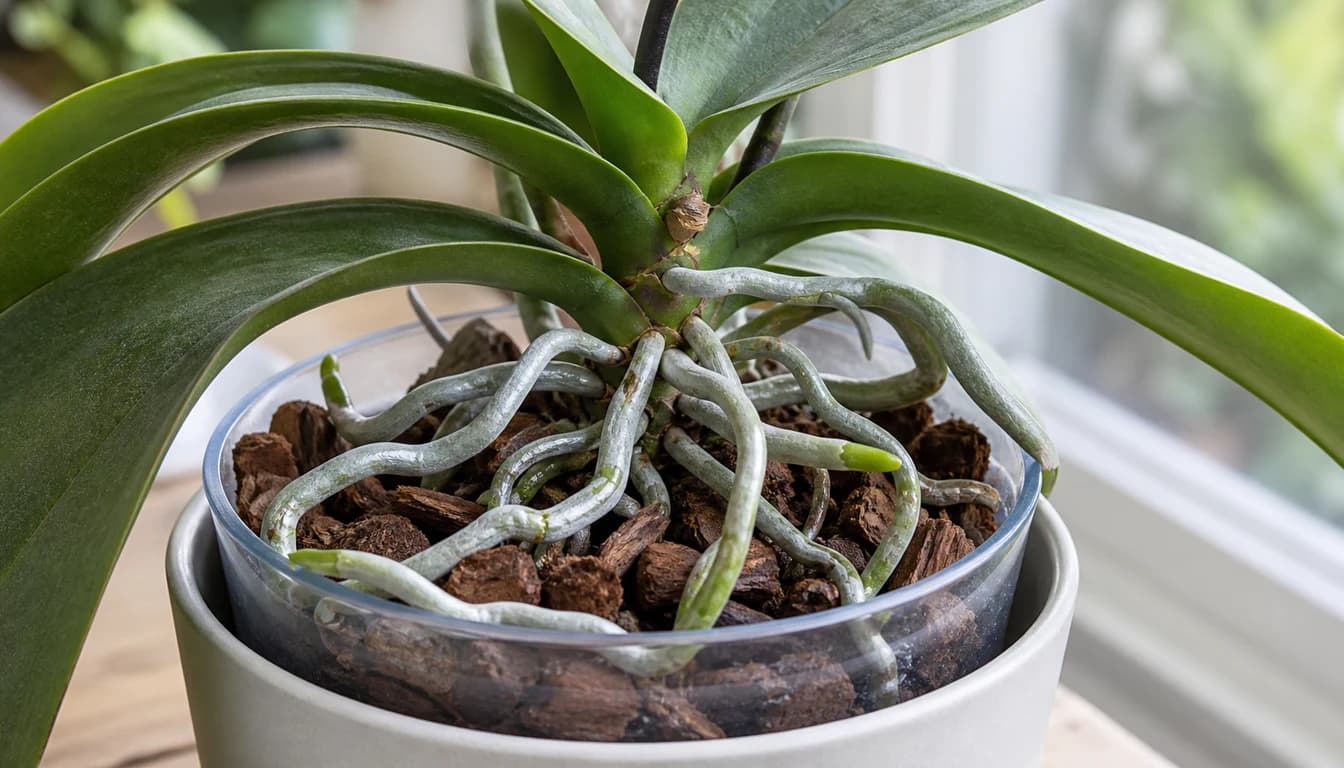
Some growers soak new bark in water for 24 hours before potting. Dry bark is hydrophobic and initially repels water — pre-soaking helps it absorb moisture evenly from the start.
Satin Pothos (Scindapsus pictus) is the luxurious trailing vine that drapes heart-shaped leaves with a silvery, satin-like sheen; it grows fast, handles low lig
Free Weekly Digest
Plant tips in your inbox
Zone-specific advice and seasonal reminders — no filler.