
When to Start Pruning Tomato Plants and Which Shoots to Keep
Tomato pruning starts with the plant's growth habit and the way it is supported. An indeterminate plant trained to a limited number of stems needs different attention from a determinate plant held in a cage.
A side shoot is capable of becoming a fruiting branch. Removing it changes the plant's shape and potential crop, so pruning is not simply clearing away useless growth.
The useful starting point is when the established plant has identifiable side shoots and flower clusters, with a clear reason to remove particular growth. A calendar month alone cannot tell you which cut belongs on your plant.
At a glance
Is Your Tomato Determinate or Indeterminate?
The plant tag or the full cultivar description is the best starting point. The determinate and indeterminate comparison explains the growth pattern, but the practical pruning question also includes the support you plan to use.
A determinate plant has a limited framework, so indiscriminate removal of side shoots can remove part of its crop. Wisconsin recommends restricting routine sucker pruning to indeterminate plants. Iowa State describes limited removal below the first flower cluster on determinates, rather than stripping side shoots throughout the plant.
| Plant and support | Pruning approach | Main tradeoff |
|---|---|---|
| Determinate in a cage | Preserve the fruiting framework and avoid routine removal of upper side shoots | A tidy outline is not worth sacrificing useful growth |
| Indeterminate on a single-stem support | Remove side shoots that are not part of the chosen framework | More training work and fewer retained branches |
| Indeterminate with two trained stems | Retain a selected side shoot as the second leader | The support must carry both stems |
| A plant in a roomy cage | Let the cage and canopy guide selective thinning | More branches need more room and access |
These are different arrangements, not stages every plant has to pass through. A cage-grown tomato does not automatically need the same pruning as a vine on a narrow string support.
What Exactly Is a Sucker, and Where Does It Grow?
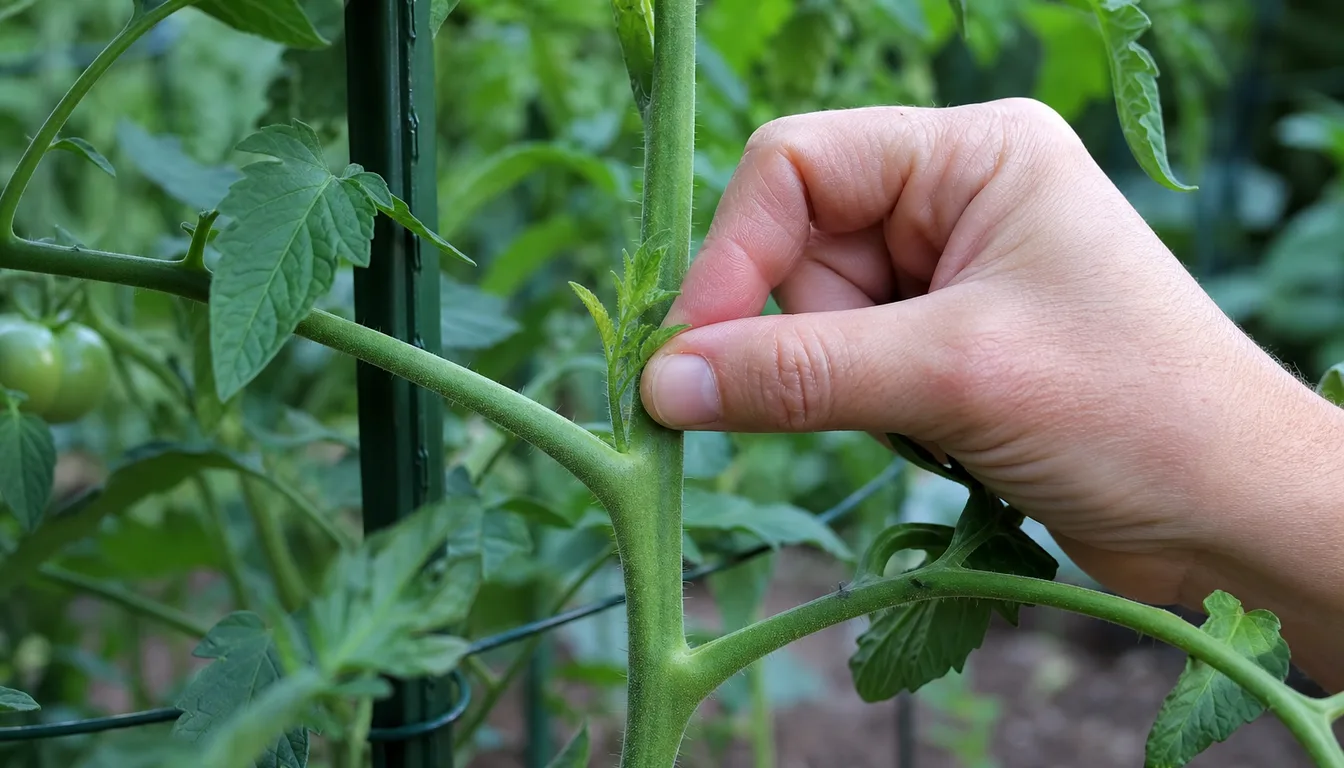
A sucker is a side shoot that develops at the leaf axil, the angle where a leaf joins the main stem. Small leaves appear on that shoot as it grows. A flower cluster carries buds and flowers, so it is a different structure with a different consequence if removed.
Wisconsin explicitly notes that a retained sucker can produce its own leaves, flowers, fruit, and further shoots. Its pruning method deliberately keeps one as a second stem. Calling all suckers unproductive would contradict that reason for keeping one.
Identification comes before removal. If the growth is difficult to distinguish, leaving it while checking the plant is less damaging than pinching an unidentified shoot.
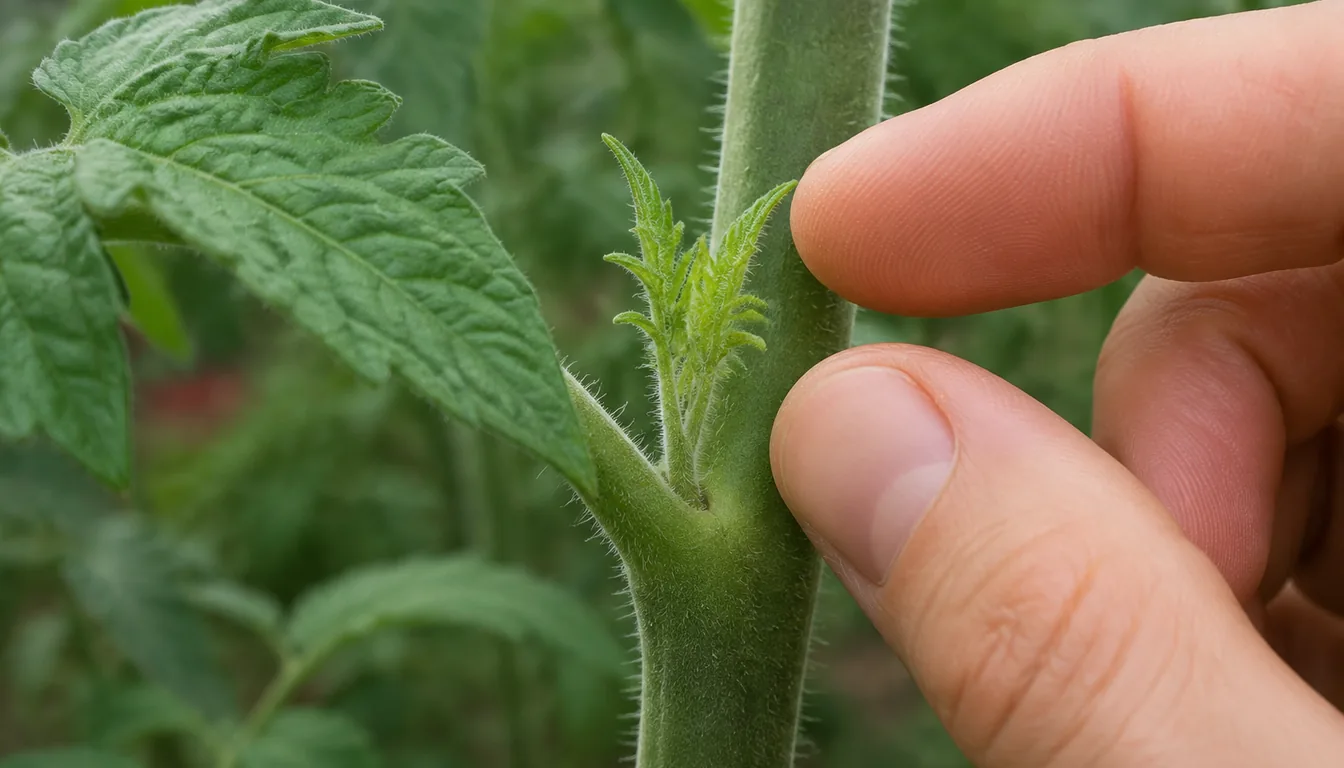
- Trace the main stemFollow the stem to a leaf attachment and find the growth in the angle above it.
- Identify the structureLook for developing leaves on a side shoot and buds on a flower cluster.
- Match the training planKeep a shoot selected as a leader. Remove only the unwanted side shoot.
- Make a clean removalPinch a small shoot near its base, or use clean, sharp pruners for growth that will not pinch cleanly. Avoid tearing the main stem.
When Does Pruning Begin, and How Many Stems Stay?
An established plant with visible shoots and flower clusters gives you something reliable to identify. That stage is more useful than transferring a regional June or July date to every climate or planting time.
University of New Hampshire guidance for an overhead trellis allows one or two leaders. One leader needs a support for one continuing stem, while two leaders include a retained sucker below the first flower cluster. This is a training choice, not a requirement for every indeterminate tomato.
A retained stem needs support as it lengthens. Leaving a shoot to grow and then removing it after it has become a large fruiting branch is a different loss from removing a small unwanted shoot early.
The schedule also follows the method. Wisconsin describes an early sequence of pruning sessions that stops before first harvest to allow protective foliage to develop. Iowa State describes ongoing selective sucker removal while warning against opening the canopy too far. Combining the most aggressive parts of both into one season-long rule would remove those limits.
- Starting cue
- Established plant with identifiable shoots and flower clusters
- Stem choice
- Match the selected training and support method
- A retained sucker
- Can become a flowering and fruiting leader
- Limit
- Preserve enough foliage to shade developing fruit
How Much of the Bottom of the Plant Comes Off?
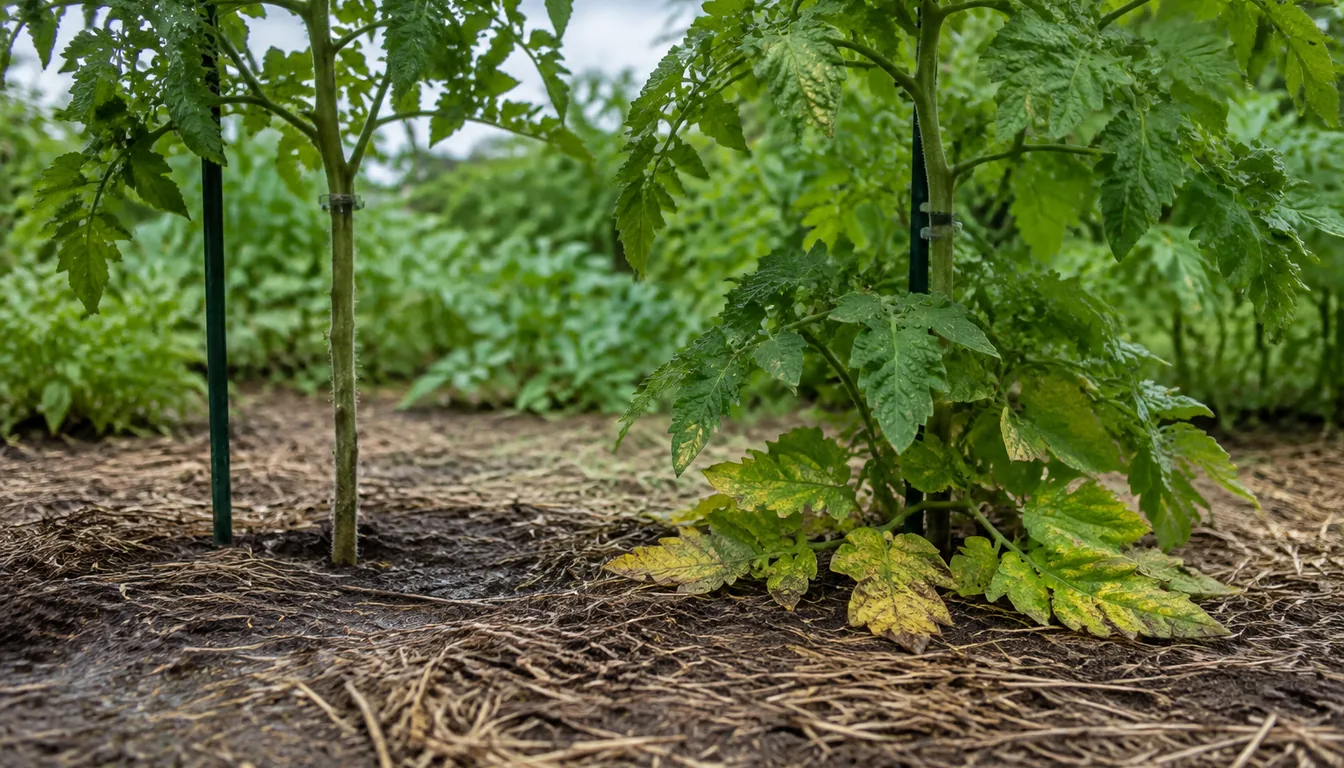
Leaves against the ground are exposed to soil splash and can make the base difficult to inspect. Removing appropriate lower foliage and keeping plants supported can reduce that contact and improve access, but a bare stem does not make a plant disease-proof.
Iowa State describes clearing lower leaves and shoots from the bottom 6–12 inches. That range needs the context of the plant's size. Applying it blindly to a small transplant could remove most of its foliage.
The useful result is a clearer base with a functioning canopy above it. Enough leaves still need to cover developing fruit, because abrupt exposure to strong sunlight can cause sunscald.
When Is Late-Season Topping Useful?
Topping removes a growing tip to limit further extension. It can be useful on an indeterminate tomato when the remaining season favors ripening existing fruit over making additional growth. It is optional, and it is not a routine treatment for a determinate plant.
Iowa State suggests considering it about four to six weeks before the average first fall frost. That is a regional planning guide, not a guarantee of ripening or a fixed date for frost-free climates.
The remaining fruit must still have enough time, warmth, healthy foliage, and water to develop. A cut cannot turn every small green tomato into a mature crop, and removing one tip does not prevent every other shoot on the plant from growing.
For a suitable indeterminate plant, a cut above a leaf or fruit cluster can shorten the selected stem without removing the fruit below. Plants already stressed by drought or disease need that problem addressed rather than another automatic cut. The frost-date calculator can compare dates you supply, but it does not predict your local weather.
What Makes a Pruning Session Worthwhile?
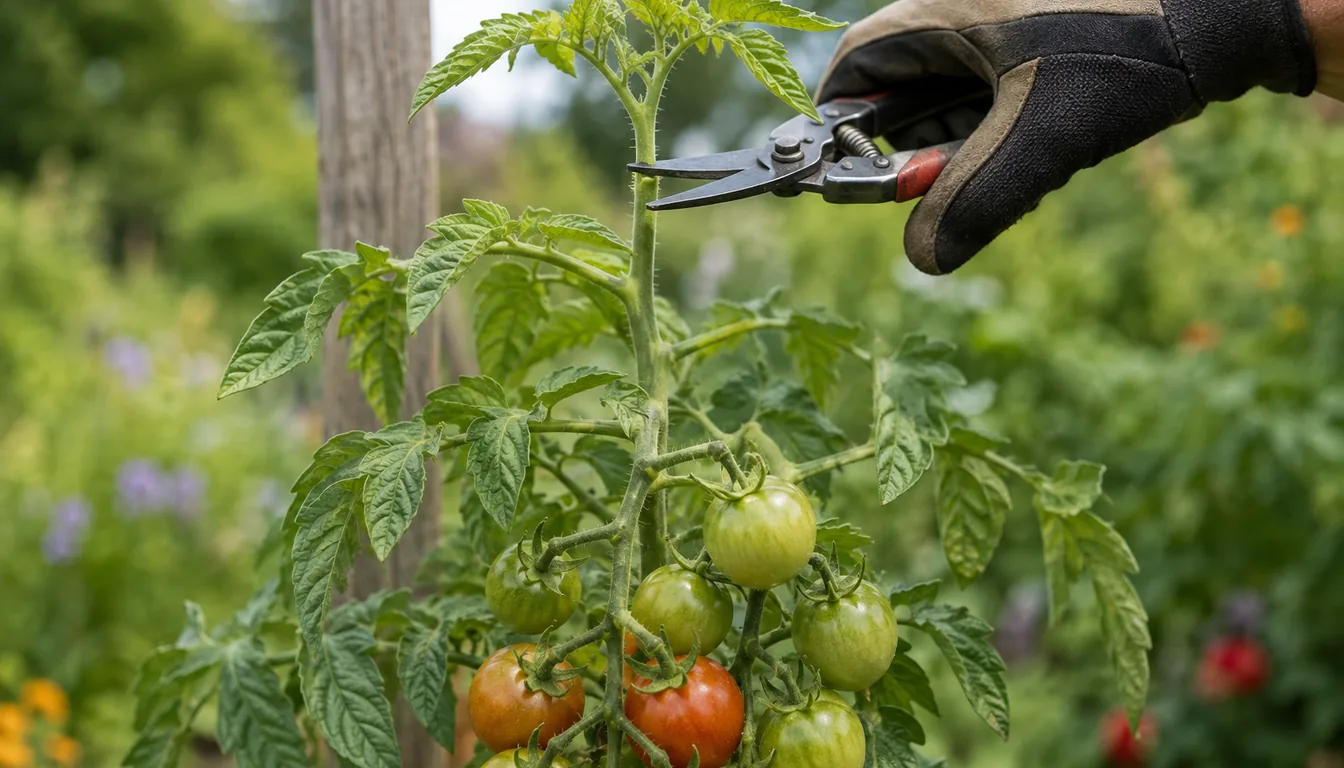
A useful session has a specific purpose, such as keeping the selected stems on their support, removing ground-contact foliage, or making the plant accessible for harvest. A larger pile of removed leaves is not evidence of a better result.
Dry conditions and clean hands and tools help limit the spread of disease between plants. Wisconsin recommends cleaning hands and decontaminating pruning tools between plants, which matters even when a plant has no obvious symptoms.
The tomato care guide covers the water, site, and growth conditions that pruning cannot replace. A plant with weak growth or damaged fruit may need a different explanation before more foliage comes off.
The final check is the plant left standing. Its intended stems have support, fruiting clusters remain, and enough healthy foliage protects the crop. Further cuts need a reason beyond making every plant look alike.
Sources & References
Related Guides
Cutting Back a Leggy Houseplant Does Not Fix It
Most people cut a houseplant back because it has gone long and bare.
11 min read
Deadheading Daffodils Matters Less Than the Six Weeks After
Almost every page about spent daffodils tells you to remove the seed pod so the bulb is not…
11 min read
French Lavender Pruning Depends on the Plant and Season
French lavender needs light trimming within its leafy growth, rather than a hard cut into bare…
6 min read
Fruit Tree Pruning Starts With Where the Crop Forms
A fruit tree that gives small, crowded, scabby fruit is usually not underfed.
11 min read
How Deep Can You Cut a Spent Lavender Spike?
Deadheading lavender is the lightest cut you will ever make on the plant, and the one place people…
7 min read
How Do You Prune Spanish Lavender for a Second Flush?
Spanish lavender is the one that flowers first and the one that keeps going.
7 min read