
When to Aerate a Lawn in Michigan, and When Clay Soil Needs It Twice
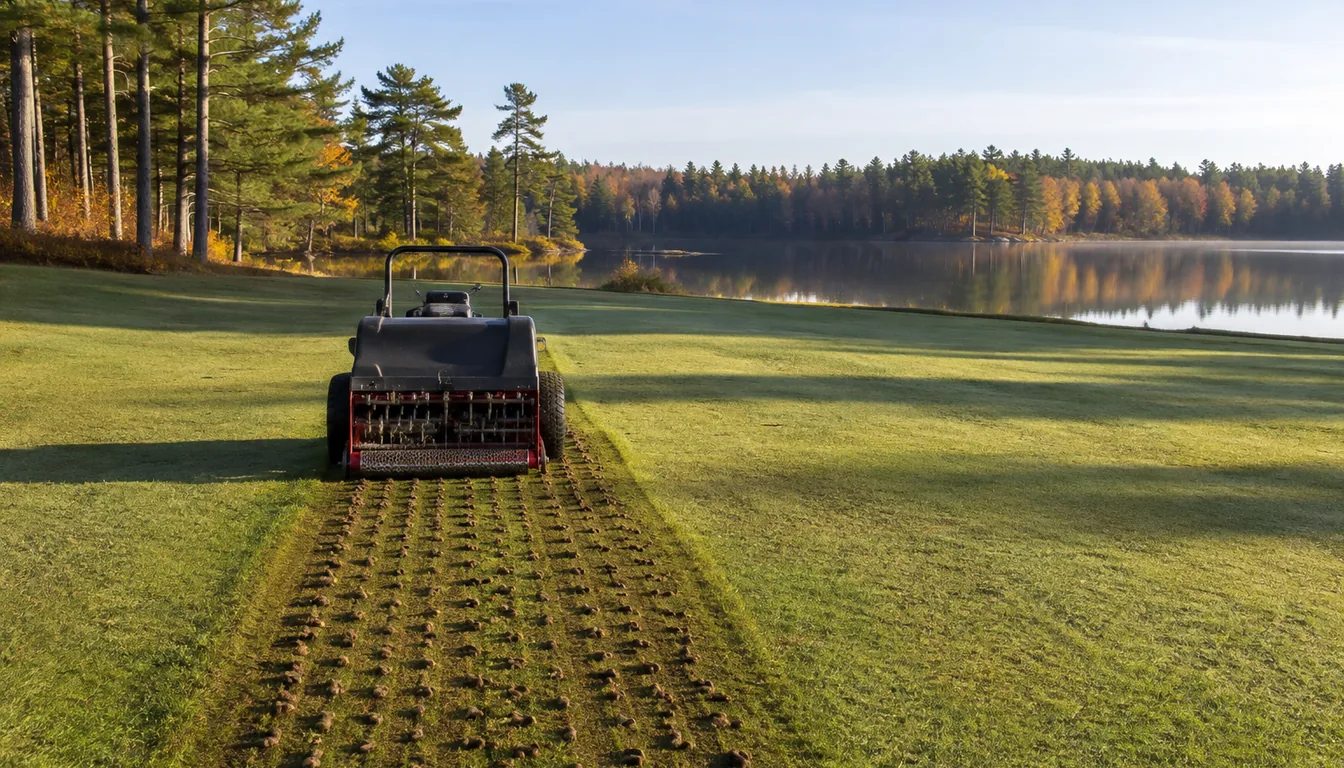
Michigan State University Extension puts the main aeration window in late summer through early fall. Soil is less likely to be waterlogged then than in spring, and the grass has cool weeks of active growth to recover from the holes. For lawns on heavy clay, MSU turf specialist Kevin Frank recommends coring in both spring and fall, and in summer too when heat and drought are not extreme.
How often depends on the lawn more than the calendar. MSU's rule is that lawns with frequent foot traffic, especially on clay, benefit from yearly aeration, while lawns that are not compacted and carry less than half an inch of thatch do not need it every year.
At a glance
Why Does MSU Favor Fall for Michigan Lawns?
Two things make autumn the default in Michigan. Kevin Frank of MSU Extension points out that fall soil is more likely to be at a workable moisture than spring soil, which often swings between saturated and dry. Fall also gives the turf several cool weeks to heal from what he calls a rather invasive procedure. A second MSU article adds that improved soil air in late summer and early fall lines up with the lawn's active fall growth.
The grass itself fits that timing. MSU's lawn seeding bulletin describes Kentucky bluegrass as the most popular lawn grass in Michigan, alongside perennial ryegrass, tall fescue, and fine fescue. All four grow best when soil sits between 50 and 65 degrees F and air between 60 and 75 degrees F, conditions Michigan gets in spring and again in fall. Without irrigation they can go dormant in hot, dry summer weather, which is the wrong time to tear holes in the root zone.
Kentucky bluegrass also explains why thatch shows up in so many Michigan lawns. It spreads by rhizomes and builds thatch more readily than bunch-type ryegrass or tall fescue, so a bluegrass lawn is the one most likely to need coring for thatch as well as compaction.
Does Your Michigan Lawn Need Aeration Every Year?
MSU gives a two-part test. A lawn that gets frequent foot traffic, especially on soil with a high clay content, benefits from yearly aeration. A lawn that is not compacted and has thatch under half an inch does not need it every year.
| What you see | What MSU links it to | Aeration plan |
|---|---|---|
| Water runs off instead of soaking in | Thatch over 0.5 inch or compacted soil | Core this fall, and check thatch depth |
| Lawn feels spongy underfoot | Thick thatch layer | Core aerate, which slowly reduces thatch |
| Turf yellows in low spots that stay wet for days | Roots losing oxygen in saturated clay | Let it dry, then core to help water soak in |
| Paths worn by kids, pets, or a mower | Traffic compaction | Yearly coring in those zones |
| Loose soil, thin thatch, steady growth | No compaction problem | Skip a year |
The thatch link matters because thatch changes where the roots live. MSU explains that grass growing in thatch thicker than about half an inch roots into the thatch instead of the soil, where the roots are less protected from summer heat and swings in moisture. Coring moves rooting back down into the soil over time.
If the turf in a soggy low spot is already turning yellow, Frank notes that aeration helps but probably will not cure it. Regrading or drain lines remove the water, while coring only helps oxygen and water move through what is left.
Why Clay Soil Can Justify Spring and Fall Aeration
MSU notes that compacted soil is common in the parts of Michigan with clay soils, and that thatch often builds on those same lawns because poor drainage slows the microbes that break it down. That combination is why Frank recommends coring clay lawns twice a year, in spring and fall.
Spring coring on clay has one condition. Saturated spring soil has to dry out first, because Frank's own warning is not to send a core aerator into soggy areas. A clay lawn that stays wet into May may get only the fall pass that year, and that is a better outcome than smearing wet soil.
Summer coring is the exception, not a routine. Frank allows it on clay only when the weather is not extremely hot or dry. In a normal Michigan July, unirrigated cool-season grass is slowing or dormant, so the holes stay open longer and the lawn recovers slowly.
Coring does not change the soil's makeup. For a lawn that still pools after several years of aeration, fixing compacted soil covers organic matter and drainage changes that work alongside it.
How Should the Lawn Be Prepared Before Coring?
Soil moisture is the main preparation step. MSU says aeration works best with good soil moisture, and that dry soil can keep tines from going in. If the lawn is dry, water it thoroughly a couple of days before the aerator arrives. If the soil is so wet that plugs stick inside the tines, wait.
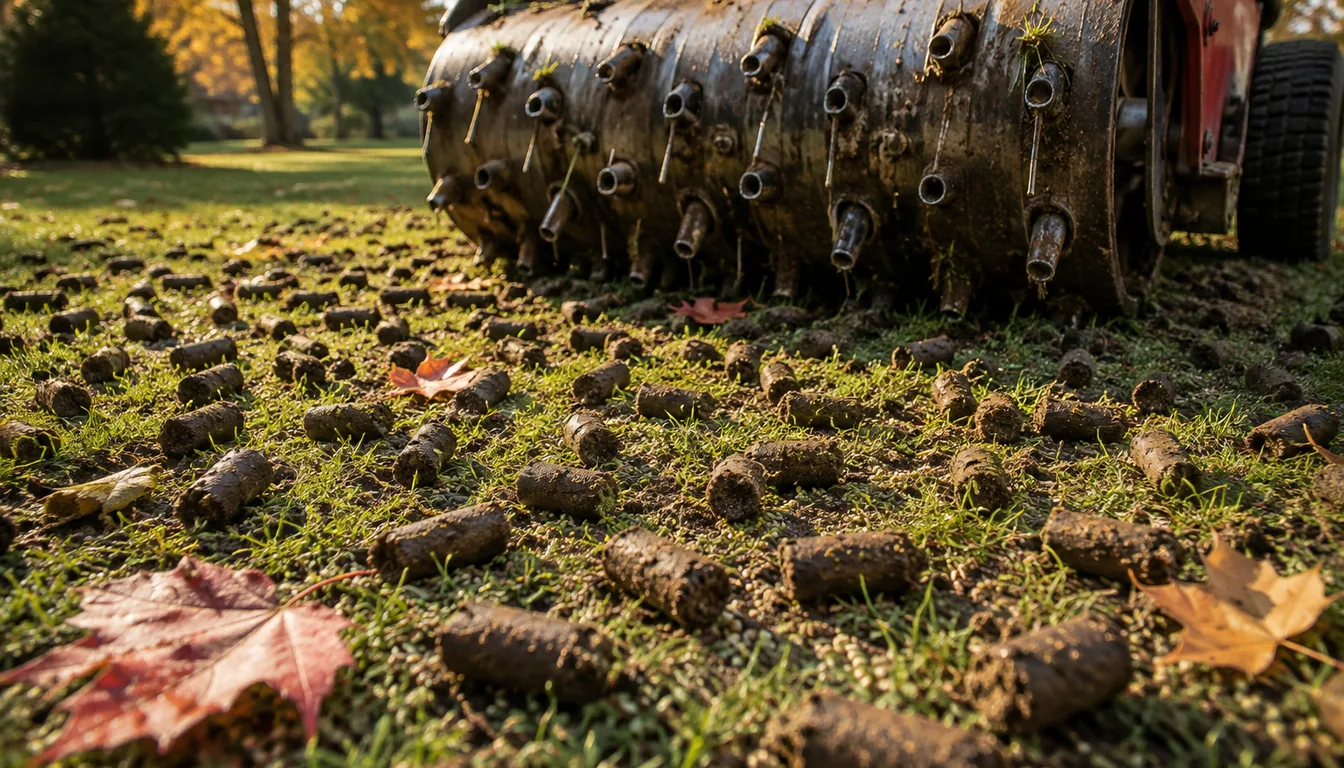
The machine sets what a pass accomplishes. MSU describes most core aerators as self-propelled machines with hollow tines that pull plugs about 0.75 inch wide and 2 to 4 inches long, spaced 2 to 6 inches apart depending on the model. Wider spacing means fewer holes, so a machine at the wide end needs more passes in compacted areas.
Buried lines are the other preparation step. Frank's checklist before coring includes knowing where every sprinkler head is and finding other underground lines such as invisible dog fence wire. Those lines are normally buried deeper than the tines reach, but a quick check costs nothing.
- Soil was watered a couple of days ago if the lawn was dry.
- Plugs come out cleanly rather than sticking in the tines.
- Sprinkler heads and pet fence wire are flagged.
- The lawn is mowed and fallen leaves are cleared.
When Must Seeding Be Finished After Aeration in Michigan?
Aeration alone can run into October. Aeration followed by seed cannot, because the seedlings need time to establish before the ground freezes. MSU's dates differ between the southern and northern parts of the state.
| Part of Michigan | Preferred seeding window | Source |
|---|---|---|
| Southern Michigan | August 15 to September 15 | MSU bulletins E-1491 and E2910 |
| Northern Michigan | August 10 to September 1 | MSU bulletin E-1491 |
| Statewide stretch | Through September, into early October in a warm fall | MSU Extension, 2012 |
| Spring fallback | No later than June 15 | MSU bulletin E2910 |
The northern dates come from an older MSU bulletin, and the logic still holds. A shorter season up north means the seedlings need to start sooner. MSU's 2012 article says seeding into early October can still work if the weather stays warm, but it calls October riskier because a cold snap can stop seedlings before they establish.
MSU also describes dormant seeding in November, after soil is too cold for germination, so the seed is in place to grow in spring. Aeration holes are not needed for that, and MSU warns of losses to rot and insects. For the wider regional picture, Midwest overseeding timing compares windows across neighboring states.
Core Holes or a Slit Seeder for Thin Michigan Lawns?
MSU's fall seeding tips treat core aeration as one way to get seed into soil, not the only one. Broadcasting seed onto a lawn without holes, slits, or a soil cover mostly feeds birds. Core aerating before interseeding gives the seed somewhere to land and also relieves compaction, which MSU notes is useful on high-clay sites.
The method MSU ranks first is a slit seeder, which cuts a slice and drops seed directly into it. MSU recommends running it in at least two directions at right angles for better coverage. On a compacted clay lawn, coring first and then slit seeding handles both problems in one visit.
Match the seed to the lawn. MSU's advice is that in most of Michigan an unknown lawn grass is most likely Kentucky bluegrass, so bluegrass cultivars are the safe choice for patching. Turf-type tall fescue is an option for a full renovation where drought tolerance matters, though MSU advises against pasture-type Kentucky 31. Keep to the bag's seeding rate, because MSU says higher rates do not shorten establishment and can weaken the stand through crowding.
Mowing continues as usual. MSU's guidance after interseeding a thin lawn is to keep the normal mowing schedule, since mowing helps the turf spread sideways, and mowing after overseeding covers how to handle the first few cuts.
What Fertilizer Rules Apply After Aerating in Michigan?
Michigan restricts lawn phosphorus. MSU explains that the state's rules limit phosphorus applications in most cases unless a soil test shows a need, and the limits also affect many natural organic fertilizers that contain phosphorus. New seeding is the main exception. Starter fertilizer is still allowed for establishing turf, with no more than 1.5 pounds of phosphate (P2O5) per 1,000 square feet in one application and 2.5 pounds per year.
For a fall interseeding after aeration, MSU suggests a starter fertilizer at 1 pound of nitrogen per 1,000 square feet, using a product with a nitrogen-to-phosphate ratio near 1 to 1 or 1 to 1.5. MSU sells a home soil test kit, and following its results is better than guessing.
For an aerated lawn that is not being seeded, the regular fall feeding applies. MSU recommends getting it down in September, preferably early in the month, with slow-release nitrogen such as sulfur-coated or polymer-coated urea. Frank advises against all fast-release urea at that time because it pushes top growth and more mowing at the expense of rooting. Fall lawn fertilizing covers the rest of that schedule.
What to Do in the Weeks After Aeration
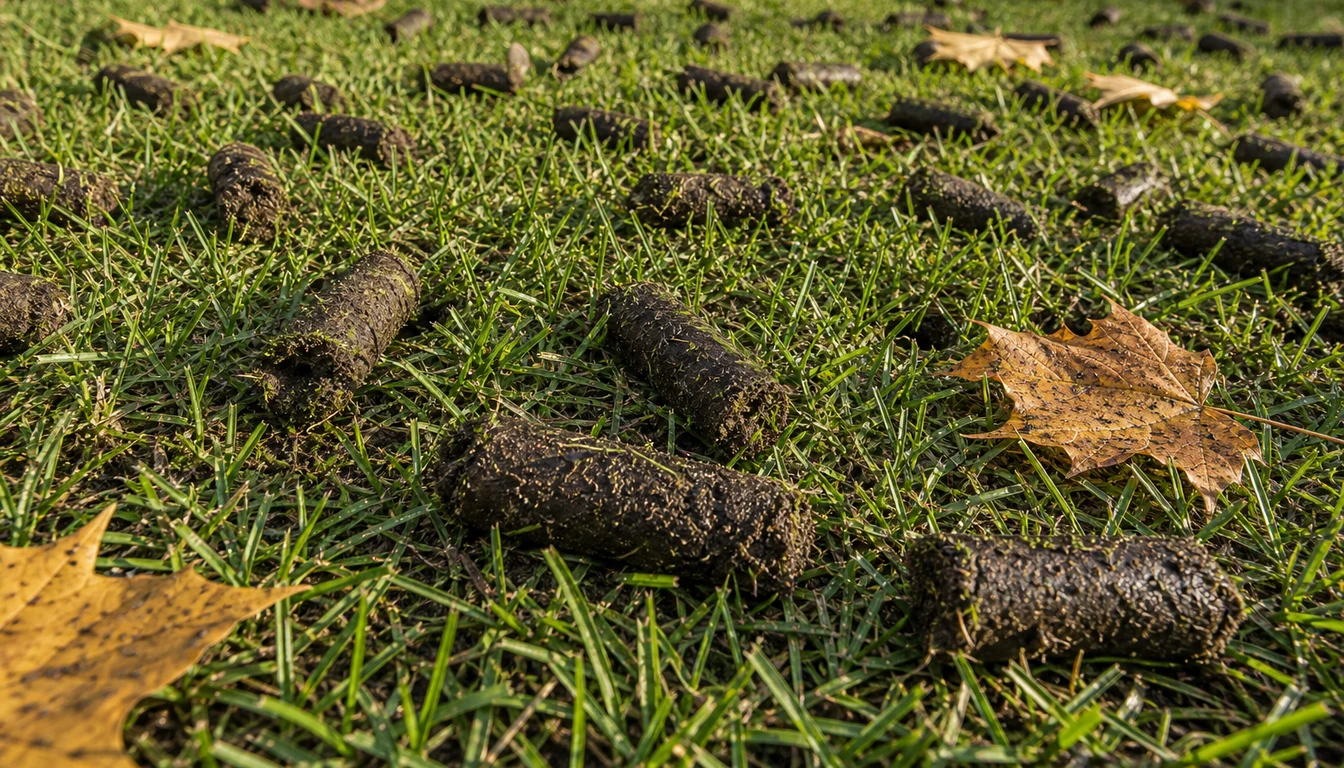
Leave the plugs on the lawn. They dry, crumble under rain and mowing, and settle back into the surface.
Fall leaves arrive at the same time, and they do not need to be raked off for the lawn's sake. Ohio State Extension cites work at Michigan State showing that chopping tree leaves into a lawn with a mulching mower does not increase thatch. Whole leaves left in a thick mat for weeks can still kill patches of grass, so chop them as they fall.
Broadleaf weed control has to wait if seed went down. MSU's 2012 seeding article says not to use broadleaf herbicides until the new grass is up and established, which takes about two months, so there is no time for a treatment that fall. MSU's seeding bulletin puts the earliest broadleaf treatment for a new lawn after the second or third mowing. Product labels give the exact waiting period.
If seed went in, keep the seedbed moist. MSU's 2019 seeding tips warn that this may take light watering several times a day, while its 2012 article on late-season overseeding, written for cooler October weather, suggests 15 to 20 minutes once or twice a week when rain is short. Watering new grass seed covers that schedule in detail.
Pro Tips
- Core aerate in late summer or early fall, when Michigan soil is less likely to be saturated than in spring.
- On compacted clay, plan on spring and fall coring, and skip spring if the soil is still soggy.
- Water thoroughly a couple of days ahead if the soil is too dry for the tines to go in.
- Wait if plugs stick inside the tines, because the soil is too wet.
- Flag sprinkler heads and invisible dog fence wire before the aerator runs.
- Finish seeding by mid-September in southern Michigan and by early September in the north.
- Use starter fertilizer only when seeding, within Michigan's phosphorus limits.
Frequently Asked Questions
How often should I aerate my lawn in Michigan?
MSU says lawns with frequent foot traffic, especially on clay, benefit from yearly aeration. Lawns that are not compacted and have less than half an inch of thatch do not need it every year, and heavy clay lawns may be cored in both spring and fall.
Is spring aeration bad for Michigan lawns?
No, but spring soil is more often saturated, and coring wet soil does more harm than good. MSU recommends spring coring mainly for compacted clay lawns, done once the soil has dried, with fall as the main window for everyone else.
Can I aerate in October in Michigan?
Yes, if the grass is still growing and the soil pulls clean cores. Seeding after an October aeration is riskier, because MSU's preferred seeding windows end in early or mid-September and seedlings may not establish before a cold snap.
Should I pick up the plugs after aerating?
No. Leave them on the lawn, where rain and mowing break them up.
Can I spray weeds after aerating and overseeding?
Not that fall. MSU advises waiting until the new grass is established, about two months after overseeding, before using broadleaf herbicides, and its seeding bulletin puts the earliest treatment after the second or third mowing of a new lawn.
Sources & References
- Michigan State University Extension, Improving soil conditions for turf with fall aeration
- Michigan State University Extension, Tips on how to best air out your turf
- Michigan State University Extension, Tips for seeding lawns in September
- Michigan State University Extension, Late season lawn seeding
- Michigan State University Extension, Establishing a New Lawn Using Seed (E2910)
- Michigan State University Cooperative Extension Service, Seeding A Lawn (Extension Bulletin E-1491, 1983)
- Michigan State University Extension, Timing for fall fertilization and rust on turf
- Ohio State University Extension, Natural Organic Lawn Care (HYG-4031)
Related Guides
Best Time to Aerate and Overseed for a Thicker Lawn
Most lawns never reach their potential because aeration and overseeding happen at the wrong time.
11 min read
Best Time to Overseed a Northeast Lawn for Thick Turf
Overseeding in the Northeast is all about catching that short window when soil is warm, air is…
11 min read
Can You Overseed a Lawn Without Aerating It First?
Thin turf and bare patches do not always mean you need to rent an aerator.
11 min read
Dethatching vs Aerating: Which Does Your Lawn Need?
Choose dethatching when a measured layer of thatch has become excessive.
16 min read
How Long After Planting Grass Seed Can You Walk On It Safely
Most new lawns fail not from bad seed, but from feet, paws, and mower wheels showing up too soon…
11 min read
How to Fertilize a Lawn Without Burning It
Those yellow stripes and crispy patches after fertilizing are almost always user error, not bad…
14 min read