
How to Stop Powdery Mildew on Cucumber Leaves
Powdery mildew on Cucumber forms expanding white colonies on older leaves, then shortens the useful life of the canopy.
Confirm the growth on both leaf surfaces, judge how far it has spread, and protect clean foliage before the vine loses the leaves that size and shade its fruit.
Quick diagnosis
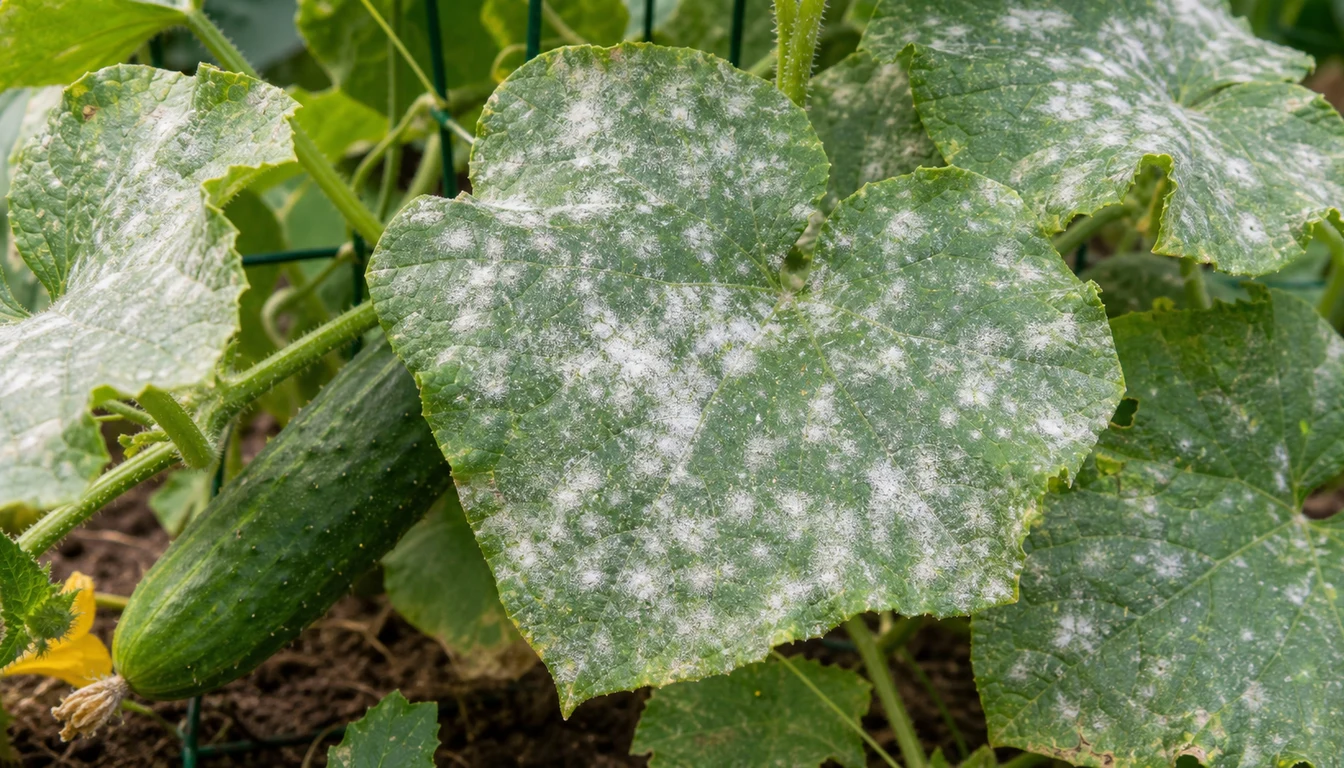
Powdery mildew when white surface colonies expand across older leaves
Look for separate white patches that enlarge and merge on the upper or lower leaf surface.
Powdery mildew becomes more convincing when the growth spreads between inspections, while angular yellow lesions, fixed silver mottling, webbing, or a deposit that follows spray droplets point elsewhere.
Open the full diagnosisWhat You Are Seeing
Powdery mildew usually reaches cucumber around fruit production, when a productive vine still needs a broad green canopy.
The fungus feeds on living tissue, and severe infection makes leaves yellow and die early instead of directly rotting the cucumbers.
Water sitting on the leaf is not required for infection. Humid periods favor infection, then warm dry weather can support rapid spore production and wind dispersal, so switching from overhead irrigation may help other leaf diseases without curing established powdery mildew.
The practical goal is to slow new infection while keeping enough healthy foliage to fill and shade the crop. A leaf already covered in white growth will not become clean green tissue again, so the result appears in slower spread and cleaner expanding leaves.
Common Causes
01 High likelihood
Powdery mildew colonies
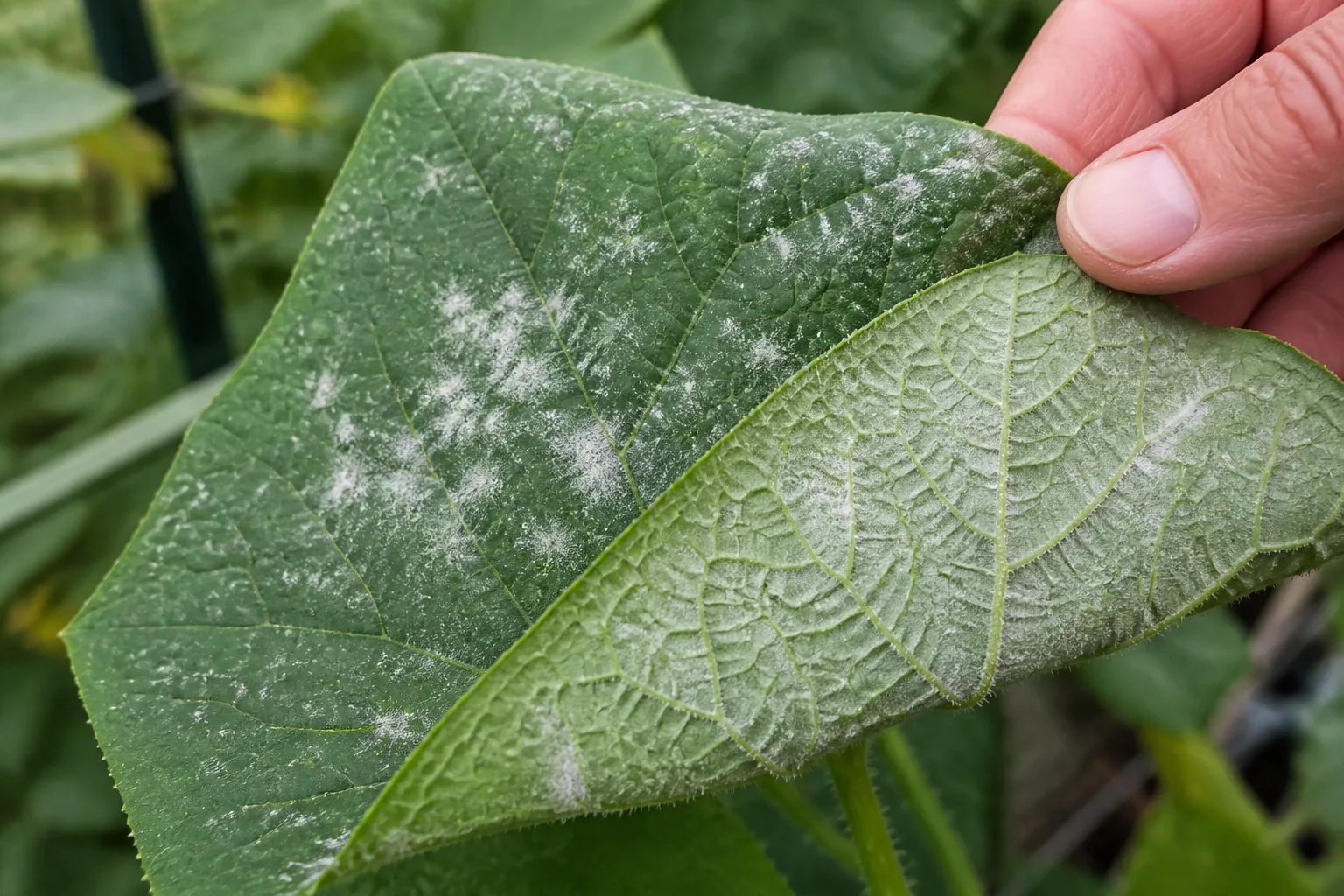
Podosphaera xanthii and related cucurbit powdery mildew fungi grow across living leaf surfaces and release windborne spores. Older cucumber leaves usually show the first colonies, but heavy pressure can reach petioles, stems, and young foliage.
How to identify it
- White circular colonies enlarge into irregular powdery sheets.
- Growth may occur on both the upper and lower leaf surface.
- Older leaves are affected before the newest vine tip.
- Advanced leaves turn yellow, brittle, and brown after losing green area.
What to do
- Scout the rest of the canopy before deciding how much tissue to remove.
- Remove individual leaves that are heavily coated and contribute little green area.
- Protect useful clean foliage with a cucumber-labeled product when disease is increasing.
- Preserve enough canopy to shade fruit and sustain harvest.
- Choose a resistant cucumber cultivar for the next planting when this disease recurs.
02 Important lookalike
Downy mildew mistaken for powdery growth
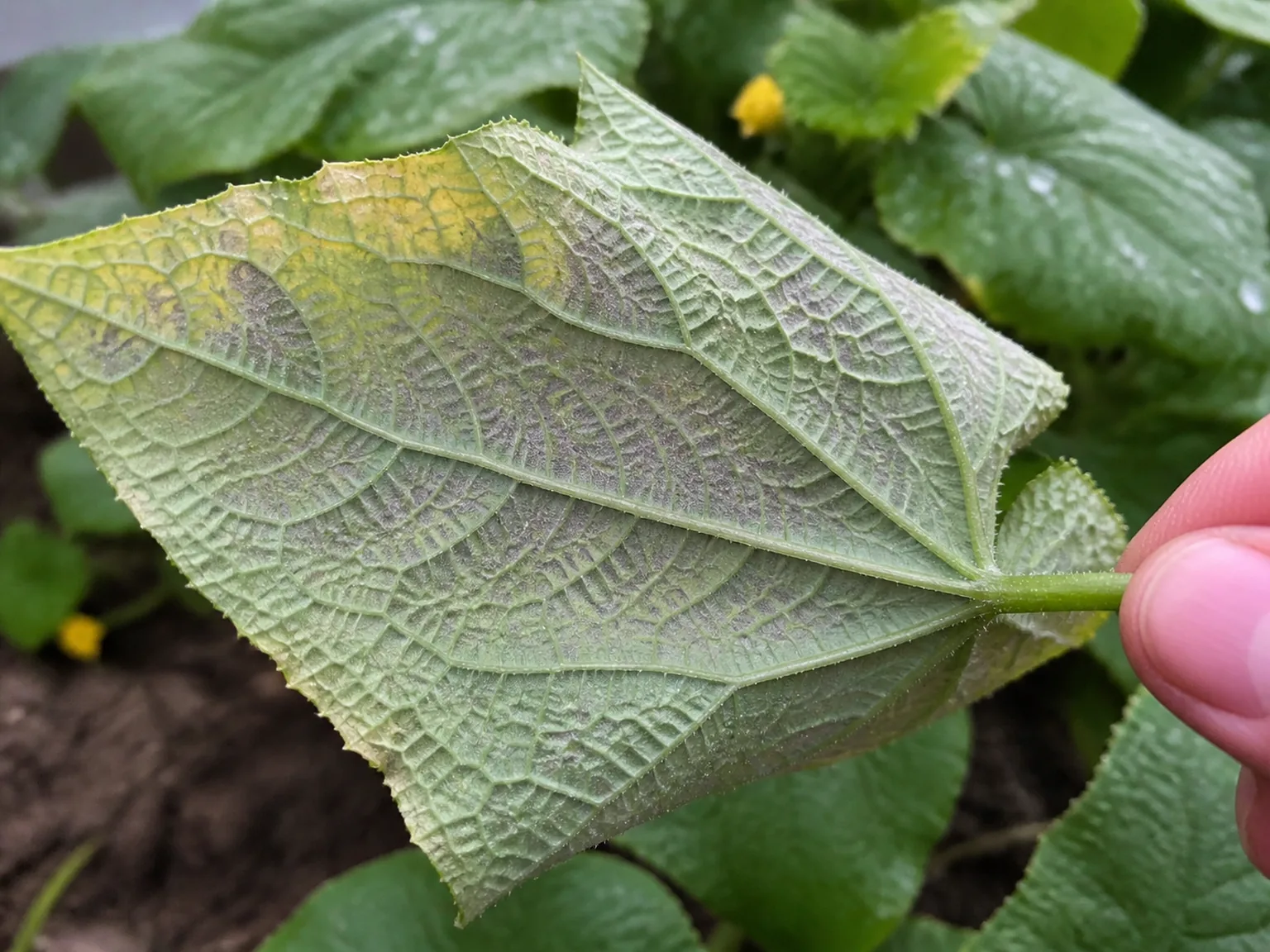
Downy mildew is an oomycete disease with a different treatment program. Its upper-leaf lesions are usually angular because veins limit their spread, while dark gray or purple sporulation develops beneath those lesions during humid conditions.
How to identify it
- Yellow areas form angular blocks between major veins.
- Gray-purple growth appears mainly beneath matching lesions.
- Brown tissue develops inside the angular pattern.
- The disease can move quickly through otherwise green leaves.
What to do
- Turn suspect leaves over during a cool humid morning.
- Keep this diagnosis separate from powdery mildew before selecting a product.
- Remove severely damaged tissue without carrying it through healthy vines.
- Seek current regional guidance because downy mildew risk and product performance change by location.
03 Application dependent
Dried spray or mineral residue
Clay products, hard-water minerals, bicarbonate mixes, and dried foliar sprays can leave pale droplets or a chalky film. The deposit follows application coverage and does not send new colonies across untreated tissue.
How to identify it
- Marks appeared immediately after irrigation or spraying.
- Droplet edges repeat in the same direction across several leaves.
- New untreated leaves remain clean.
- The deposit lifts without revealing yellow or collapsing tissue below.
What to do
- Review what reached the foliage before treating again.
- Rinse a small test area with plain water and let it dry.
- Do not add fungicide when the pattern remains stable and the tissue is healthy.
- Adjust hard-water or spray practices only if the residue blocks inspection or light.
04 Cultivar dependent
Natural silver mottling in cucumber leaves
Some cucumbers and other cucurbits carry pale silver patterning around veins as a normal leaf trait. This color sits inside the tissue, stays flat, and repeats in a stable pattern rather than forming a dusty surface colony.
How to identify it
- Pale areas follow veins or repeat symmetrically.
- The surface has normal leaf texture without fuzzy growth.
- The pattern does not rub onto a finger or cloth.
- Leaves remain firm and productive as the pattern ages.
What to do
- Compare several healthy leaves from the same plant.
- Mark one patterned leaf and check whether the pale area expands independently of growth.
- Leave normal mottled foliage in place.
- Use surface texture and change over time rather than color alone.
05 Hot dry weather lookalike
Spider mite stippling and webbing
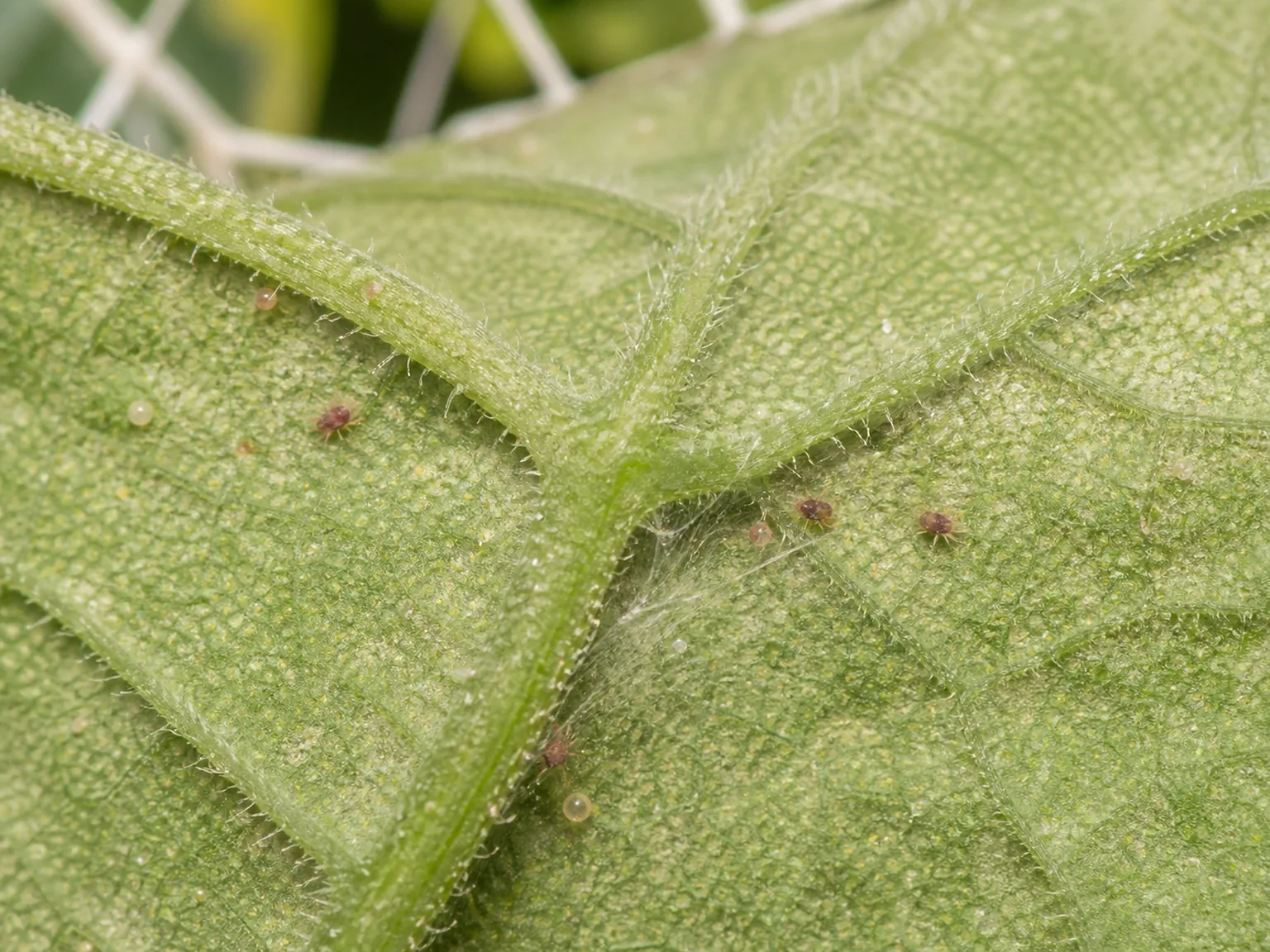
Spider mites remove cell contents from the underside and create thousands of pale pinpoints that can make a leaf look gray from a distance. Fine webbing and moving mites distinguish this injury from fungal powder.
How to identify it
- Pale dots are embedded in tissue rather than resting on it.
- Fine silk crosses veins, petioles, or leaf edges.
- Tiny mites or eggs appear under magnification.
- Damage is strongest in hot dusty parts of the planting.
What to do
- Inspect the underside with a hand lens or tap it over white paper.
- Reduce dust and severe water stress around the vines.
- Use a product labeled for mites on edible cucumbers when treatment is needed.
- Avoid assuming a powdery mildew fungicide will control an animal pest.
06 Wet-weather lookalike
Bacterial angular leaf spot
Angular leaf spot begins as water-soaked areas bounded by veins. Lesions may dry pale, tear out, or leave crusted bacterial exudate, but they do not form an even superficial white colony.
How to identify it
- Fresh lesions look translucent when held to light.
- Veins create sharp angular borders.
- Dry centers crack or fall out and leave holes.
- Symptoms follow wet handling, splash, or prolonged leaf wetness.
What to do
- Keep irrigation water off the foliage when practical.
- Avoid working among wet vines.
- Remove badly affected leaves only when the canopy can spare them.
- Use clean seed and rotate away from cucurbits when the diagnosis is confirmed.
07 Background stress
Nutrition or root stress without a surface colony
Uneven moisture, root injury, or nutrient imbalance can turn cucumber leaves pale or yellow and reduce their resistance to disease. These stresses change tissue color broadly but do not create removable fungal growth.
How to identify it
- Yellowing follows veins, margins, or the whole leaf without white texture.
- Wilting, poor growth, or root-zone problems accompany the color change.
- Several leaves change together after a watering or fertilizer event.
- No expanding surface colonies appear during follow-up.
What to do
- Check soil moisture through the active root zone.
- Base fertilizer changes on growth pattern and soil evidence.
- Correct drainage or irrigation problems without repeatedly wetting foliage.
- Diagnose any separate surface growth before combining treatments.
Powdery mildew reduces the working cucumber canopy
White colonies matter because they occupy green tissue that the vine uses to build sugars.
As infected leaves senesce, the plant has less capacity to size fruit and continue flowering through the harvest period.
Cucumbers exposed after premature leaf loss can develop sunscald, especially during hot bright weather. That consequence makes aggressive stripping a poor response even when removing one heavily coated lower leaf is sensible.
Resistant cultivars reduce disease development but do not make scouting unnecessary. Powdery mildew populations can overcome individual resistance traits, and fungicide resistance can also develop when one mode of action is used repeatedly.
Confirm powdery mildew on both leaf surfaces
Start with an older leaf that has a fresh white patch, then inspect the same location from below. Powdery mildew can grow on either surface, so an upper-leaf wipe test alone cannot settle the diagnosis.
Loose white colonies may transfer partly to a dark cloth, but the tissue below often remains pale or injured. A stable chalky deposit follows dried droplets, while normal silver mottling remains flat inside the leaf and repeats along veins.
Angular yellow blocks require a separate underside check for downy mildew. Stippling requires magnification for mites and webbing, which prevents a fungicide choice based only on the leaf looking gray.
Powdery mildew
- Expanding white surface colonies
- Upper or lower leaf growth
- Older leaves first
Downy mildew
- Angular vein-bound lesions
- Gray-purple growth below
- Rapid tissue browning
Residue or mottling
- Follows droplets or veins
- Does not spread as colonies
- Healthy firm tissue remains
Map the infection before choosing a response
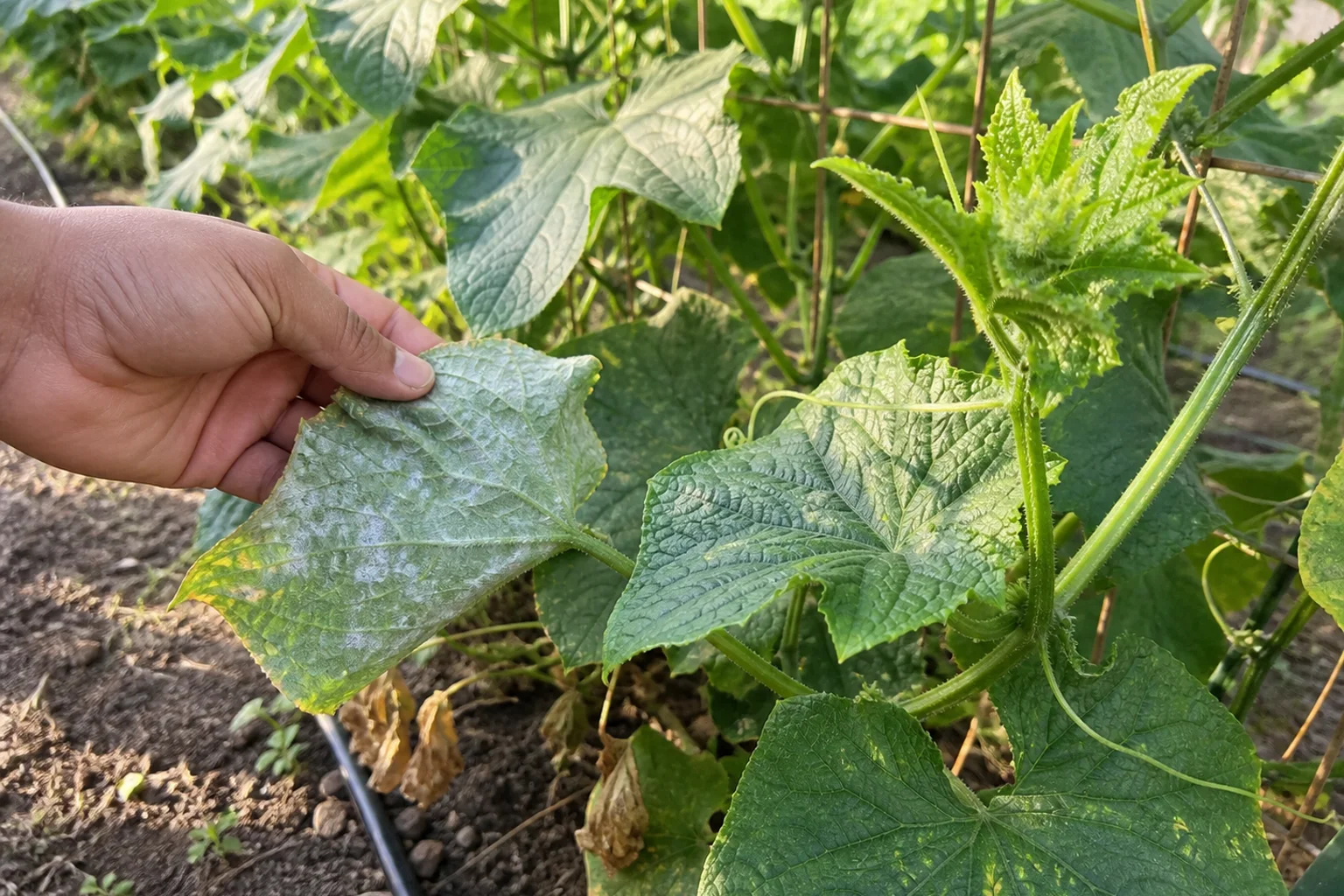
Sample older leaves from several parts of the row instead of counting one dramatic leaf as the whole problem. Cornell's field threshold begins action when one symptomatic leaf appears among 50 older leaves inspected, a useful signal that protection works best near onset.
A home garden does not need false precision, but it does need distribution. Record whether colonies remain low on the oldest foliage, appear throughout the fruiting canopy, or have reached clean expanding tips.
- Inspect upper and lower surfaces on older leaves across the planting.
- Mark the first affected area so new spread is visible at the next check.
- Compare the lowest leaves with the active vine tips.
- Choose monitoring, selective removal, or labeled treatment from that pattern.
Remove low-value leaves without exposing the fruit
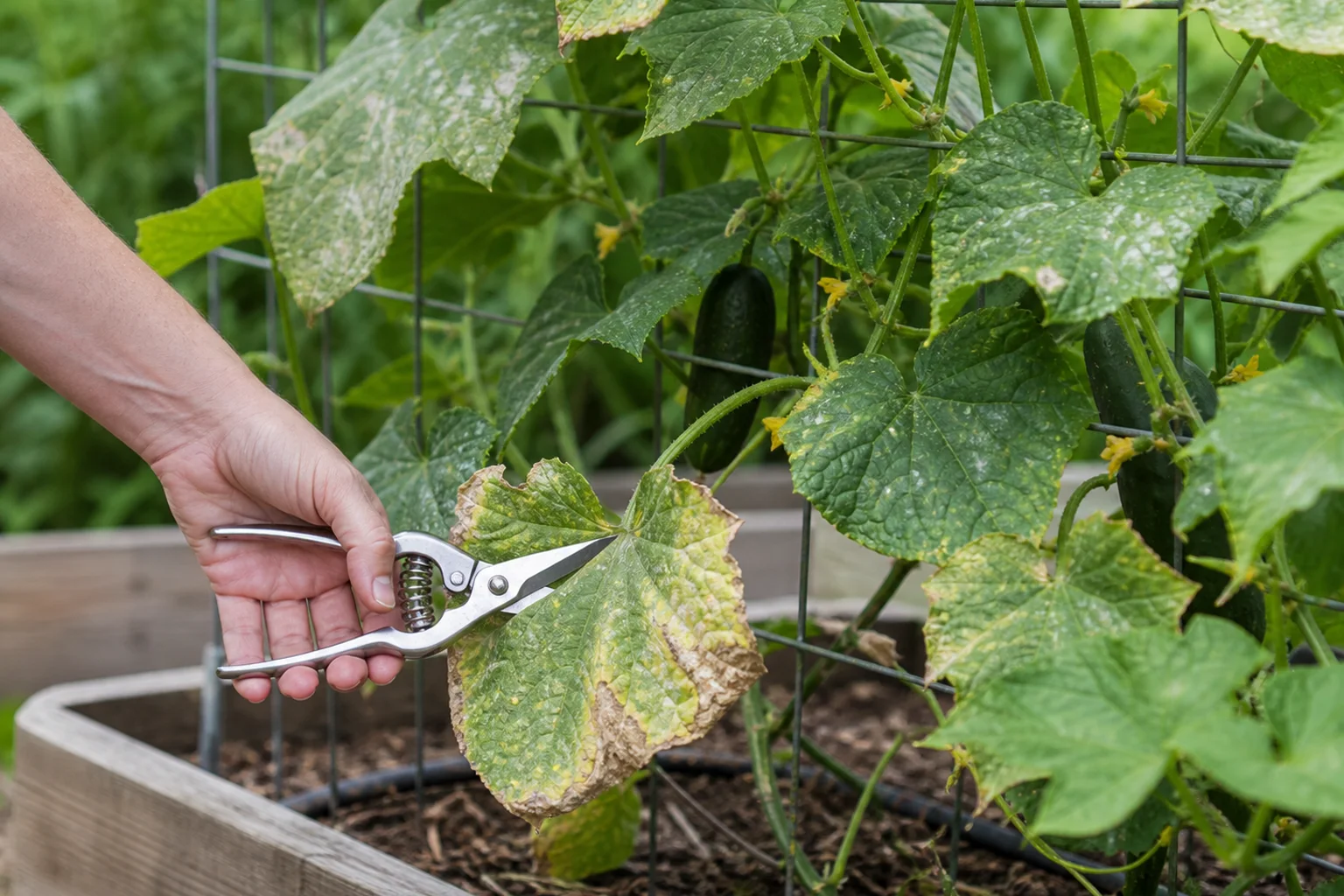
A lower leaf that is mostly white, yellow, or brittle contributes little and produces abundant spores. Cut that leaf at its petiole with clean shears and carry it out without brushing it through the vine.
A partly affected leaf with substantial green area may still feed and shade fruit. Keep it when removing it would open a bright window onto cucumbers during hot weather, then protect the remaining foliage from further spread.
Do not strip the vine in one cleanup session. Premature canopy loss can shorten harvest and expose fruit to sunscald, so the decision belongs to each leaf's remaining value and position.
Place diseased debris where it will not stay beside active cucurbit vines. Clean cutting tools before moving to another planting, especially when angular bacterial lesions remain possible.
Choose a labeled treatment that protects new tissue
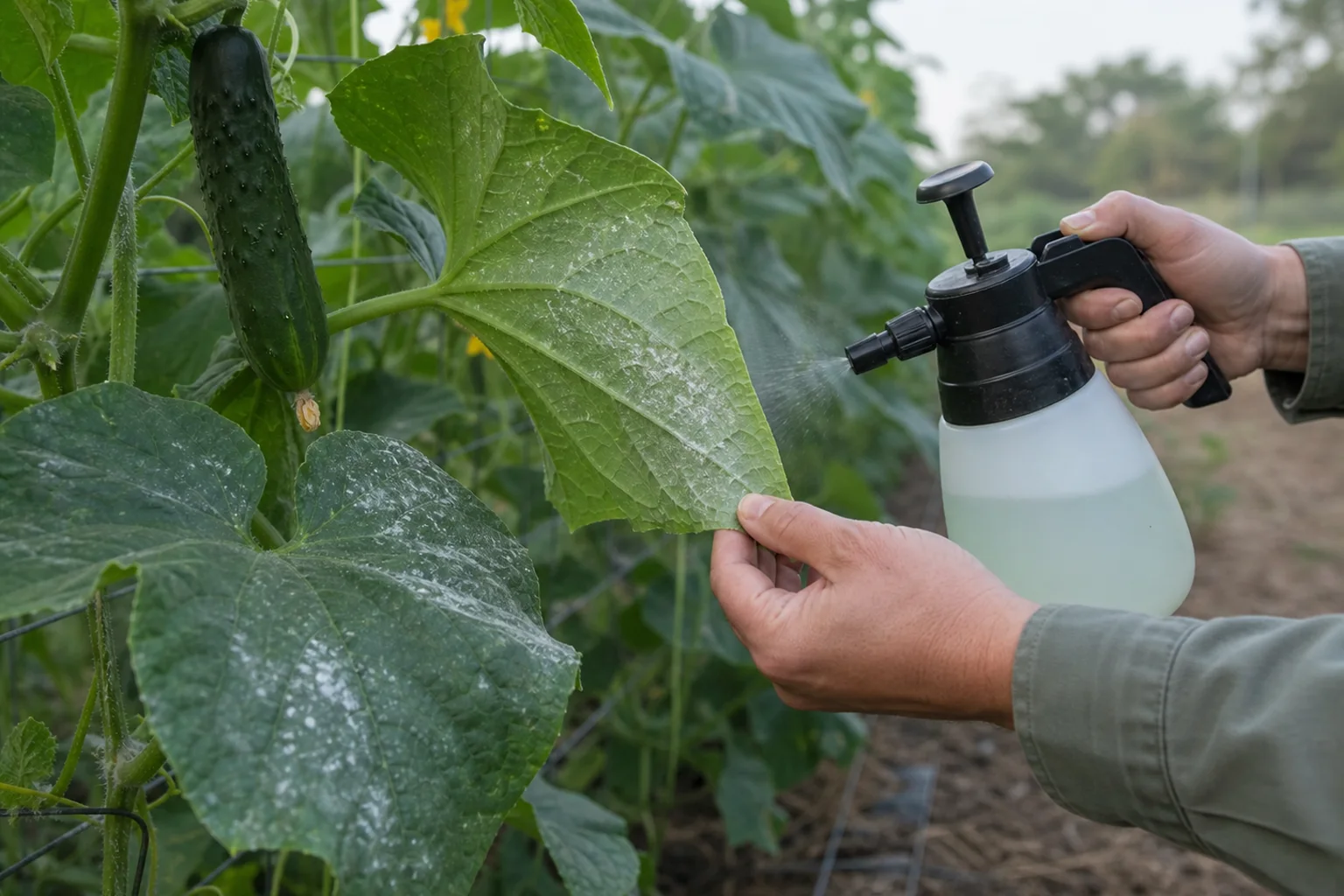
Use a fungicide only when its label lists cucumbers or the applicable cucurbit crop group, powdery mildew, and the intended garden site. The label also owns the dose, repeat interval, protective equipment, reentry period, and pre-harvest interval.
Sulfur, horticultural oils, bicarbonate products, biological products, and conventional fungicides differ in preventive strength and injury risk. They are not interchangeable recipes, and a product that worked elsewhere may be unsuitable for a cucumber close to harvest.
Apply contact material evenly to the surfaces named by the label, including lower leaves that are easy to miss. Stop before runoff because excess liquid does not replace coverage and may increase injury.
Commercial programs rotate modes of action because cucurbit powdery mildew readily develops fungicide resistance. Home gardeners should follow the same label principle and avoid repeating one at-risk active ingredient beyond its allowed sequence.
Judge control by the next leaves and harvest
Existing colonies may remain visible after a successful response. Look instead for clean expanding leaves, slower movement into the upper canopy, and enough retained green area to continue sizing fruit.
Reopen the diagnosis when new lesions become angular, wet, perforated, or concentrated beneath the leaf without matching powder above. Repeating a powdery mildew product against a different disease delays the action that the cucumber actually needs.
Keep harvesting usable cucumbers on schedule while following every product's pre-harvest interval. Removing overmature fruit reduces an avoidable demand on a vine already supporting a stressed canopy.
Recovery Plan
Confirm and map the colonies
Check both leaf surfaces across the row, mark affected areas, and separate powdery growth from angular lesions, residue, mottling, and mites.
Protect the useful canopy
Remove only low-value heavily coated leaves, follow any labeled treatment interval, and watch whether clean vine tips remain free of new colonies.
Judge fruit shade and new growth
Retain enough green foliage to size and shade cucumbers, honor every pre-harvest interval, and remove diseased debris after the planting finishes.
Reduce future powdery mildew pressure with resistant cucumber cultivars, adequate spacing, trellising, weed control, balanced nitrogen, and separation between successive cucurbit plantings when space allows. Begin scouting older leaves around fruit formation because early detection preserves more canopy than late cleanup.