
Why Cherry Blossom Leaves Develop Spots and Holes
Spots and holes on ornamental cherry leaves need a lesion-first diagnosis.
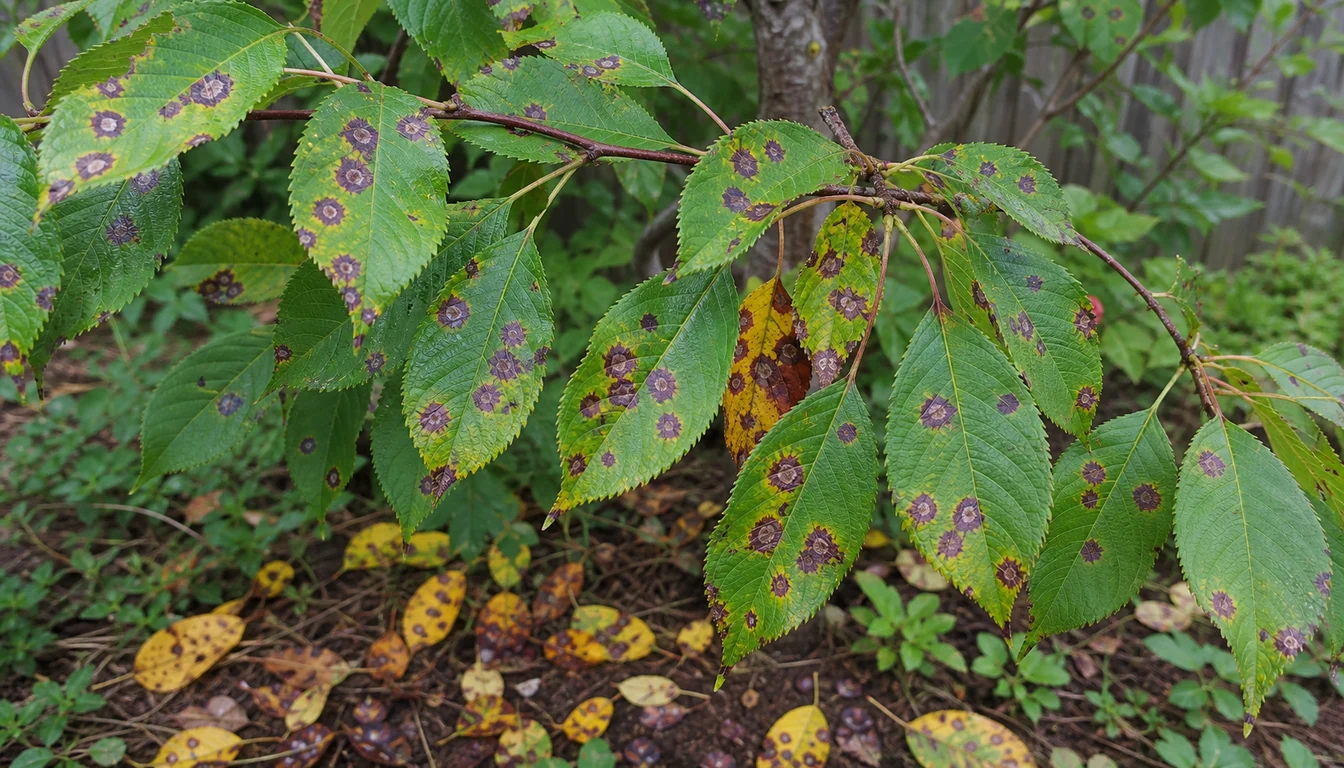
Round purple spots that brown, develop pale centers, yellow the leaf, and cause early drop support classic cherry leaf spot, while angular black lesions plus gum or cankers support bacterial disease.
Quick diagnosis
Read the tissue around each hole before naming the cause
Look for intact young lesions as well as old holes.
Purple round spots with yellowing and whitish patches beneath support fungal cherry leaf spot, angular dark spots with twig gum support bacterial spot and canker, while clean irregular bites, fine stippling, or a white surface coating point elsewhere.
Open the full diagnosisWhat You Are Seeing
A shot hole records missing tissue but does not reveal why that tissue died. Cherry leaves can drop the centers of fungal or bacterial lesions, and physical or chemical injury can sometimes produce a similar separation layer.
Inspect several leaves at different stages, including the underside, and follow affected petioles back to the twig. The combination of lesion shape, underside growth, canopy position, wet-weather timing, gum, and branch injury is more useful than the hole count.
This symptom begins on expanded foliage. If the leaves look serviceable but the tree produced few flowers, move to Cherry Blossom poor flowering rather than treating leaf spots as the cause.
Common Causes
01 High likelihood
Fungal cherry leaf spot
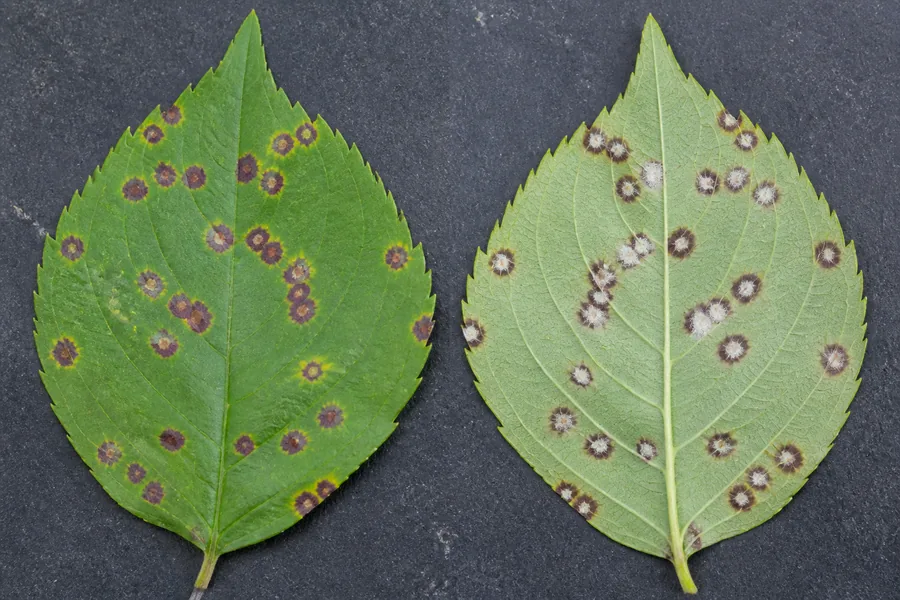
Cherry leaf spot caused by Blumeriella begins as small purple spots on the upper surface, often on older leaves in early summer. Spots enlarge and brown, yellow areas develop around them, whitish spore patches can appear beneath during wet weather, and heavily affected leaves fall early.
How to identify it
- Round purple to reddish-brown spots appear before holes form.
- Older lesions have brown or tan centers and may merge into larger dead areas.
- Tiny whitish feltlike patches occur in lesion centers on the underside during damp weather.
- Leaves carrying many lesions turn yellow and drop well before autumn.
- Disease increases after frequent spring or early-summer rain and begins on slower-drying foliage.
What to do
- Collect infected fallen leaves because the fungus can survive winter in that debris.
- Water at soil level and adjust sprinklers that repeatedly wet the canopy.
- Preserve a clean mulch ring without piling material against the trunk.
- Record when defoliation begins and how much canopy is lost because repeated early loss changes the treatment decision.
- For a valuable tree with severe repeated defoliation, ask local extension about a preventive product labeled for the exact ornamental Prunus and site.
02 Medium likelihood
Bacterial spot and canker
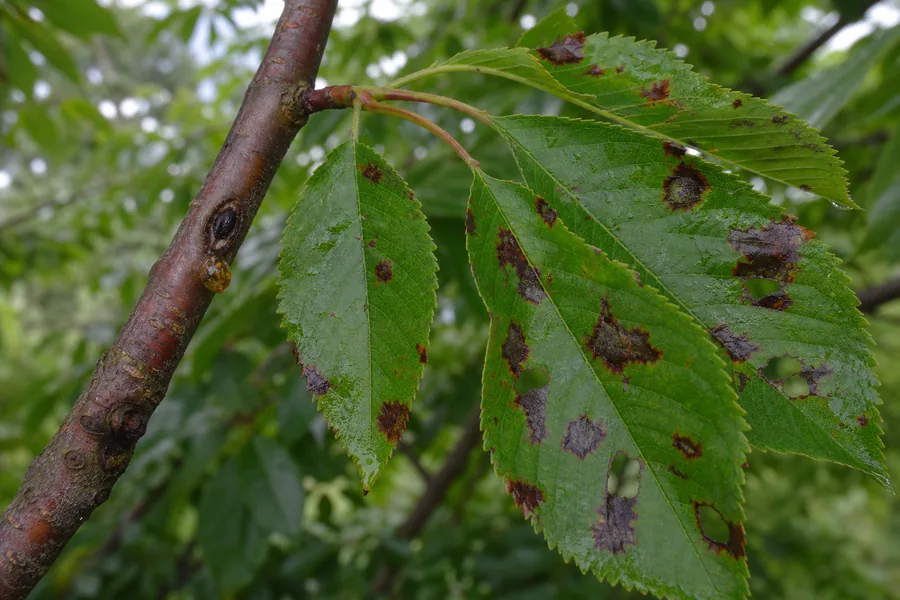
Bacterial disease can make angular brown to black leaf spots that fall out and leave a ragged shot-hole pattern. Browned blossoms, sunken twig lesions, sour-smelling liquid, or amber gum strengthen this branch because the problem extends beyond the leaf blade.
How to identify it
- Young lesions are angular or dark rather than consistently round and purple.
- Holes retain dark or reddish margins and can make leaves look ragged.
- Blossoms or tender shoots browned during cool wet weather or after frost injury.
- Twigs show sunken dark cankers, bark cracks, dieback, or sticky gum.
- Damage follows branches instead of appearing only as random spots across otherwise healthy shoots.
What to do
- Photograph fresh leaf lesions and woody symptoms before old tissue falls away.
- Avoid pruning or handling wet foliage because moisture can help spread bacteria.
- Have a local diagnostic service confirm the cause when cankers, shoot death, or recurring gum are present.
- Prune confirmed diseased wood only at the locally recommended season and sanitize tools between cuts.
- Do not apply copper or another bactericide from symptom name alone because timing, host label, weather, and local resistance guidance matter.
03 Medium likelihood
Other fungal or noninfectious shot-hole injury
Several fungi, bacteria, sprays, and physical injuries can make Prunus leaf tissue wall itself off and fall away. When only old holes remain, the original cause may no longer be identifiable from appearance alone.
How to identify it
- Holes appear without enough fresh lesions to establish their starting pattern.
- Damage followed a foliar spray, drift event, hail, or abrupt environmental injury.
- The pattern is concentrated on exposed surfaces or where droplets landed.
- No underside spores, cankers, gum, insects, or continuing spread are found.
- New untreated foliage stays clean after the suspected event ends.
What to do
- Stop repeat foliar treatments until the application record and label have been reviewed.
- Keep fresh affected leaves for diagnosis because empty holes preserve little evidence.
- Rinse only when a current product label or local expert says immediate rinsing is appropriate.
- Protect the root zone during recovery and avoid adding fertilizer to force replacement leaves.
- Monitor new growth to determine whether the damage was a one-time event or an active infection.
04 Low likelihood
Lace bugs or mites
Sap-feeding insects and mites usually remove color in tiny points rather than killing neat circular centers. Lace bugs can leave pale stippling above with insects, shed skins, and dark varnish-like waste on the underside.
How to identify it
- Upper leaf surfaces show many pale pinpricks or a washed-out patch without a dark dead rim.
- Leaf undersides carry small insects, delicate mites, shed skins, webbing, or dark waste spots.
- Damage is strongest on favored branches or canopy levels.
- Fresh tissue remains present between stippled points instead of dropping out as a round plug.
- A hand lens confirms a live pest rather than fungal growth.
What to do
- Inspect several symptomatic and healthy leaves with magnification before treating.
- Use a firm water spray only when the tree size and pest make that practical without extending leaf wetness.
- Protect predators and avoid broad insecticide use when no live pest is confirmed.
- Choose a labeled pest treatment only after identifying whether lace bugs, mites, or another feeder is present.
- Judge control from live-pest counts and clean new leaves because stippled old tissue will not refill with color.
05 Low likelihood
Powdery mildew
Powdery mildew produces the surface pattern covered in white spots on plant leaves and may curl or distort young cherry leaves. It can coexist with spots, but a coating spread across the surface is different from whitish spore patches confined to the underside of individual cherry leaf spot lesions.
How to identify it
- White or gray growth spreads across the leaf surface instead of remaining inside discrete spots.
- Young leaves may curl, wrinkle, or remain smaller than normal.
- Purple round lesions and yellow halos are absent or form a separate pattern.
- The coating is visible without waiting for dead centers to fall away.
- Twigs lack the sunken canker and gum evidence of bacterial disease.
What to do
- Improve light and air movement without removing a large share of the live canopy.
- Avoid excess nitrogen that drives dense susceptible growth.
- Remove badly affected small shoots when practical and dispose of debris.
- Confirm the diagnosis before selecting any preventive fungicide.
- Treat leaf spot and mildew as separate problems if both patterns are present.
06 Low likelihood
Necrotic ringspot virus pattern
A ringspot virus can delay spring leafing on individual branches or the whole tree and produce pale rings, line patterns, rough blades, and holes in dead patterned tissue. Persistent branch-level symptoms, smaller leaves, bark splitting, or dieback make this more serious than a wet-season leaf spot flare.
How to identify it
- Affected branches leaf out later than the rest of the tree.
- Leaves carry rings or line patterns rather than random round rain-splashed spots.
- Blades are small, rough, wavy-edged, or repeatedly distorted.
- The same branch pattern returns in later growth rather than fading when weather dries.
- Severe cases include bark splitting or branch decline.
What to do
- Do not diagnose a virus from one perforated leaf.
- Submit representative leaves and branch history to a qualified plant diagnostic service.
- Avoid propagating from a tree with a confirmed graft-transmissible virus.
- Sanitize cutting tools and avoid unnecessary wounding while diagnosis is pending.
- Follow local removal advice if testing confirms a virus that cannot be cured.
07 Low likelihood
Chewing insects
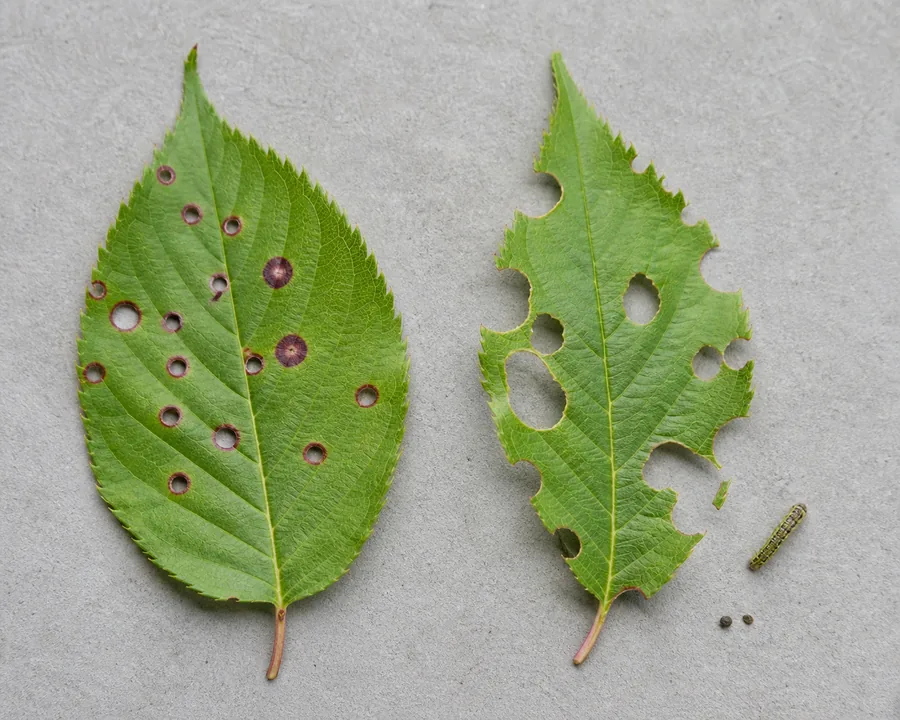
Caterpillars, beetles, and other chewing pests remove live tissue directly. Their holes are often irregular or begin at an edge and lack the purple, brown, or yellow lesion boundary that forms before diseased tissue drops out.
How to identify it
- Fresh holes have green cut edges without a necrotic ring.
- Chewing starts at margins or crosses veins in an irregular path.
- Larvae, beetles, frass, silk, rolled leaves, or feeding scars are present nearby.
- Leaves do not yellow and drop in the classic heavily spotted sequence.
- Turning over leaves or checking at dusk reveals an active feeder.
What to do
- Identify the feeder before choosing a control because incidental chewing may not justify treatment.
- Hand-remove a small visible population when the tree is reachable and the pest is safe to handle.
- Preserve beneficial insects and avoid spraying holes after the feeder has gone.
- Use a product only when the pest, ornamental cherry, and site appear on the label.
- Continue checking for true lesions because chewing and leaf spot can occur on the same tree.
A hole is the last stage, not the diagnosis
Find the youngest damaged tissue first.
A fresh purple round lesion, angular black lesion, pale stippling field, surface coating, patterned ring, and green-edged bite each preserve more information than an empty old hole.
Turn a spotted leaf over while it is damp.
Whitish feltlike growth centered beneath purple lesions supports fungal cherry leaf spot, while insects, waste, webbing, or a clean underside move the diagnosis elsewhere.
Follow the leaf stem back to the twig. Gum, sunken bark, blossom injury, and branch dieback make bacterial canker or another woody problem more plausible and raise the value of laboratory confirmation.
Measure severity by timing and canopy loss. A few spots are often cosmetic, while repeated early defoliation reduces stored energy and can leave the tree less prepared for winter and the next spring.
Recovery Plan
Protect uninfected foliage
Existing spots and holes will not close. Remove fallen diseased leaves, stop avoidable overhead irrigation, document fresh lesions, and use root-zone watering evidence so the tree is supported without keeping foliage wet.
Track canopy retention
Watch whether new leaves stay cleaner and whether yellow drop slows. Seek diagnosis sooner when gum, cankers, delayed leafing, or branch death accompanies the leaf symptoms, and avoid heavy pruning while the tree is already losing foliage.
Break carryover and test the correction
Collect fallen cherry leaves before spring spores develop and maintain an open, clean root zone. If the tree lost much of its canopy early for several years, use local extension guidance to decide whether a preventive, label-correct program is justified next season.
Reduce recurring Cherry Blossom leaf spot by removing infected leaf litter, watering below the canopy, and preserving reasonable spacing and airflow around ornamental trees. Inspect fresh lesions before they become holes, avoid unnecessary foliar sprays, and base any fungicide or bactericide decision on diagnosis, repeated severity, local timing, and the product label.