
When to Pick Bagworms Off Arborvitae and When to Spray
Bagworms strip arborvitae foliage that never grows back, which makes this a calendar problem rather than a spray problem. Btk works only while the cases are still small, and picking the bags off by hand is a free fix that works all winter.
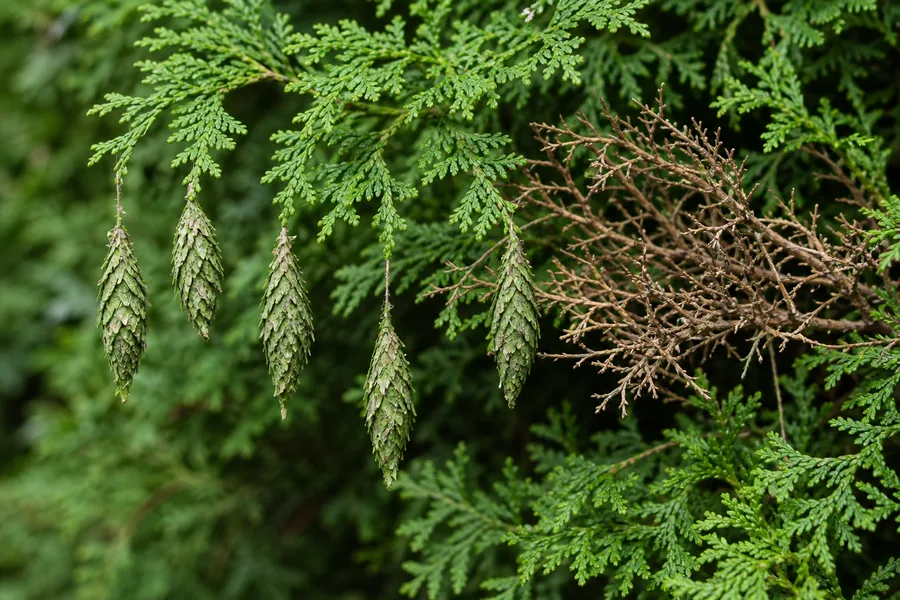
Quick diagnosis
Bagworm caterpillars feeding inside silk cases shingled with the arborvitae's own foliage.
Take hold of one of the hanging shapes and pull gently.
A bagworm case is tied on with a band of silk and resists, where a cone or a scrap of debris comes away in your fingers.
Then measure it. Anything under two thirds of an inch means the larvae are still young enough for a biological spray to work, and anything larger means the window has closed and you are handpicking instead.
If the browning has no cases attached to it at all, look at arborvitae winter burn before you treat for anything.
Open the full diagnosisWhat You Are Seeing
The hanging shapes are not fruit and not cones.
Each one is a silk case that a caterpillar built and then shingled with clipped pieces of whatever it is eating, so a bagworm on arborvitae is wearing arborvitae and disappears into the hedge until the foliage around it starts thinning.
The caterpillar never leaves it, feeding with its head out and the rest of it inside and hauling the case along the branch as it goes. Because the caterpillar is armoured from its first meal to its last, timing decides whether a treatment works at all, and the product barely matters.
There is also a harder truth on an evergreen. An arborvitae does not push fresh foliage out of bare inner wood, so anything the caterpillars strip this summer stays stripped, and the cost of missing a season here is permanent in a way it would not be on a deciduous tree.
Common Causes
01 High likelihood
Young larvae, cases still under two thirds of an inch
Eggs hatch from late May into early June, and not all at once. The sunny south face of a hedge hatches days ahead of the shaded north face, so one walk along the row is never a complete survey.
This is the only stretch of the year when Bacillus thuringiensis kurstaki does the job, and it lasts a few weeks at most. Once cases pass roughly two thirds of an inch the treatment stops being reliable, whatever the label promises.
Btk has to be eaten to work. A caterpillar that never crawls across a treated spray simply never receives a dose, which is why thorough coverage of the foliage matters far more here than the volume of mix you go through.
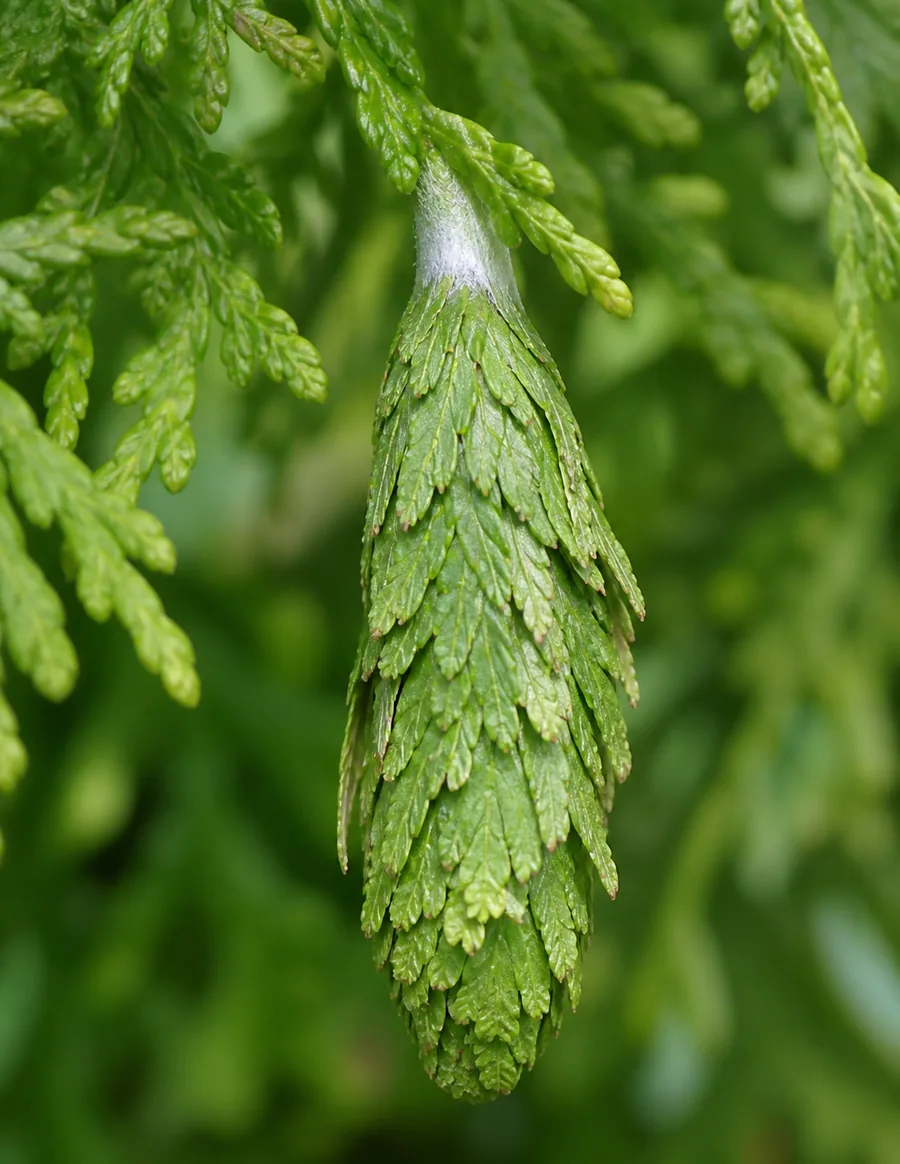
How to identify it
- Small green cases, an inch or less, hanging from the outer sprays.
- The cases match the foliage color almost exactly and are easiest to see from below.
- Fine stippled feeding damage on the tips near each case rather than whole bare stems.
- Cases move to a new spot on the branch over a few days.
What to do
- Measure a few cases against a ruler before you decide anything, since size is what picks the treatment.
- Spray Btk at label rate while cases are still under two thirds of an inch, covering the whole outer surface of the hedge including the underside of the sprays.
- Treat the sunny side first and come back to the shaded side a week later, because those larvae hatch behind the others.
- Scout again after seven to ten days and repeat if you find live larvae, as a single application rarely catches a staggered hatch.
- Handpick anything you can reach on the same visit, which costs nothing and does not depend on the spray landing.
02 High likelihood
Larger larvae in grown cases
A grown case is armour. Disturb one and the caterpillar withdraws and closes the opening, so contact sprays land on silk and foliage fragments rather than on the insect.
The worst feeding also happens late. Bagworms pass through seven larval stages, and the last of them eat far more than the early ones, so damage accelerates at exactly the point when spraying has stopped paying for itself.
How to identify it
- Cases over an inch long, some approaching two inches by late summer.
- Whole sprays stripped to bare twig rather than stippled tips.
- Cases turning brown and papery as the foliage on them dries.
- A case that closes up when you touch it.
What to do
- Switch to handpicking, which works at any larval size and does not care how thick the case is.
- Carry a bucket of soapy water and drop each case straight into it rather than pocketing them.
- Clip cases that are tied on too firmly to pull, cutting the silk band rather than tearing the twig.
- Work the inside of the canopy as well as the face, since the cases you cannot see are the ones that overwinter.
- Reserve a labeled insecticide for a heavy infestation you cannot reach by hand, and accept that late applications are a partial answer.
03 High likelihood
Old cases left on through winter
A female bagworm never leaves her case, never develops wings, and lays hundreds of eggs inside it before she dies. Every old case still hanging in February is next June's outbreak, sitting in the hedge waiting for warm weather.
Winter is when they are easiest to find. The foliage fragments on an old case dry to brown while the hedge stays green, so the camouflage that hid them all summer stops working, and they read as obvious hanging shapes from several feet away.
This is also the only control that costs nothing and cannot fail. Removing a case removes the eggs, which is a different kind of certainty from a spray that has to be eaten by an insect you cannot see.
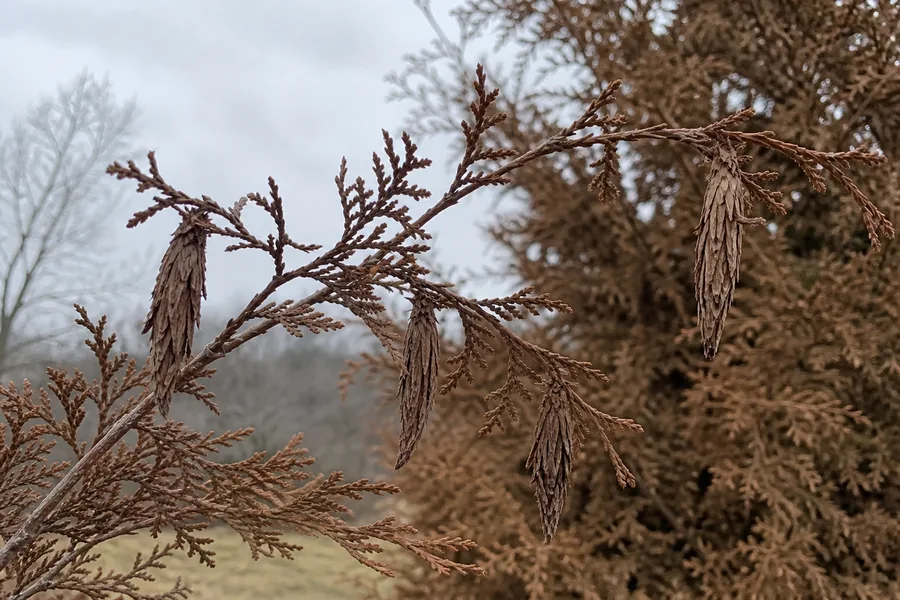
How to identify it
- Dry brown spindle-shaped cases tied to branch tips after growth has stopped.
- The cases are sealed at the top rather than open.
- The same hedge produces bagworm damage year after year.
- Cases cluster on the sheltered or sunny side of the shrub.
What to do
- Walk the hedge once between leaf fall and bud break, which is any time from October to April.
- Take down every case you can reach, and part the canopy to find the ones hanging inside it.
- Seal the removed cases in the bin or drown them, since composting leaves the eggs viable.
- Mark the worst sections with a length of tape so you know where to look again in late May.
- Use a pole pruner on anything above head height rather than leaving the top of the hedge as a reservoir.
04 Medium likelihood
A neighboring evergreen restocking the hedge
Bagworms are not fussy. They feed on juniper, spruce, pine and dozens of other conifers as well as arborvitae, and newly hatched larvae spin a thread and travel on the wind, so a hedge you cleaned thoroughly can be restocked in a single afternoon from an untreated plant next door.
How to identify it
- New cases appear along the side of the hedge nearest another evergreen.
- The neighboring plant carries the same hanging cases.
- Damage starts on the outer sprays facing that plant rather than through the hedge evenly.
- The hedge was clean in spring and has cases again by midsummer.
What to do
- Check every conifer within throwing distance before you decide the hedge is the problem.
- Clear old cases from the neighboring plants during the same winter walk rather than a season later.
- Speak to a neighbor whose plant is the source, since a hedge on a boundary cannot be cleaned from one side only.
- Treat the whole planting group as one job on both the winter and the late-spring visit.
05 Medium likelihood
Picked cases dropped under the hedge
Eggs inside a case that lands in the mulch hatch on schedule, and the larvae climb straight back into the plant they came out of. An afternoon of careful removal undoes itself if the cases spend the winter six inches below where they were hanging.
How to identify it
- Old cases lying in the mulch or grass at the base of the hedge.
- A hedge that was stripped of cases in autumn has young larvae again in June.
- The new infestation starts low in the canopy rather than at the top.
- Removed cases went onto the compost heap rather than into the bin.
What to do
- Carry a bucket of soapy water with you and drop each case in as you pick it.
- Rake out and bin any cases already lying under the hedge from a previous session.
- Keep bagworm cases out of the compost, since the heap protects the eggs rather than killing them.
06 Medium likelihood
Bare patches that are already old damage
Arborvitae grows outward from its tips and does not generate new foliage on bare inner wood. A section the caterpillars stripped last summer will still be bare next summer and the summer after, no matter how well the infestation was dealt with in between.
That catches people out. The brown does not fill in, so it reads as a treatment that failed, and the hedge gets sprayed again for an insect that left months ago.
The check is simply whether cases are present. Bare twigs with nothing hanging on them are a scar rather than a live problem.
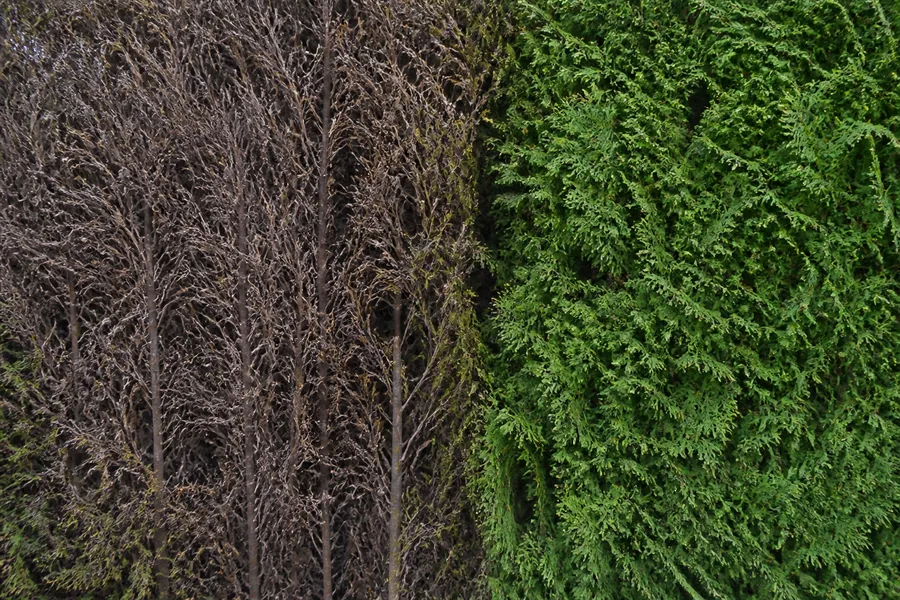
How to identify it
- Bare gray-brown twigs with no cases hanging anywhere on them.
- The boundary between bare and green is sharp rather than gradual.
- The patch has looked identical for a full growing season.
- Green tips are extending at the edges of the bare area but not within it.
What to do
- Look for cases before treating anything, because their absence settles the question.
- Leave the bare wood in place while neighboring branches grow across it, which takes years rather than months.
- Judge whether the infestation is over by watching for new cases in June, not by watching the brown.
What Grows Back and What Does Not
Most bagworm advice was written with deciduous hosts in mind, and it sounds more forgiving than it should because those trees refoliate the following spring. An arborvitae does not have that option.
New growth on this plant comes from the tips of living shoots.
Once a shoot has been stripped back to bare wood there is nothing left on it to grow from, so the gap closes only when the branches on either side of it eventually reach across.
That makes stopping the damage and repairing the look two separate projects. The first is finished in a season, and the second is measured in years, which is worth knowing before anyone spends a summer expecting green to return.
Is the Hedge Worth Saving?
The proportion of green left is what decides it. A plant that still carries healthy foliage over most of its height will live, feed itself and keep growing, even if the shape it has now is the shape it keeps.
Cutting back rarely rescues the appearance. Arborvitae does not resprout from old bare wood, so pruning into a stripped section removes the last green on that stem and leaves you with a permanent hole instead of a thin patch.
Replacing one plant in a run is often the faster answer. A young arborvitae planted into a gap catches up within a few seasons, where waiting for neighbors to close a bare section can take longer than the plant took to grow in the first place.
Recovery Plan
Stop the feeding
Removing cases ends the damage the same day, though it restores nothing. Whatever is already bare has reached its final state.
The work that matters most
One walk along the hedge between autumn and bud break takes down next year's population before it exists.
Where you find out
A hedge that was cleaned properly shows no new cases at hatch time. That absence, rather than the brown filling in, is the result you are looking for.
Two short inspections a year end the cycle.
Walk the hedge once in winter and take down every case you can reach, which removes the eggs while they are still sitting in plain sight.
Then check again in late May, while anything you missed is small enough for a biological spray to reach it. Everything else on this page is what happens when those two visits get skipped.