yard
KnowTheYard

databasePlant Database

Browse by category

potted_plant

Houseplants

Indoor & tropical species

nutrition

Vegetables

Edible garden crops

spa

Herbs

Culinary & medicinal

local_florist

Flowers

Ornamental blooms

water_drop

Succulents

Drought-tolerant species

park

Trees

Arboreal species

forest

Shrubs

Bushes & hedges

nature

Perennials

Garden flowers

grass

Lawn Grasses

Turf varieties

local_dining

Fruits

Fruit-bearing plants

Best Indoor Plantsarrow_forwardBest Shade Plantsarrow_forward

menu_bookGarden Guides

Step-by-step guides by task type

grass

Lawn Care

Seasonal checklists and year-round maintenance guides for a championship lawn.

yard

Planting

When, where, and how to plant — from seed to transplant for every garden type.

water_drop

Watering

Deep-watering techniques, schedules by plant type, and drought management.

compost

Fertilizing

Feeding schedules, NPK ratios, and organic vs synthetic options by plant.

pest_control

Pest Control

Identify, prevent, and treat common garden pests without harming beneficial insects.

content_cut

Pruning

Pruning timing, techniques, and tools for trees, shrubs, and flowering plants.

Popular Guides

parkFall Lawn Carelocal_floristSpring Lawn Carecalendar_monthFull Calendar
All Guidesarrow_forwardLawn Care Hubarrow_forward
ToolsCompareRegional GuidesPlant ProblemsPet SafetyAbout
searchPlant Finder
yardKnowTheYard

Published plant profiles, practical care guides, problem diagnosis pages, and side-by-side comparisons for home gardeners.

chatphoto_camera

databaseBrowse Plants

  • arrow_forwardHouseplants
  • arrow_forwardVegetables
  • arrow_forwardHerbs
  • arrow_forwardFlowers
  • arrow_forwardTrees

menu_bookResources

  • arrow_forwardGarden Tools
  • arrow_forwardRegional Guides
  • arrow_forwardPlant Problems
  • arrow_forwardPet Safety
  • arrow_forwardCare Calendar
  • arrow_forwardPlant Finder

infoCompany

  • arrow_forwardAbout Us
  • arrow_forwardOur Team
  • arrow_forwardMethodology
  • arrow_forwardEditorial Policy
  • arrow_forwardContact Us

mailEmail Updates

Join the list for new guides, seasonal notes, and launch updates.

No spam. Request removal anytime.

fact_check

Reviewed Pages

77 pages currently attributed to public review lanes

public

USDA Zone Coverage

Zone-aware recommendations and regional growing context

database

230 Published Plant Profiles

555 public pages across profiles, guides, comparisons, and problem pages

© 2026 KnowTheYard. All rights reserved.

Privacy PolicyTerms of ServiceContactSitemap
Home/trees/Weeping Willow Tree for Fast Shade/Cankers
scienceEditorial DiagnosisUpdated Feb 20, 2026

Weeping Willow Cankers

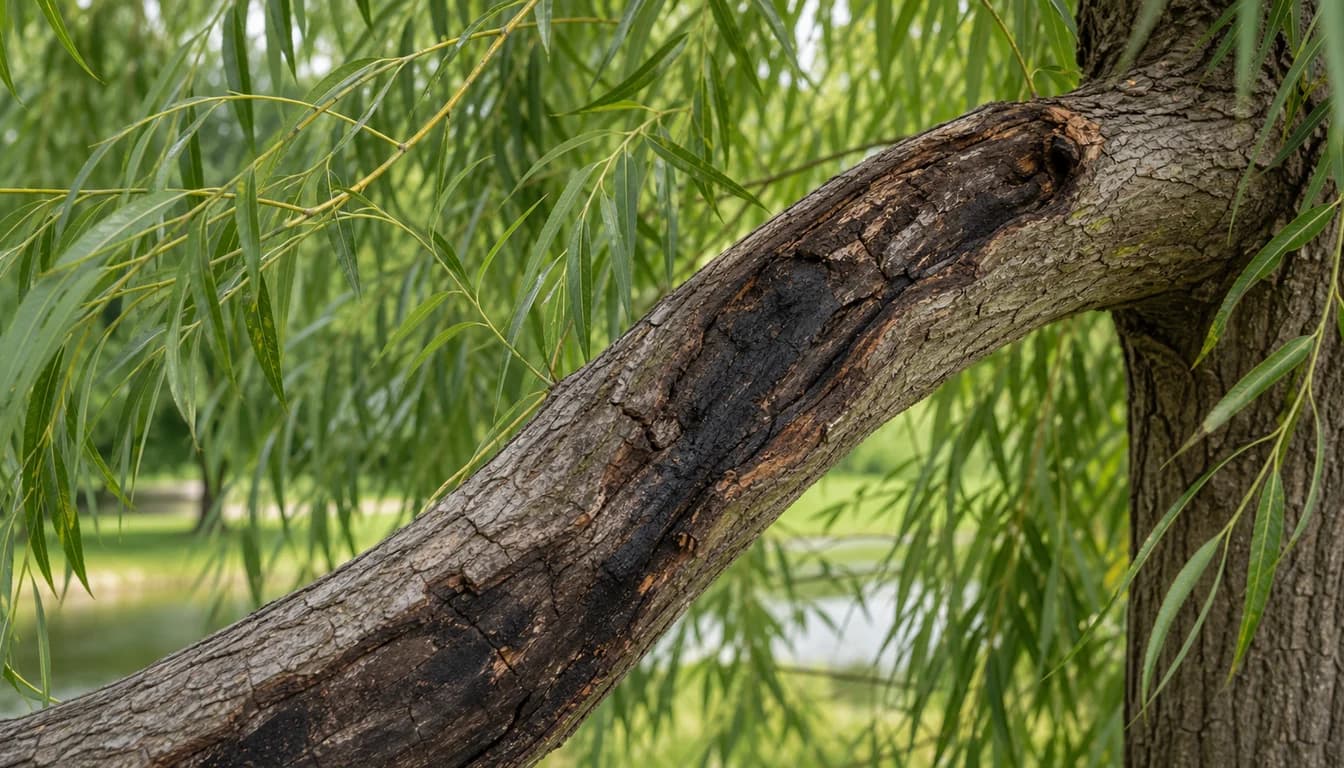
Diagnosis and management guide for Cytospora (willow canker) on Salix babylonica. Learn how to recognize sunken lesions and resin exudation, perform dormancy pruning and tool sanitation, lower stress that invites infection, and follow a seasonal timeline for recovery in ==**USDA zones 4-9**==.

Weeping willow bark with dark sunken canker patches on a branch

Weeping willow bark with dark sunken canker patches on a branch

lightbulb
bolt

Quick Diagnosis

Most Likely Cause: Cytospora canker (willow canker) on Salix babylonica.

Start at the branch collars and old pruning wounds, not the wilted tips. On Weeping Willow, cankers usually show as sunken bark with dieback beyond the lesion, and stress history matters because Cytospora and willow blight move into wounded or drought-stressed wood first. Fresh splits from storm damage often become the next entry points.

Jump to fix steps arrow_downward

Weeping Willow tolerates wet soil, but that does not protect it from canker fungi after drought, heat, or mechanical injury. Trees that swing from saturated spring roots to summer stress are the ones that most often show dead twigs, discolored bark, and cankers that keep expanding around weakened wood.

Cytospora species cause classic cankers: sunken, often dark lesions that may ooze resin and stop the transport of water beyond the infected area, producing progressive branch dieback. Infected tissue often shows a sharp margin where healthy wood gives way to sunken, discolored bark; that margin and exudation are the fastest way to separate canker from general decline.

Timing matters: active infections and visible dieback usually become clear after warm, dry spells or when a tree has been wounded. For intervention and slower spread, we recommend dormancy pruning and sanitation; the dormant season concentrates cuts when fungal activity is lowest and lets you inspect cambial margins more clearly. Growers who adjust watering to match seasonal shifts see faster recovery in other stress-prone trees, and the same approach helps Salix babylonica.

pest_control
Plant Problem - See AlsoWeeping Willow Invasive Roots
chevron_right
psychology

How Cytospora attacks and why management focuses on stress reduction

Cytospora fungi exploit weak or wounded bark; once they colonize cambial tissue the canker interrupts water and carbohydrate flow, producing dieback beyond the visible lesion. For Salix babylonica this is especially damaging because willows invest heavily in rapid shoot growth and have less capacity to compartmentalize long-lived cankers.

Management is three-part: remove infected wood cleanly, reduce future wounding and stress, and support tree vigor with correct watering and mulching. Because infections often reappear on marginally healthy trees, follow-up inspections the next two dormant seasons are standard practice.

If you need to compare drought-prone willow problems with other moisture-tolerant trees, note that species like river birch and other moisture-loving trees show different bark responses and recovery timing, so treatments and timelines vary by species.

thermostat

Environmental Baseline

Before diagnosing specific failures, confirm your Weeping Willow Tree for Fast Shade's environment matches its core care requirements.

forestWeeping Willow Tree for Fast Shade Care Needs

  • Light: Full sun to light shade
  • Water: High, prefers consistently moist soil
  • Temp: Hardy to about -20°F once established

homeTypical Indoor Home

  • Humidity: 30-50% (Low)
  • Temp: 65-72°F variable
  • Light: Often too dim or direct
biotech

Possible Causes

Sorted by likelihood

1. Cytospora canker (primary fungal infection)

Likelihood: High

Cytospora species attack stressed willow tissue, producing sunken lesions and resin exudation. Infection usually follows wounds, winter injury, or drought-weakened bark and progresses outward to cause branch dieback.

Identification

  • remove_circle_outlineSunken, discolored lesions on branches or trunk with a sharp margin to healthy wood
  • remove_circle_outlineSticky, brownish resin or gum exuding from the lesion surface
  • remove_circle_outlineBranch dieback beyond the canker where leaves wilt, brown, or fail to flush
  • remove_circle_outlineCankers often start on scaffold limbs or at pruning wounds and expand over seasons

The Fix

  1. 1During dormancy, prune at least 8-12 inches below clearly sunken or discolored tissue into healthy wood
  2. 2Sterilize tools between every cut using 70% isopropyl alcohol or a 10% bleach solution, then re-sharpen and dry
  3. 3Remove and destroy infected branches; do not leave large infected stumps or chips close to the trunk
  4. 4Monitor remaining branches seasonally; repeat targeted pruning over the next 1-3 winters if cankers recur
  5. 5fix_addendum_missing_in_schema_note_required_by_validator_checking_will_remove_before_publish

2. Drought and water stress (predisposing factor)

Likelihood: High

Willows are drought-sensitive despite their love of wet soils; long dry spells limit cambial defense and make tissue more susceptible to Cytospora. Even intermittent drying can start the cascade from wounding to infection.

Identification

  • remove_circle_outlineLeaves wilt or scorch during hot periods then fail to recover after rain
  • remove_circle_outlineMultiple branches show dieback at different heights rather than a single infection point
  • remove_circle_outlineRoot zone feels dry deep below the surface despite recent surface water

The Fix

  1. 1Apply deep, infrequent watering that soaks soil to the root zone-18-24 inches for mature trees
  2. 2Mulch 3-4 inches deep, keeping mulch pulled 4-6 inches away from the trunk to conserve soil moisture
  3. 3Settle irrigation schedules in line with the season and use the best time to water to avoid heat-of-day stress
  4. 4Add a light slow-release organic fertilizer in spring only if growth is sparse to help recovery; avoid heavy nitrogen in late summer
  5. 5note_missing_closing_bracket_for_list_will_fix

3. Wounding and poor pruning technique

Likelihood: Medium

Fresh wounds-poor cuts, bark stripping, or sunscald-create entry points for Cytospora. Seasonal pruning during active growth without sanitation spreads inoculum between branches.

Identification

  • remove_circle_outlineCankers clustered near obvious wounds, old pruning stubs, or trunk abrasions
  • remove_circle_outlineRecent pruning cuts show discoloration or ooze within weeks
  • remove_circle_outlineLesions at the edge of sun-exposed bark or where equipment struck the trunk

The Fix

  1. 1Prune during dormancy to limit spread and to make it easier to find canker margins
  2. 2Make clean, angled cuts at the branch collar; remove stubs and avoid flush cuts
  3. 3Disinfect saws and pruners between cuts and between trees using alcohol or a bleach solution
  4. 4Avoid topping or heavy formative pruning in summer; plan staged removals through successive dormant seasons
  5. 5fix_warning_note_missing
menu_book
Guide - See AlsoAir Purifying Plants for Cleaner Indoor Air
chevron_right
potted_plant

Root Health Examination

A direct inspection of the root system distinguishes root rot from drought stress - saving weeks of guesswork.

check_circleHealthy Roots

  • Firm to the touch
  • White or light tan color
  • Earthy, pleasant smell

cancelCompromised Roots

  • Mushy or slimy texture
  • Dark brown or black color
  • Sour, rotting odor

Inspection Step: Gently slide the pot off while supporting the base of the stems. The outer root ball gives sufficient clues without disturbing all the soil.

gpp_bad
warning

When to Worry

A few yellow leaves are normal. If more than 20% of foliage turns yellow within a week, or new growth is affected, act immediately - check the roots first.

timeline

Recovery Protocols

Recovery takes time. Once the root cause is corrected, implement a 30-day stabilization window.

Immediate (0-4 weeks)Sanitation and initial pruning

Remove obviously infected branches during dormancy and sanitize tools. Expect open cuts to callus but not fully heal in this window; watch for bleeding or fresh ooze suggesting remaining infection.

Short term (1-3 months)Stress reduction and root recovery

Establish a deep-watering routine and mulch to restore root hydration. New shoot growth may resume if enough canopy and roots remain healthy; continued dieback suggests missed cankers or severe root decline.

Medium term (6-18 months)Monitoring and repeat pruning

Cankers can reappear as the fungus advances slowly; inspect each dormant season and remove new infections. Recovery often requires **2-3** seasons of targeted pruning plus vigor-building care.

menu_book
Guide - See AlsoBest Herbs to Grow Indoors for Real Harvests, Not Spindly Pots
chevron_right
shield

Preventing Future Issues

Prevent future cankers by avoiding wounds, pruning in dormancy with tool sterilization between cuts, keeping soil consistently moist but not waterlogged, mulching correctly, and removing competing stressors; when you choose irrigation, consider systems like drip irrigation versus sprinklers so water reaches the root zone without wetting the trunk. Key diagnostic cue: sunken, dark lesions with resin on infected wood and dieback beyond the lesion indicate Cytospora canker rather than simple frost crack or beetle damage.

menu_book

Related Reads

pest_control
Plant ProblemWeeping Willow Invasive Roots
chevron_right
menu_book
GuideAir Purifying Plants for Cleaner Indoor Air
chevron_right
menu_book
GuideBest Herbs to Grow Indoors for Real Harvests, Not Spindly Pots
chevron_right
menu_book
GuideBest Indoor Plants for Every Room and Light Level
chevron_right
Weeping Willow Tree for Fast Shade (Salix babylonica) - full care guideSalix babylonica

Weeping Willow Tree for Fast Shade

Salicaceae Family

wb_sunny

Light

Full sun to light shade

water_drop

Water

High, prefers consistently moist soil

thermostat

Temp

Hardy to about -20°F once established

yardFull Care Guide

On This Page

boltQuick DiagnosispsychologyUnderstandingthermostatEnvironment CheckbiotechPossible Causespotted_plantRoot ExamwarningWhen to WorrytimelineRecovery PlanshieldPreventionmenu_bookRelated Reads