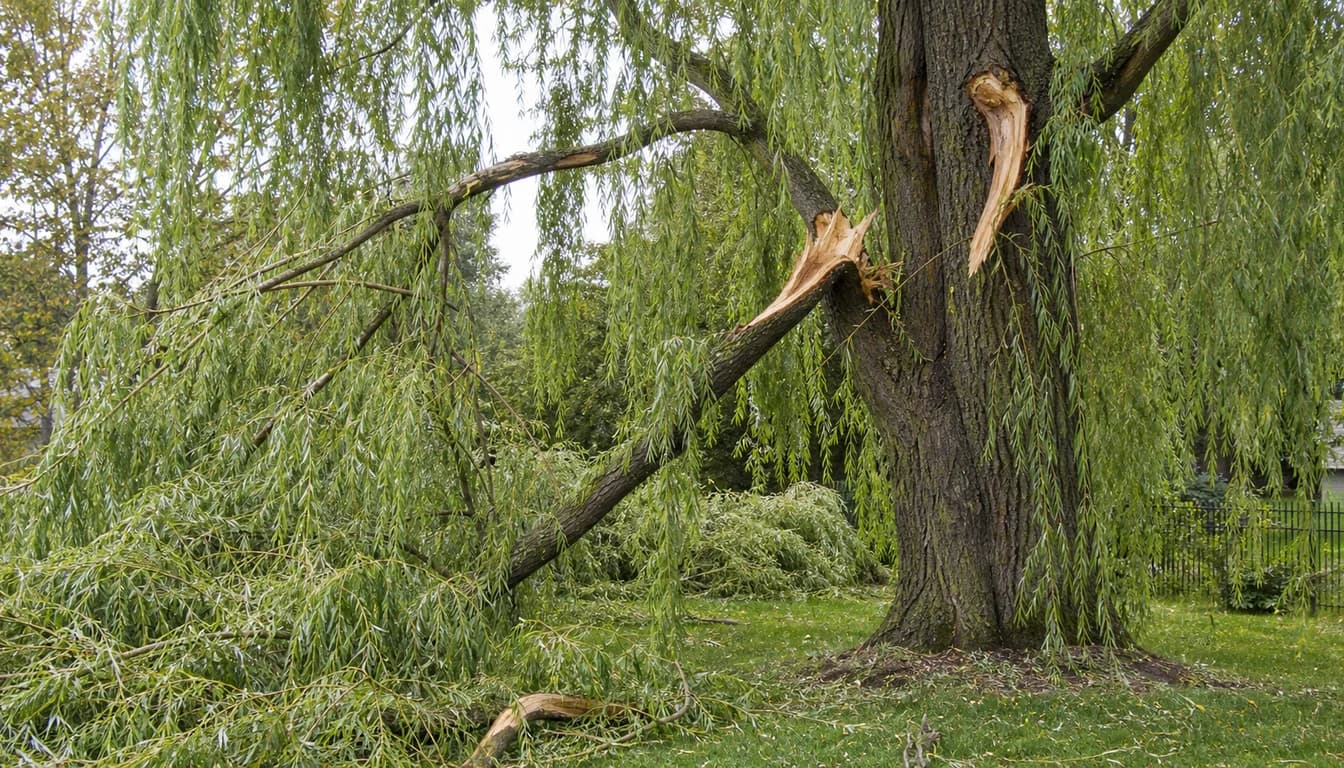
1. Wind throw and large gusts
Likelihood: HighStrong gusts and straight-line winds commonly snap long, flexible willow branches or torque branches at weak crotches. The broad, pendulous crown creates sail area that multiplies wind forces on limbs and the trunk.
Identification
- remove_circle_outlineLong, pendulous branches snapped clean or jagged from scaffold unions.
- remove_circle_outlineTree leaning suddenly with root flare partially lifted.
- remove_circle_outlineBranches twisted or hanging by bark fibres rather than fully severed.
- remove_circle_outlineThe trunk or major limbs may show a fresh, white wood surface at the break point.
The Fix
- 1Clear the drop zone and cut and remove fully separated limbs first to reduce hazard.
- 2Make clean pruning cuts back to a lateral branch or collar using a saw sized for the limb diameter.
- 3For large scaffold breaks, leave a few inches of cambium to allow professional tapering if the cut is awkward or near the trunk.
- 4Use temporary guying or bracing to stabilize the main trunk if the tree is leaning but salvageable; follow professional weight limits.
- 5Monitor for secondary bark tears and protect them with clean cuts-do not wrap with tar or sealant.