yard
KnowTheYard

databasePlant Database

Browse by category

potted_plant

Houseplants

Indoor & tropical species

nutrition

Vegetables

Edible garden crops

spa

Herbs

Culinary & medicinal

local_florist

Flowers

Ornamental blooms

water_drop

Succulents

Drought-tolerant species

park

Trees

Arboreal species

forest

Shrubs

Bushes & hedges

nature

Perennials

Garden flowers

grass

Lawn Grasses

Turf varieties

local_dining

Fruits

Fruit-bearing plants

Best Indoor Plantsarrow_forwardBest Shade Plantsarrow_forward

menu_bookGarden Guides

Step-by-step guides by task type

grass

Lawn Care

Seasonal checklists and year-round maintenance guides for a championship lawn.

yard

Planting

When, where, and how to plant — from seed to transplant for every garden type.

water_drop

Watering

Deep-watering techniques, schedules by plant type, and drought management.

compost

Fertilizing

Feeding schedules, NPK ratios, and organic vs synthetic options by plant.

pest_control

Pest Control

Identify, prevent, and treat common garden pests without harming beneficial insects.

content_cut

Pruning

Pruning timing, techniques, and tools for trees, shrubs, and flowering plants.

Popular Guides

parkFall Lawn Carelocal_floristSpring Lawn Carecalendar_monthFull Calendar
All Guidesarrow_forwardLawn Care Hubarrow_forward
ToolsCompareRegional GuidesPlant ProblemsPet SafetyAbout
searchPlant Finder
yardKnowTheYard

Published plant profiles, practical care guides, problem diagnosis pages, and side-by-side comparisons for home gardeners.

chatphoto_camera

databaseBrowse Plants

  • arrow_forwardHouseplants
  • arrow_forwardVegetables
  • arrow_forwardHerbs
  • arrow_forwardFlowers
  • arrow_forwardTrees

menu_bookResources

  • arrow_forwardGarden Tools
  • arrow_forwardRegional Guides
  • arrow_forwardPlant Problems
  • arrow_forwardPet Safety
  • arrow_forwardCare Calendar
  • arrow_forwardPlant Finder

infoCompany

  • arrow_forwardAbout Us
  • arrow_forwardOur Team
  • arrow_forwardMethodology
  • arrow_forwardEditorial Policy
  • arrow_forwardContact Us

mailEmail Updates

Join the list for new guides, seasonal notes, and launch updates.

No spam. Request removal anytime.

fact_check

Reviewed Pages

77 pages currently attributed to public review lanes

public

USDA Zone Coverage

Zone-aware recommendations and regional growing context

database

230 Published Plant Profiles

555 public pages across profiles, guides, comparisons, and problem pages

© 2026 KnowTheYard. All rights reserved.

Privacy PolicyTerms of ServiceContactSitemap
Home/vegetables/Watermelon: Heat, Space, Pollination, and Ripe Picking/Blossom End Rot
scienceEditorial DiagnosisUpdated Feb 20, 2026

Watermelon Blossom End Rot

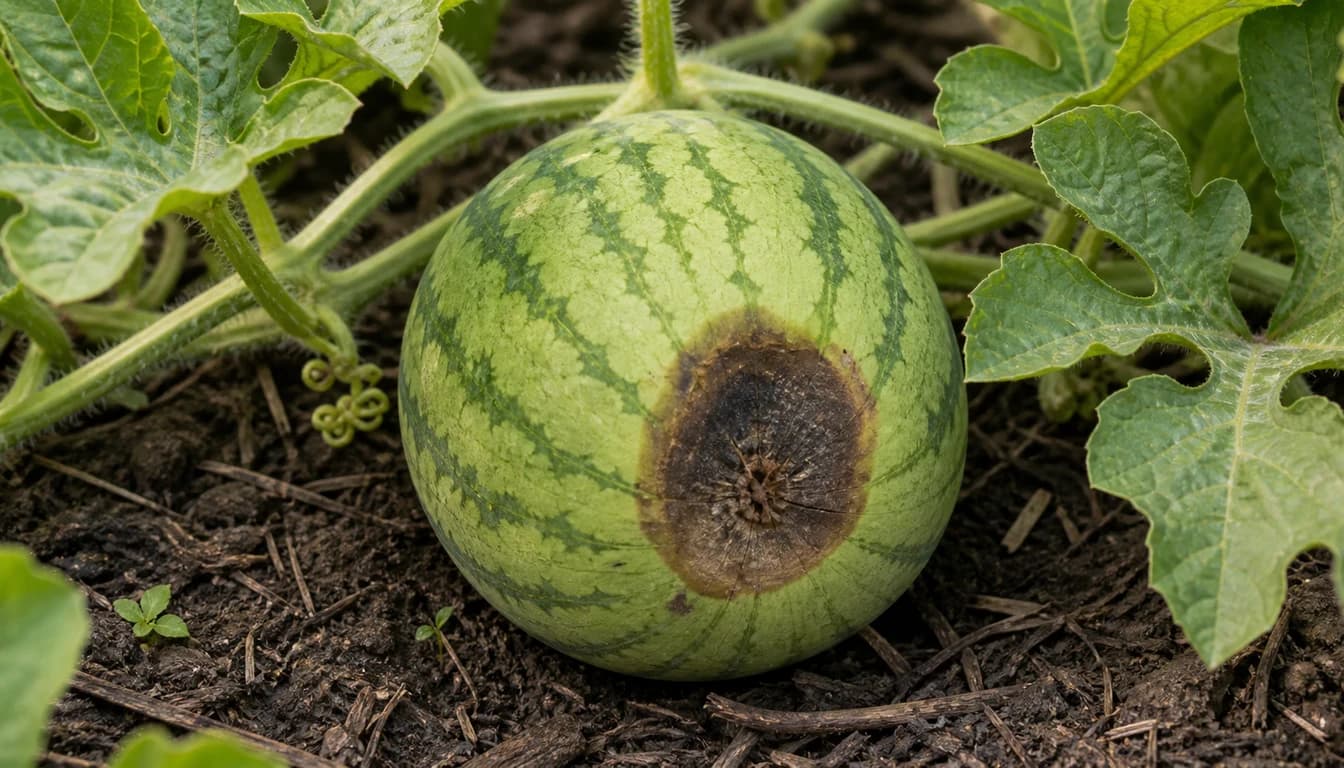
Blossom end rot (BER) on **Watermelon** is a physiological disorder caused by localized calcium deficiency in developing fruit tissue, most often triggered by uneven soil moisture or root stress. It appears as sunken, dark, leathery spots at the blossom end of the fruit and is not a fungal or bacterial disease. Fixing BER focuses on steady irrigation, good soil calcium availability, and cultural practices rather than fungicides.

Small watermelon with a dark sunken blossom end rot patch resting on garden soil

Small watermelon with a dark sunken blossom end rot patch resting on garden soil

lightbulb
bolt

Quick Diagnosis

Most Likely Cause: Physiological calcium-transport problem (Blossom End Rot).

Check whether the dark lesion sits exactly on the blossom end of a young fruit and feels leathery before it goes soft. On Watermelon, that pattern points to blossom end rot from disrupted calcium movement, not a contagious fruit disease; the visual pattern is close to blossom end rot on tomatoes, but the vine management is different.

Jump to fix steps arrow_downward

Watermelon blossom end rot usually shows up while vines are growing hard and young fruit are expanding fast. The plant can be vigorous and still fail to keep calcium moving into the fruit if irrigation swings damage feeder-root consistency or salts build up around the crown.

Watermelon (Citrullus lanatus) is a warm-season crop in the family Cucurbitaceae and sets fruit when soils and air are warm and plants are actively growing. The typical soil window for avoiding BER is pH 6.0-6.8 in a well-draining, fertile bed; that keeps calcium soluble and roots healthy. Growers who favor deeper, less-frequent watering and keep surface mulch in place tend to see fewer BER outbreaks.

BER is strongly associated with moisture swings: a stretch of dry weather followed by heavy irrigation or thunderstorm rain commonly triggers new BER on fruit that were small or just starting to expand. Rapid fruit expansion in hot weather raises demand for calcium and can expose marginal calcium supply issues even when soil tests show adequate total calcium content.

pest_control
Plant Problem - See AlsoWatermelon Poor Fruit Set
chevron_right
psychology

Understanding BER in Watermelon

Blossom end rot is a symptom of inadequate calcium in the fruit tissue during rapid growth, not a pathogen. The core problem is calcium transport: calcium is relatively immobile once fixed in plant tissue, so the window to protect young Watermelon fruit is before and during early fruit expansion.

Treatments aimed at curing existing BER spots are limited. Foliar calcium sprays can marginally reduce new spot formation if applied at the right time, but they do not reliably reverse established lesions. The best strategy is to stabilize soil moisture and support steady root uptake - actions that reduce the chance of new BER on subsequent fruit.

link_paragraph

thermostat

Environmental Baseline

Before diagnosing specific failures, confirm your Watermelon: Heat, Space, Pollination, and Ripe Picking's environment matches its core care requirements.

forestWatermelon: Heat, Space, Pollination, and Ripe Picking Care Needs

  • Light: Full sun, ==**8-10 hours**== if possible
  • Water: Deep moisture through vine growth and fruit fill
  • Temp: Best with warm soil and ==**70-90 F**== weather

homeTypical Indoor Home

  • Humidity: 30-50% (Low)
  • Temp: 65-72°F variable
  • Light: Often too dim or direct
biotech

Possible Causes

Sorted by likelihood

1. Inconsistent soil moisture (High)

Likelihood: High

The most common trigger for BER is uneven soil moisture: drought stress followed by heavy watering or a big rain interrupts steady calcium transport into developing fruit. Even short dry cycles during fruit set can produce BER.

Identification

  • remove_circle_outlineRecent stretch of dry weather followed by heavy irrigation or rain within the last 1-3 weeks
  • remove_circle_outlinePlants show no overall wilting at midday but fruit formed during the dry period have sunken spots
  • remove_circle_outlineSoil surface is cracked or very dry between watering cycles while root zone farther down is wet

The Fix

  1. 1Switch to an even, deep watering schedule: provide 1-1.5 inches of water per week, split once or twice, depending on heat
  2. 2Install drip irrigation or soaker hoses to supply steady moisture directly to the root zone - avoid overhead-only sprinklers
  3. 3Apply 2-3 inches of organic mulch to reduce evaporation and buffer soil moisture swings
  4. 4dummy

2. Limited calcium uptake despite adequate soil calcium (Medium)

Likelihood: Medium

Soils can contain calcium but conditions (cold wet soils, high salinity, compacted or poorly drained soils, or chemical interactions) limit root uptake. High soil magnesium or sodium can compete with calcium, and very acid soils reduce availability.

Identification

  • remove_circle_outlineRecent soil test shows adequate total calcium but plant tissue tests low in calcium
  • remove_circle_outlinePlants in poorly drained patches or compacted areas show more BER
  • remove_circle_outlineRaised beds or containers with lightweight mixes show BER more quickly than in established ground

The Fix

  1. 1Take a soil test and a tissue (leaf) calcium test to compare available calcium and plant uptake; correct pH to 6.0-6.8 if needed
  2. 2Improve drainage and soil structure with compost and by loosening compacted layers so roots can explore more soil
  3. 3Use calcium-containing amendments like lime or gypsum only when guided by soil test recommendations - these correct long-term availability rather than curing existing spots
  4. 4dummy

3. Root damage or shallow roots (Medium)

Likelihood: Medium

Damaged or restricted roots (from cultivation, pests, or hardpan) reduce the plant’s ability to take up water and calcium steadily, especially during rapid fruit growth.

Identification

  • remove_circle_outlinePlants near recent digging, trenching, or heavy foot traffic show more BER
  • remove_circle_outlineUneven fruiting and smaller root mass on inspection when repotting or digging a test plant
  • remove_circle_outlineLocalized BER patches rather than whole-bed incidence

The Fix

  1. 1Avoid cultivating close to crown once vines are established; hand-weed near crowns to protect roots
  2. 2Improve rooting depth with deep, infrequent watering to encourage deeper root growth
  3. 3Replace or amend compacted soil areas with well-draining mix and organic matter
  4. 4dummy
pest_control
Plant Problem - See AlsoWatermelon Powdery Mildew
chevron_right
potted_plant

Root Health Examination

A direct inspection of the root system distinguishes root rot from drought stress - saving weeks of guesswork.

check_circleHealthy Roots

  • Firm to the touch
  • White or light tan color
  • Earthy, pleasant smell

cancelCompromised Roots

  • Mushy or slimy texture
  • Dark brown or black color
  • Sour, rotting odor

Inspection Step: Gently slide the pot off while supporting the base of the stems. The outer root ball gives sufficient clues without disturbing all the soil.

gpp_bad
warning

When to Worry

A few yellow leaves are normal. If more than 20% of foliage turns yellow within a week, or new growth is affected, act immediately - check the roots first.

timeline

Recovery Protocols

Recovery takes time. Once the root cause is corrected, implement a 30-day stabilization window.

Immediate actions (0-2 weeks)Stop new damage quickly

Begin even irrigation and add mulch. New fruit that set after moisture is stabilized rarely develop BER if calcium availability is adequate. Existing fruits with large lesions will not recover, but further spread to adjacent fruit is prevented by steady moisture.

Short term (2-6 weeks)Correct soil availability

Get a soil pH and calcium check and amend if needed. Adjusting pH to **6.0-6.8** and improving drainage or adding composted organic matter helps root uptake over the next several weeks.

Season-long (6-12+ weeks)Maintain habits to stop recurrence

Once you adopt steady irrigation, mulch, and soil improvements, new fruit across the warm-season window should show far fewer BER cases. Continue even watering and avoid heavy nitrogen pushes that encourage rapid canopy growth at the expense of fruit calcium.

menu_book
Guide - See AlsoAir Purifying Plants for Cleaner Indoor Air
chevron_right
shield

Preventing Future Issues

Prevent BER by prioritizing steady soil moisture (drip irrigation or regular deep soaking), correcting soil pH to 6.0-6.8, maintaining good soil structure and drainage, and testing soil and tissue when BER is recurrent. Calcium amendments change long-term availability but are not a quick cure for existing spots; focus first on irrigation and root health, and consider using mulch and compost together to stabilize moisture and feed soil biology. BER is about calcium transport and moisture, not a fungus or bacteria. Stabilize irrigation to prevent new BER on developing fruit.

menu_book

Related Reads

pest_control
Plant ProblemWatermelon Poor Fruit Set
chevron_right
pest_control
Plant ProblemWatermelon Powdery Mildew
chevron_right
menu_book
GuideAir Purifying Plants for Cleaner Indoor Air
chevron_right
menu_book
GuideBest Herbs to Grow Indoors for Real Harvests, Not Spindly Pots
chevron_right
menu_book
GuideBest Indoor Plants for Every Room and Light Level
chevron_right
Watermelon: Heat, Space, Pollination, and Ripe Picking (Citrullus lanatus) - full care guideCitrullus lanatus

Watermelon: Heat, Space, Pollination, and Ripe Picking

Cucurbitaceae Family

wb_sunny

Light

Full sun, ==**8-10 hours**== if possible

water_drop

Water

Deep moisture through vine growth and fruit fill

thermostat

Temp

Best with warm soil and ==**70-90 F**== weather

yardFull Care Guide

On This Page

boltQuick DiagnosispsychologyUnderstandingthermostatEnvironment CheckbiotechPossible Causespotted_plantRoot ExamwarningWhen to WorrytimelineRecovery PlanshieldPreventionmenu_bookRelated Reads