
White Powder on Rose Leaves? Check the New Shoots and Buds
Rose powdery mildew forms white-to-gray surface growth on leaves, young shoots, sepals, and buds. Confirm the coating, measure distortion and bloom damage, then choose tolerance, selective removal, canopy change, or a labeled treatment.
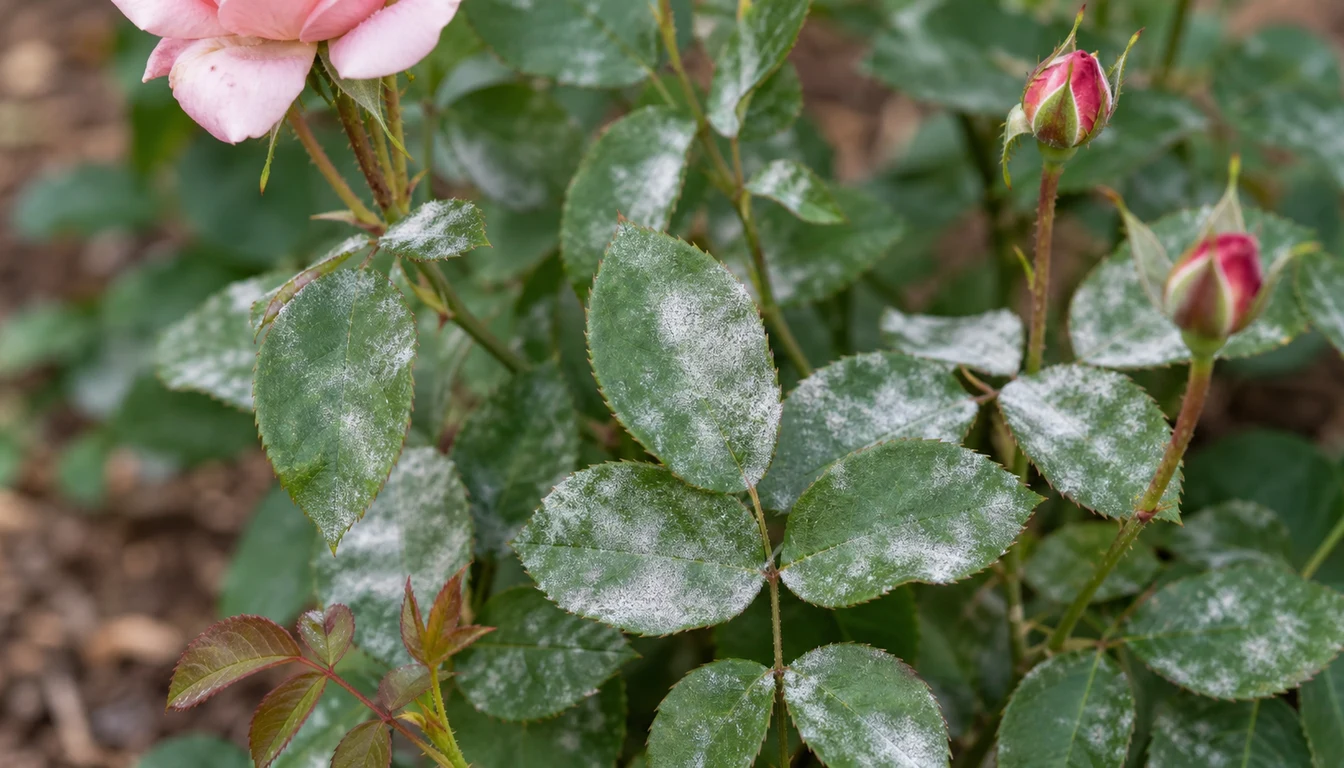
Quick diagnosis
Powdery mildew when white-gray colonies spread across living rose surfaces
Inspect both surfaces of the young leaves, then follow the coating onto red shoots, sepals, and unopened buds.
Powdery mildew looks like irregular floury patches or a thin felted mat, and infected young tissue may curl, twist, or stay small as it expands.
Check whether the white material returns or spreads on living tissue after a gentle rub. Angular purple lesions with sparse growth underneath, dark spots with yellow halos, gray decay on petals, fixed water marks, or fine mite webbing all point somewhere else.
Open the full diagnosisWhat You Are Seeing
Rose powdery mildew is usually caused by the rose-specialized form of Podosphaera pannosa, once classified under Sphaerotheca pannosa.
The fungus grows mainly across plant surfaces and feeds on the epidermal cells directly beneath it.
Unlike black spot, it does not need free water on the leaf to germinate and infect. Moderate temperatures, shaded new growth, high nighttime humidity, and still air can carry an outbreak while the leaf looks completely dry.
A few flat white patches on an otherwise vigorous rose can stay cosmetic.
Colonies that distort new shoots, coat sepals, stop buds opening properly, or return on every flush have earned a more active response.
Common Causes
01 High likelihood when powder covers leaves, shoots, sepals, or buds
Active powdery mildew is growing on young rose surfaces
Powdery mildew builds a white-to-gray mat on rose leaves and other green tissue. Colonies start as separate round patches, then join into broader coatings as windborne spores reach nearby susceptible growth.
The coating is a surface sign, but its feeding structures reach into living epidermal cells.
That is why a young leaf stays curled or distorted even after the loose powder is rubbed or washed away.
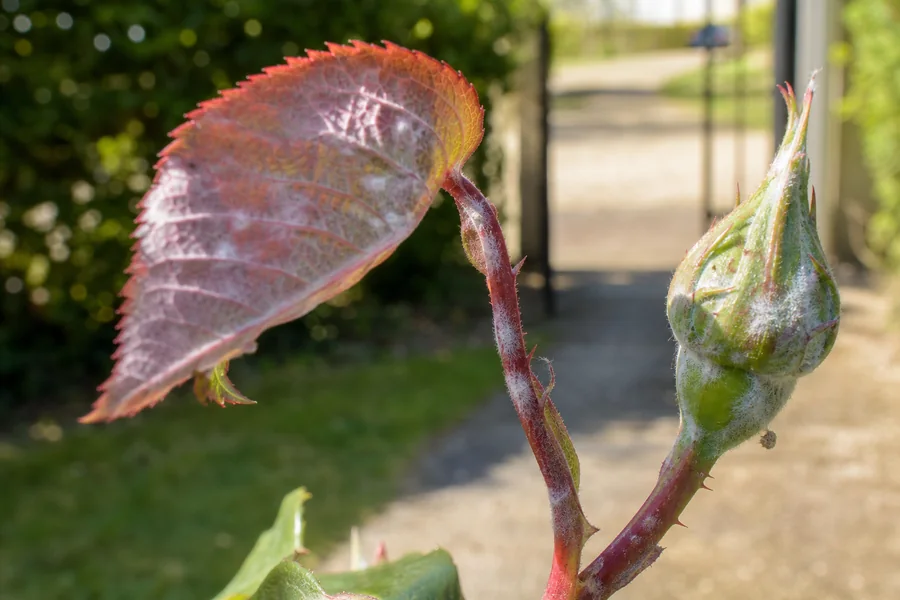
How to identify it
- Irregular white or gray colonies sit on one or both leaf surfaces.
- New red shoots, petioles, sepals, or closed buds carry the same powder.
- Young leaflets curl, twist, pucker, or remain smaller than clean leaves.
- Fresh colonies expand onto nearby new growth during favorable weather.
What to do
- Mark a coated shoot and compare its youngest unfolding leaves over several days.
- Remove a badly distorted tip when the rose retains enough healthy growth to support that loss.
- Improve light and air around the affected flush without shearing the entire shrub.
- Escalate to a labeled treatment when colonies keep spreading into buds or valuable new foliage.
02 High likelihood when inner shoots are affected before exposed foliage
Shade, high night humidity, and crowding favor the colonies
Powdery mildew thrives through mild days and cool humid nights without any film of rain or irrigation on the leaf.
Shaded inner shoots stay cooler, take less direct light, and sit in still air where the humidity around the tissue stays high.
Air movement helps, but it is not a cure on its own. Spores arrive from outside the bed, and a susceptible rose still needs protection when weather and a repeated disease history overcome good spacing.
How to identify it
- Colonies begin on inner, lower-light, or fence-facing new growth.
- Crossing canes and neighboring plants block light through the center.
- The worst coating follows mild days and humid nights rather than long rain alone.
- Open sunlit shoots remain cleaner than comparable shaded shoots on the same plant.
What to do
- Trace which canes shade the infected flush before making any cut.
- Remove one crossing or inward-growing cane at the rose's normal pruning time.
- Trim or reposition nearby growth that creates persistent deep shade around the canopy.
- Recheck the next flush before deciding that more pruning or a fungicide is necessary.
03 Medium likelihood when every tender flush develops early distortion
A soft growth flush or infected bud is restarting the problem
Rose powdery mildew targets young expanding tissue, and the fungus can persist in infected buds or living plant material between favorable periods.
A new shoot can therefore emerge already coated or distorted before the older leaves change much at all.
Excess nitrogen adds unusually soft growth, though vigorous red shoots are normal on many healthy roses. Use a known fertilizer history and repeated disease on tender tissue before blaming the feeding.
How to identify it
- White growth appears as a bud opens or a shoot begins to elongate.
- The youngest leaflets distort while mature exposed foliage stays flatter.
- An unusually lush flush follows a heavy nitrogen application or lawn-feed drift.
- Repeated colonies center on the same infected shoot or bud area.
What to do
- Remove a persistently infected shoot back to sound growth when the rose can spare it.
- Stop extra nitrogen and return to measured feeding based on the rose's actual need.
- Keep lawn fertilizer outside the rose root zone and brush granules from foliage.
- Watch the next opening buds closely so early colonies are managed before the coating becomes broad.
04 Possible when the leaf has lesions rather than a broad surface mat
Downy mildew or black spot is being mistaken for powdery growth
Rose downy mildew makes purple, red, or brown angular patches that often stop at the major veins. Sparse pale-gray growth can appear beneath those lesions in cool humid conditions, but it never spreads as broadly across leaf and shoot surfaces.
Black spot makes dark damaged areas with feathery margins and yellow tissue around them.
It depends on prolonged surface moisture and splash in a way powdery mildew does not, so the watering and sanitation decisions are different.
How to identify it
- Angular purple-brown patches bounded by veins support downy mildew.
- Sparse gray growth sits beneath a lesion rather than across a clean green surface.
- Dark round lesions with yellow halos and premature drop support black spot.
- White growth across shoots, sepals, and both leaf surfaces supports powdery mildew.
What to do
- Turn several affected leaves over and compare young and mature symptoms.
- Use bright natural light to separate pale fungal growth from reflective leaf hairs.
- Follow the management path for the confirmed disease instead of treating every mildew name alike.
- Seek a local plant diagnosis when angular lesions and surface powder occur on the same rose.
05 Possible when tissue condition and distribution disagree
Gray mold, spray residue, or mites are creating a pale surface sign
Botrytis gray mold colonizes injured or decaying petals and buds, where the tissue turns water-soaked, brown, or soft beneath fuzzy gray spores.
Powdery mildew is drier, and it spreads over living green leaves, shoots, and sepals without that soft decay.
Spray residue follows droplet edges and exposure patterns, while spider mites leave pale stippling, fine webbing, and tiny moving dots beneath the leaves. Neither makes expanding flour-like colonies tied to distorted young tissue.
How to identify it
- Gray fuzz rises from browned soft petals or a rotting bud in Botrytis.
- Pale circular marks follow dried droplets and leave normal flat tissue between them.
- Fine webbing, stippling, and moving dots beneath leaves support spider mites.
- A hand lens shows a felted surface colony instead of web strands or mineral crystals.
What to do
- Remove decaying flowers and diagnose any bud rot separately from leaf mildew.
- Rinse a small residue test area only when the foliage can dry promptly.
- Inspect leaf undersides with a hand lens before repeating a fungicide on mite damage.
- Photograph the untouched sign before washing when its structure remains uncertain.
06 Medium likelihood after similar outbreaks across several mild seasons
A susceptible cultivar repeatedly loses the newest growth
Rose cultivars vary widely in powdery mildew resistance. A susceptible plant in a shaded or humid site can need repeated intervention while nearby landscape roses stay usable with no spray program at all.
A single cosmetic episode is not a test of the cultivar.
Recurrent bud distortion, reduced flowering, and heavy coating on every flush despite canopy and feeding changes show a more durable mismatch.
How to identify it
- One rose is consistently worse than neighboring cultivars under the same conditions.
- Buds and soft shoots are damaged during several separate growth flushes.
- Canopy improvements reduce but do not prevent repeated severe colonies.
- The maintenance needed exceeds what the site or gardener can sustain.
What to do
- Record the affected tissue and bloom loss across more than one favorable mildew period.
- Compare locally recommended resistant roses with a similar mature size and garden role.
- Move a transplantable rose only when a sunnier suitable site solves a documented shade problem.
- Replace a chronically affected plant when repeated treatment and poor flowering no longer fit the garden.
Powdery mildew can grow on a dry-looking leaf
Powdery mildew spores germinate without free water on the rose surface.
Moderate temperatures, high relative humidity at night, shade, and susceptible new tissue support colonies during weather that never looks rainy.
Water on the surface inhibits or kills the spores of many powdery mildew fungi and washes loose ones away. That does not make late overhead watering safe, because foliage left wet into the night favors black spot, rust, and other rose diseases.
A mid-morning or midday rinse is a limited tactic, useful where water use is appropriate, wet-leaf disease pressure is low, and the canopy dries well before evening.
It removes surface material and nothing more, so it cannot flatten an already distorted leaf or guarantee the living infection stays away.
Airflow and sunlight change the conditions around new shoots, and resistant cultivars lower susceptibility. Neither removes airborne spores from the wider garden, so repeated severe disease can still justify a correctly chosen labeled treatment.
Powdery Mildew, Downy Mildew, Gray Mold, or Residue?
First decide whether the pale material sits on living green tissue or rises from a lesion or decaying flower. Then use the underside, droplet pattern, and a hand lens to separate the closest lookalikes.
- Powdery mildew
- Dry white-to-gray colonies spread over leaves, young shoots, sepals, and buds. Young tissue may curl or remain small.
- Downy mildew
- Purple-brown angular lesions stop at major veins. Sparse pale growth may occur beneath the damaged area during cool humid weather.
- Black spot
- Dark tissue lesions have feathery margins and yellow halos. Leaves may drop after prolonged wetness and splash-driven spread.
- Botrytis gray mold
- Fuzzy gray spores cover browned, water-soaked, or decaying petals and buds rather than a firm green leaf surface.
- Spray or mineral residue
- Pale deposits follow dried droplets and application exposure. The leaf stays flat and new fungal colonies do not expand from the mark.
- Spider mites
- Pale stippling, fine webbing, and tiny moving dots occur mainly beneath leaves. No flour-like fungal mat covers shoots or sepals.

A rose can carry more than one problem, so preserve an untouched sample when patterns overlap. Treating one confirmed sign does not explain a second lesion type automatically.
Tolerate, Remove, or Wash the First Colonies
Low-level powdery mildew can remain mainly cosmetic when leaves stay flat and buds open normally. Act more quickly when colonies move into the youngest shoots, distort unfolding leaves, or coat sepals around developing flowers.
- A few flat patches with normal growth
- Mark the shoot and watch the next leaves. Improve light and air before removing useful foliage or applying a product.
- Distorted tips or coated buds
- Remove the worst tip if the rose retains ample healthy growth, then inspect adjacent buds and the inner canopy for active colonies.
- Broad early coating or repeated rebound
- Use a well-timed rinse only where the canopy dries promptly and other disease risks are low, or move to a labeled treatment suited to the disease stage.
Do not wash in the evening or leave a dense rose wet overnight. Mid-morning timing gives dislodged spores less opportunity to settle and lets the foliage dry before conditions favor black spot or rust.
Do not strip every coated leaf from a plant that is already thin. Preserve functional green area and judge progress on the next opening leaves rather than expecting old curled tissue to become flat.
Give New Shoots Light Without Over-Pruning
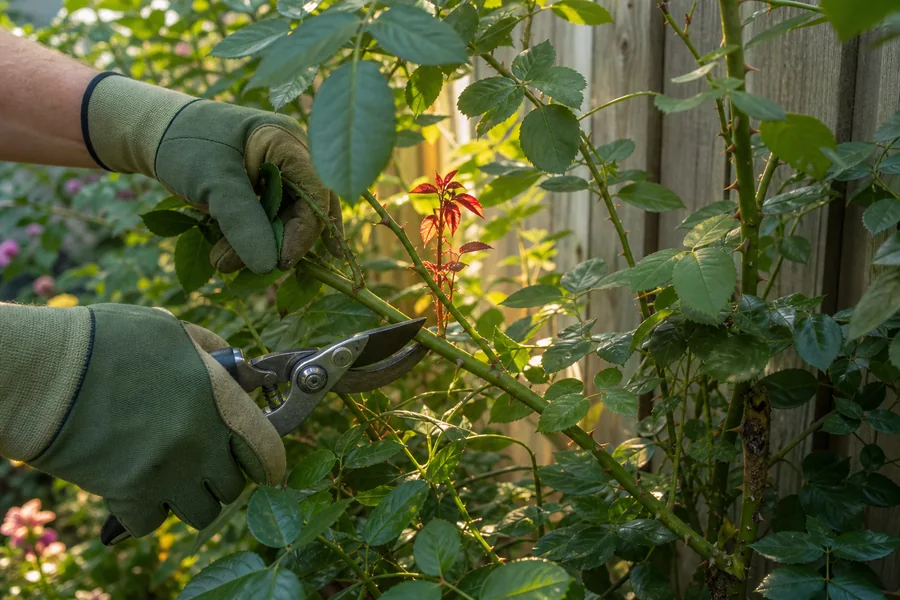
Look through the rose toward the infected inner shoot before cutting. One crossing cane or a neighboring branch may create the deep shade, while shearing the whole shrub can trigger another dense flush of soft growth.
- Identify the infected shoot and trace which cane or nearby plant blocks its light and air.
- Make one selective cut at the rose's normal pruning time instead of shearing every outer tip.
- Adjust neighboring growth or supports that keep the same canopy pocket shaded and still.
- Watch the next flush for normal leaf expansion before making another structural change.
Use measured fertilizer based on the rose's growth and soil conditions. Heavy nitrogen can prolong tender mildew-prone tissue, but starving a weak defoliated rose will not remove an established colony.
Choose a Protectant or Eradicant by Label and Timing
A valuable susceptible rose with repeated bud damage is a stronger treatment candidate than a vigorous shrub with several cosmetic patches. Start with the disease stage and plant history, then choose only a product whose current label lists roses and powdery mildew.
A protectant prevents infection on susceptible tissue and must reach new growth before it becomes colonized. An eradicant can suppress an early existing infection, but its ability and plant-injury risk depend on the active ingredient, coverage, temperature, and rose condition.
Old powder and curled leaves are poor measures of success because visible damage can remain. Check clean unfolding leaves, bud development, and the rate of new colony formation after another favorable weather cycle.
Recovery Plan
Expect old coating and distortion to remain
A rinsed surface looks cleaner, but curled or stunted tissue will never rebuild.
Mark the youngest clean leaflets and keep one photo of the affected shoot for comparison.
Look for flat tissue and clean sepals
Normally expanding leaflets, clean green gaps between the veins, and buds that keep opening are the signs of real progress. Fresh powder on the same new surfaces means the colony is still active or has come back.
Test whether the canopy change holds
Inspect the shaded inner shoots as well as the exposed tips.
Slower spread after a favorable mildew period shows that light, air, measured feeding, removal, or treatment is changing the pressure.
Decide whether the cultivar fits the site
A manageable rose keeps flowering and holds colonies to minor patches. Repeated distorted flushes and bud loss despite sound care support a more resistant cultivar, or a better location.
Choose rose cultivars with documented powdery mildew resistance for the local climate and give them enough mature space to avoid a permanently crowded canopy. Resistance reduces risk but does not block every strain or weather-driven outbreak.
Inspect young red shoots, folded leaflets, sepals, and buds whenever a flush begins. Early colonies are easier to tolerate, remove selectively, rinse where appropriate, or treat before broad surface coverage develops.
Keep the canopy open with selective pruning and manage nearby shade that traps cool humid air. Avoid heavy late nitrogen that produces a long soft flush, while still providing the soil moisture and nutrition a recovering rose actually needs.
During dormancy, remove persistently infected shoots and collect diseased material where local practice recommends it. Continue checking because the fungus can persist in living buds and airborne spores can arrive from beyond the cleaned bed.