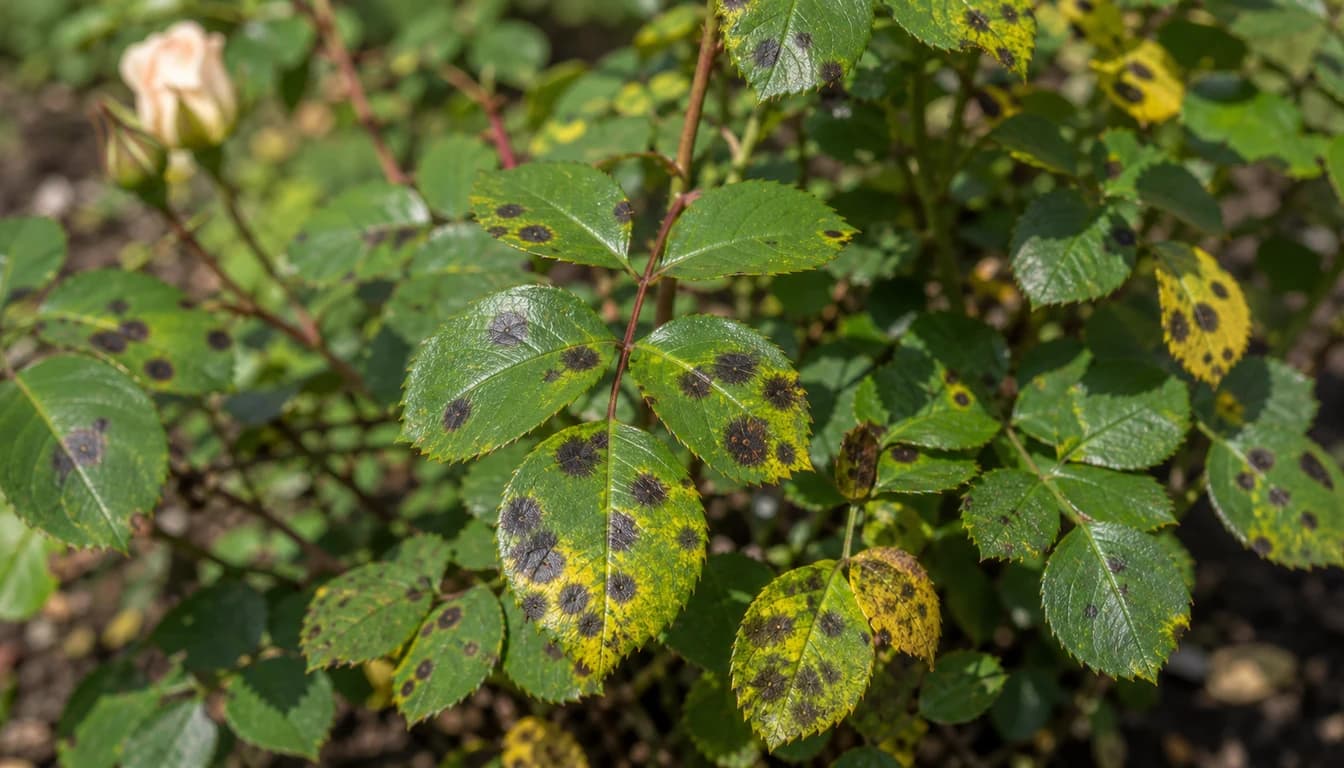
1. Primary cause: Diplocarpon rosae (fungal infection)
Likelihood: HighDiplocarpon rosae is a specialized fungus that infects Rose leaves, forming disk-like black to purple spots that later produce spores. The pathogen spreads via water splash, wind-driven rain, and contaminated tools or fallen leaves.
Identification
- remove_circle_outlineRound to irregular black or purple spots on upper leaf surfaces, often with scalloped or fringed edges.
- remove_circle_outlineYellowing (chlorosis) of leaf tissue surrounding spots, accelerating to leaf drop.
- remove_circle_outlineSpots on canes and petioles in severe infections; fruiting structures (tiny black dots) may be visible with a hand lens.
- remove_circle_outlineSymptoms start on lower, older leaves and progress upward during a single season.
The Fix
- 1Remove and dispose of all heavily infected leaves and canes; do not compost fresh infected material-bag and trash instead.
- 2Rake or lift fallen leaves and destroy them to reduce the overwintering spore load.
- 3If infection is active in-season, apply a labeled fungicide (see product guidance below) on a 7-14 day schedule while leaves are wet and during high humidity.
- 4Sterilize pruning tools between cuts with 70% isopropyl alcohol or a 10% bleach solution to avoid spreading spores.
- 5Combine fungicide use with cultural controls (below) rather than relying on chemicals alone.