
How Do You Treat Powdery Mildew on Black-Eyed Susan?
Powdery mildew on Black-Eyed Susan forms expanding white-gray colonies on living leaves, stems, or buds. Confirm the surface pattern, map how much healthy foliage remains, remove only the worst tissue, and protect clean growth when early treatment is justified.

Quick diagnosis
Powdery mildew growing on the leaf surface
Look for white to gray powdery patches or felt-like mats spreading on living Rudbeckia tissue.
A few late-season patches are usually cosmetic, while early spread onto young leaves or buds deserves closer management.
Open the full diagnosisWhat You Are Seeing
Powdery mildew is a group of host-associated fungi that grow largely across the plant surface while feeding on the living cells beneath. The coating can look like flour, baby powder, or a thin cobweb, and it turns up above and below leaves, on stems, and around buds.
Free water on the leaf is not required for infection.
Cool humid nights favor the spores while warm dry days move them on the air, so an outbreak advances during weather that never leaves the foliage visibly wet.
An established Black-Eyed Susan usually survives a moderate outbreak. The real decision is whether the disease is only spoiling appearance late in the season, or is distorting young tissue, suppressing flowering, and spreading early enough to cost the plant useful leaf area.
Do not strip every marked leaf, and do not keep spraying until the old colonies disappear.
Heavy removal cuts photosynthesis, and fungicides protect healthy tissue far more reliably than they erase an existing white mat.
Common Causes
01 High likelihood
Powdery mildew
The active colony starts as white-gray spots and expands into powdery or felt-like growth on firm living tissue.
Heavy infection yellows leaves, distorts young growth, cuts flowering, and produces tiny round orange-to-black resting structures inside the mat late in the season.
How to identify it
- White-gray colonies expand rather than staying as loose surface dust.
- Growth appears on leaves, stems, shoot tips, or flower buds.
- Young infected leaves may curl or twist as they open.
- Tiny dark round bodies may become visible in older white patches.
What to do
- Map the outbreak before cutting or spraying.
- Remove a limited number of heavily coated leaves when useful canopy remains.
- Increase light and air movement through the clump.
- Avoid excess nitrogen that produces lush susceptible growth.
- Use a labeled protectant only when timing, plant value, and disease history justify it.
02 Common lookalike
Septoria or another leaf spot
Black-Eyed Susan commonly picks up fungal or bacterial leaf spots that begin as separate brown, purple, or black lesions. Yellow tissue can merge around a severe spot, but it never builds the even surface colony powdery mildew makes.
How to identify it
- Discrete round or angular lesions remain visible within the damaged area.
- Dark spots begin on lower leaves and may merge as leaves yellow.
- No white-gray felt-like mat spreads across firm green tissue.
- Fallen leaves carry the same lesion pattern.
What to do
- Use the separate leaf-spot diagnosis when lesions dominate.
- Remove badly spotted fallen debris at seasonal cleanup.
- Water the root zone when practical to reduce splash-driven leaf diseases.
- Do not apply a powdery-mildew product to an unconfirmed lesion disease.
03 Weather and pattern dependent
Downy mildew
Downy mildew is a fungus-like disease that produces pale or whitish growth beneath Rudbeckia leaves.
That lower-surface growth lines up with yellow, angular, oily-looking discoloration on top, and cool damp conditions favor it.
How to identify it
- White-gray growth is concentrated on the underside.
- Upper lesions look yellow, angular, or bounded by veins.
- Symptoms advance during cool wet weather.
- The upper surface lacks the typical powdery colony.
What to do
- Compare both leaf surfaces before treating.
- Reduce prolonged leaf wetness and crowding for this wet-weather disease.
- Remove affected debris and seek a local diagnosis when it spreads rapidly.
- Select only a product labeled for downy mildew if chemical control is warranted.
04 Hot dry conditions
Spider-mite feeding and webbing
Mites empty individual cells, leaving pinpoints that merge into bronzing. Their fine webbing looks dusty from a distance, but a hand lens shows threads, eggs, and moving mites rather than fungal powder.
How to identify it
- Leaves show fine pale stippling before broader discoloration.
- Delicate threads span veins, petioles, or leaf edges.
- Tiny mites or eggs appear under magnification.
- White material does not form a felt-like colony on the surface.
What to do
- Inspect leaf undersides and tap foliage over white paper.
- Confirm live mites before applying any treatment.
- Rinse dusty foliage when it can dry promptly.
- Follow a labeled mite treatment and monitor new leaves for clean growth.
05 Exposure dependent
Pollen, dust, or spray residue
Loose material settles unevenly on rough Rudbeckia leaves.
Residue wipes away, but wiping is not a complete test on its own, because some superficial fungal growth also smears or partly lifts.
How to identify it
- Material appeared immediately after nearby work, dust, pollen shed, or spraying.
- The same film coats unrelated objects or several plant species.
- Clean tissue remains clean instead of developing expanding patches.
- No distortion, embedded mat, or dark resting bodies follow.
What to do
- Compare affected foliage with nearby hard surfaces and unrelated leaves.
- Rinse one marked leaf gently and observe whether the pattern returns.
- Review recent sprays before assuming a disease.
- Treat only if the coating begins behaving like a living expanding colony.
06 Wet decay dependent
Gray mold on dying flowers or wet tissue
Botrytis gray mold grows as fuzzy gray-brown spores on faded flowers, wounds, and wet dying tissue.
Powdery mildew is drier and whiter and sits on firm living surfaces, while gray mold turns up with brown, collapsed, or rotting material.
How to identify it
- Fuzzy growth begins on dead petals or brown wet tissue.
- Infected flowers or leaves collapse and decay.
- Weather has been persistently wet or humid.
- Healthy firm green leaves lack expanding white colonies.
What to do
- Remove fading infected flowers and decaying tissue.
- Increase spacing so rain and irrigation dry promptly.
- Avoid handling wet plants when spores are active.
- Keep gray-mold debris separate from healthy cuttings or flowers.
07 Risk factor
A crowded shaded canopy that favors infection
Dense stems, neighboring plants, fences, and overhead shade cut the light and the air movement around the inner leaves. That pocket stays humid overnight, which lets powdery mildew establish even though the leaf surface never needs to be wet.
How to identify it
- The first colonies occur on inner, lower, or shaded foliage.
- Outer sunny leaves stay cleaner longer.
- Stems press against neighboring plants and airflow is limited.
- The outbreak repeats in the same section of the bed.
What to do
- Thin a few crossing or heavily infected stems without opening a bare crown.
- Move or divide crowded neighbors during the suitable season.
- Restore available sun where taller plants create avoidable shade.
- Use mature plant width when planning replacement spacing.
08 Management dependent
Excess nitrogen producing susceptible growth
Heavy nitrogen pushes fast soft green growth, and powdery mildew infects it readily.
The plant looks lush right before the disease appears, and more fertilizer afterwards does nothing to rebuild a coated leaf.
How to identify it
- New shoots are unusually long, soft, and dark green.
- Disease concentrates on recent lush growth.
- High-nitrogen fertilizer or repeated feeding preceded the outbreak.
- Soil moisture and light support excessive vegetative growth.
What to do
- Stop routine feeding while infection is active.
- Base future fertilizer on a soil test and plant performance.
- Avoid high-nitrogen lawn fertilizer drifting into the perennial bed.
- Let clean mature growth replace soft infected tissue naturally.
Why Does Powdery Mildew Grow on Dry Leaves?
Powdery mildew is unlike most leaf-spot fungi, because it does not need rain, dew, or irrigation sitting on the leaf to start an infection.
Humid air around the canopy supplies everything it needs while the surface looks dry.
Warm dry daytime weather then carries the spores on air currents. That cycle is why shade, dense growth, and cool humid nights matter more to the diagnosis than whether a sprinkler once touched the plant.
Root-zone watering is still worth doing, because it delivers water efficiently and avoids encouraging the splash-driven diseases.
It is not a cure for colonies already growing on a leaf.
The white mat is the result of an infection, not a stain waiting to be washed off. Management protects the foliage that still works, changes the canopy conditions, and cuts the sources that feed the next outbreak.
How Can You Confirm It Is Powdery Mildew?
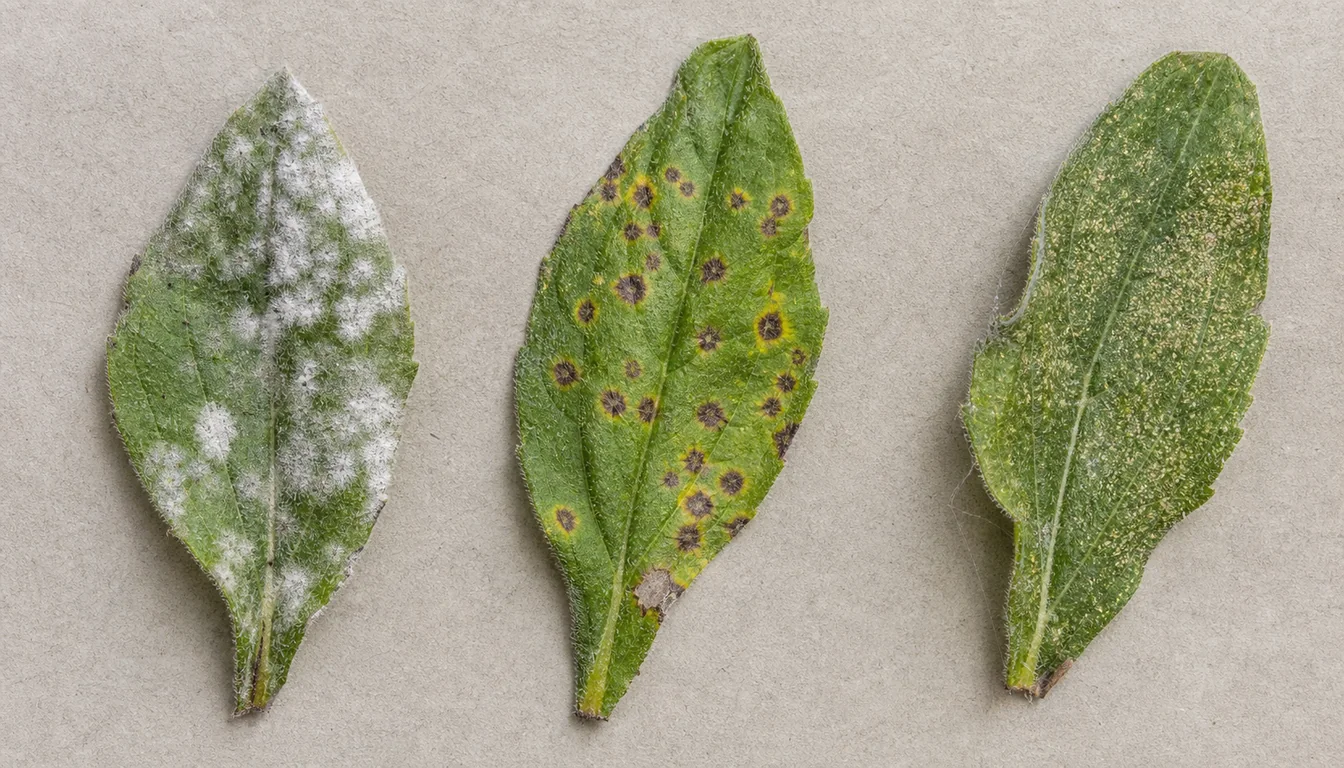
Choose newly affected leaves as well as older white ones, then examine both surfaces with bright side lighting. Look for the edge of an expanding patch, young distorted tissue, and any tiny dark bodies embedded in an older colony.
Rub one small area with a damp white cloth but do not let the wipe decide the diagnosis alone. Loose dust transfers cleanly, while mildew may smear yet leave an attached uneven patch that continues expanding on later checks.
Use a hand lens when the surface is stippled or threaded. Moving mites, eggs, and isolated web strands direct treatment away from fungi, while discrete dark lesions route the plant to the leaf-spot diagnosis.
Flip leaves with pale upper discoloration. Whitish growth limited below and aligned with angular yellow areas above deserves downy-mildew consideration, particularly after cool wet weather.
Powdery mildew
- White-gray surface colonies
- May distort young leaves
- Can spread in dry weather
Leaf spot
- Discrete dark lesions
- Yellow halos may merge
- No broad fungal mat
Spider mites
- Fine pale stippling
- Delicate web threads
- Mites visible with lens
Downy mildew
- Growth mainly below
- Angular yellow areas above
- Favors cool wet weather
When Does Powdery Mildew Need Treatment?

Walk around the entire clump and look from below as well as above. Note whether colonies remain on a few old inner leaves or are reaching new shoots, buds, and the outer photosynthetic canopy.
Mild late-season disease can be tolerated when growth and flowering remain intact. Removing many green leaves for appearance may reduce the plant's energy more than the remaining mildew does.
Early recurring infection on young growth carries more weight because the plant still needs those leaves and buds. A high-value planting with a history of severe early disease is the strongest case for preventive planning and timely protection.
When most leaves are already coated, reset expectations. A spray will not restore their green surface, so preserve whatever clean tissue remains and plan sanitation, spacing, or resistant replacement for the next cycle.
Should You Cut Back an Infected Black-Eyed Susan?

Start with heavily coated basal leaves, collapsed tissue, and a few congested stems that contribute little light capture. Retain firm green stems, flowers, and lightly affected leaves when their removal would leave a thin or unstable plant.
Cut at a natural leaf or stem junction with clean tools and collect material directly. Pause after each small group of cuts so you can see whether light and air now reach the crown.
Do not scalp the clump during summer or remove every marked surface. If infection is already widespread, the safer action may be to tolerate it until normal seasonal cleanup rather than forcing weak regrowth.
At the end of the season, remove clearly diseased foliage from the bed. Municipal yard waste or trash is safer when a home compost pile cannot sustain pathogen-killing temperatures throughout all material.
- Select heavily coated low-value tissue first.
- Make a few clean cuts at natural junctions.
- Collect debris without shaking it through the clump.
- Stop when the crown is open but the useful canopy remains.
When Should You Spray Powdery Mildew on Rudbeckia?
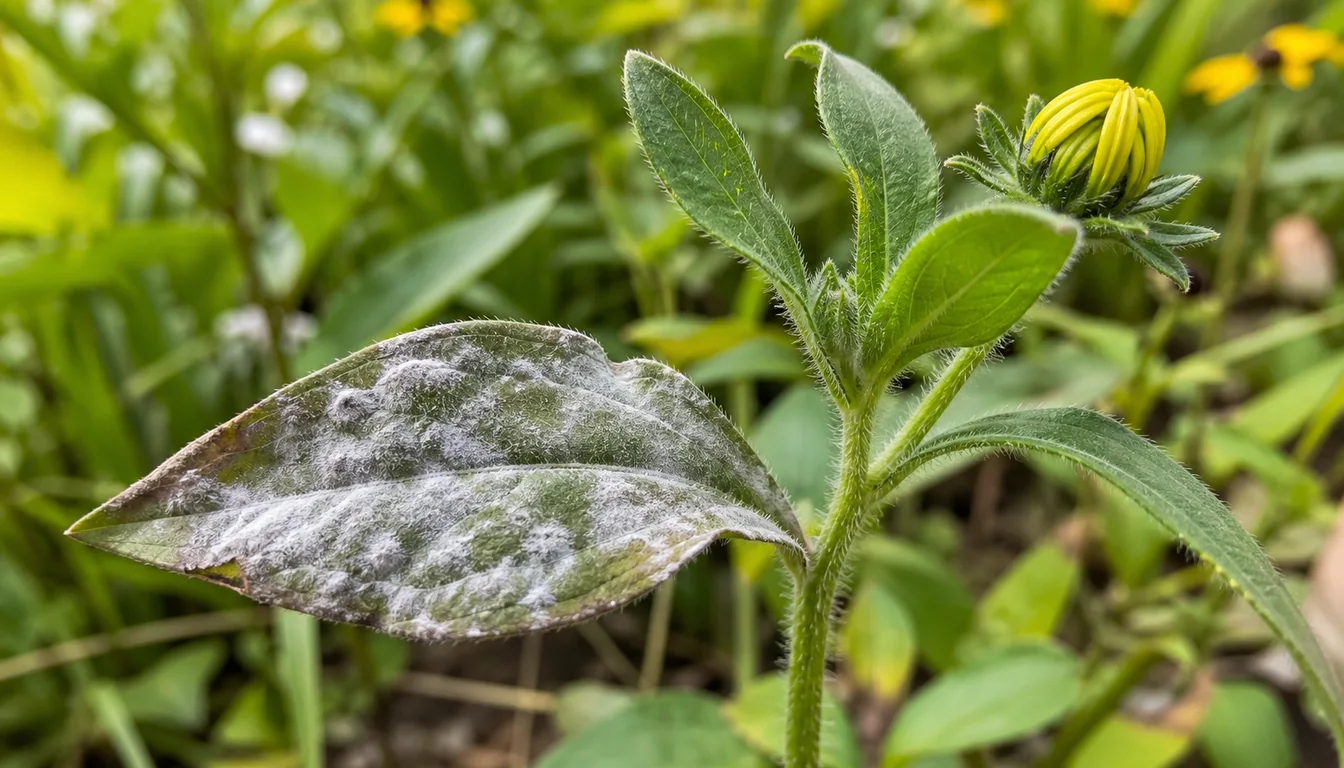
Reserve fungicide for a valued plant with repeated damaging disease, especially when monitoring catches the first colony early. The goal is to protect the clean leaves and buds, not to bleach old colonies from infected foliage.
Choose only a product labeled for powdery mildew on the intended ornamental site and follow every mixing, interval, temperature, and pollinator direction. Horticultural oils can injure stressed plants or foliage under unsuitable heat, so the label conditions matter as much as the ingredient.
Coverage must reach the tissue the label directs, and repeated applications may be required for protection. Avoid improvised mixtures and incompatible tank combinations that can burn Rudbeckia without improving control.
Photograph the next leaves and buds rather than repeatedly judging the old white leaf. Clean new tissue shows that protection and canopy changes are working, while fresh colonies mean the plan or timing needs review.
Recovery Plan
Confirm and map
Examine both leaf surfaces, rule out lesions and mites, and record whether the mildew is confined to old inner leaves or has reached young growth and buds.
Watch clean tissue
After limited sanitation or an early labeled protectant, judge whether the new leaves stay clean.
The existing white patches may persist even once the spread has stopped.
Protect the canopy
Keep water going in at the roots, keep nitrogen down, and tolerate a stable late-season cosmetic infection when stronger intervention would cost useful foliage.
Reset the bed
Remove diseased debris, correct crowding and shade where you can, and choose resistant Rudbeckia selections when early outbreaks keep repeating.
Reduce repeat powdery mildew by planting Black-Eyed Susan in strong light with room for mature air movement, thinning congested stems, avoiding excess nitrogen, and removing clearly diseased end-of-season debris. Root-zone watering supports the plant and limits other leaf diseases, but powdery mildew prevention still depends on humidity, canopy structure, host susceptibility, and early monitoring.
Sources
- Powdery Mildew in the Flower Garden, University of Minnesota Extension
- Powdery Mildew Disease on Flowers, University of Maryland Extension
- Perennials, Selection, Planting, and Care, University of Maryland Extension
- Black-Eyed Susan, Beautiful and Beneficial, Penn State Extension
- Downy Mildew, Penn State Extension