
How to Diagnose Leaf Spot on Black-Eyed Susan
Dark spots on Black-Eyed Susan often come from Septoria leaf spot, but angular bacterial lesions and four-lined plant bug feeding can look similar.
Lesion shape, vein boundaries, canopy position, and recent weather tell you which response is safest.
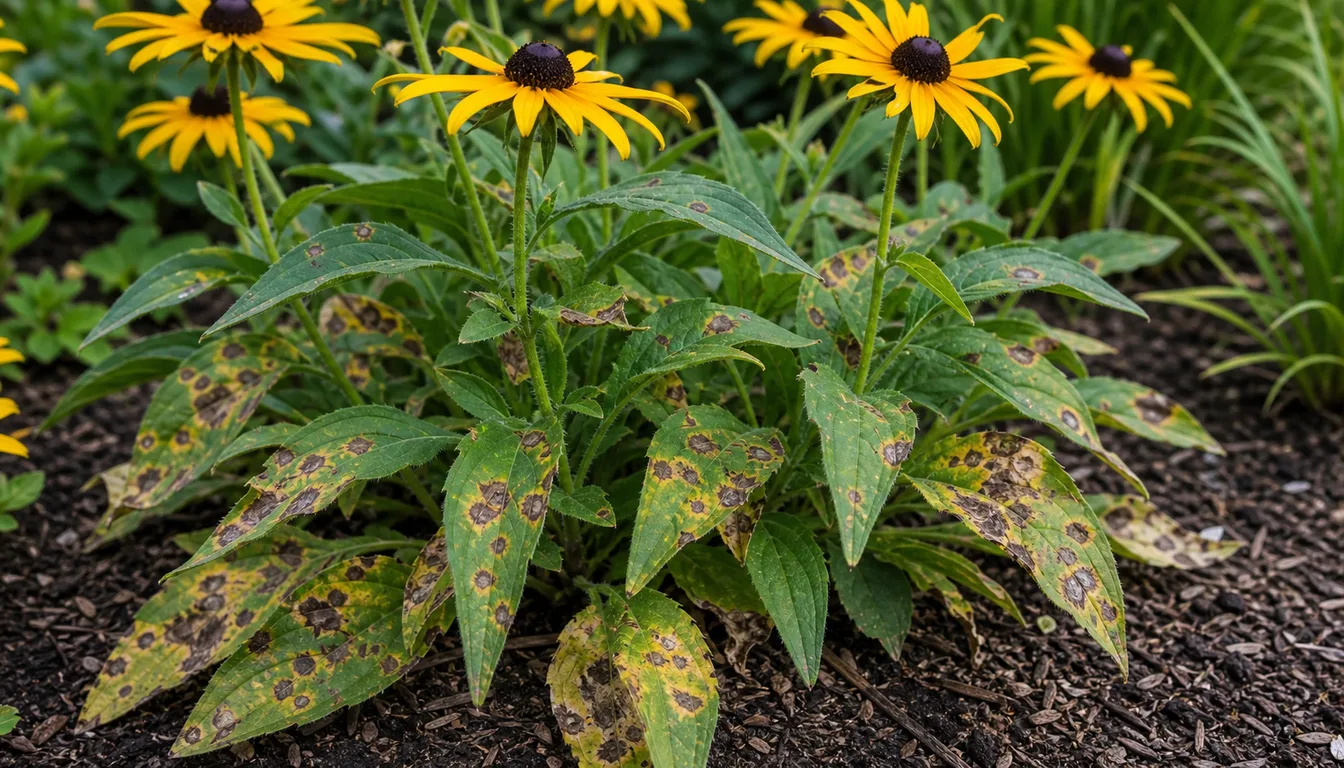
Quick diagnosis
Septoria leaf spot when dark lesions begin low and move upward
Irregular purplish-brown to black spots on lower leaves, sometimes with gray centers or one straight edge along a vein, fit Septoria. Spots confined between small veins suggest bacterial angular leaf spot, while white surface growth points to powdery mildew.
Open the full diagnosisWhat You Are Seeing
Start with a fresh lesion, not the oldest blackened leaf. Old spots merge, dry, and tear, which erases the shapes that help separate fungal infection, bacterial infection, and insect feeding.
Then look at the whole clump. A splash-driven disease commonly begins on crowded lower leaves and advances upward after rain or overhead irrigation, while isolated feeding marks may appear on otherwise clean foliage.
A spotted plant can keep flowering because leaf spot is often more cosmetic than lethal. The response should protect remaining green leaf area rather than strip the clump in pursuit of perfect foliage.
Do not choose a spray from color alone. A fungicide aimed at Septoria does not solve bacterial leaf spot or insect feeding, and no product turns existing dead tissue green again.
Common Causes
01 High likelihood
Septoria leaf spot
Septoria rudbeckiae is a characteristic fungal leaf spot of Rudbeckia. Long periods of leaf wetness support infection, and splashing rain or irrigation moves spores from infected debris and lower leaves into newer parts of the clump.
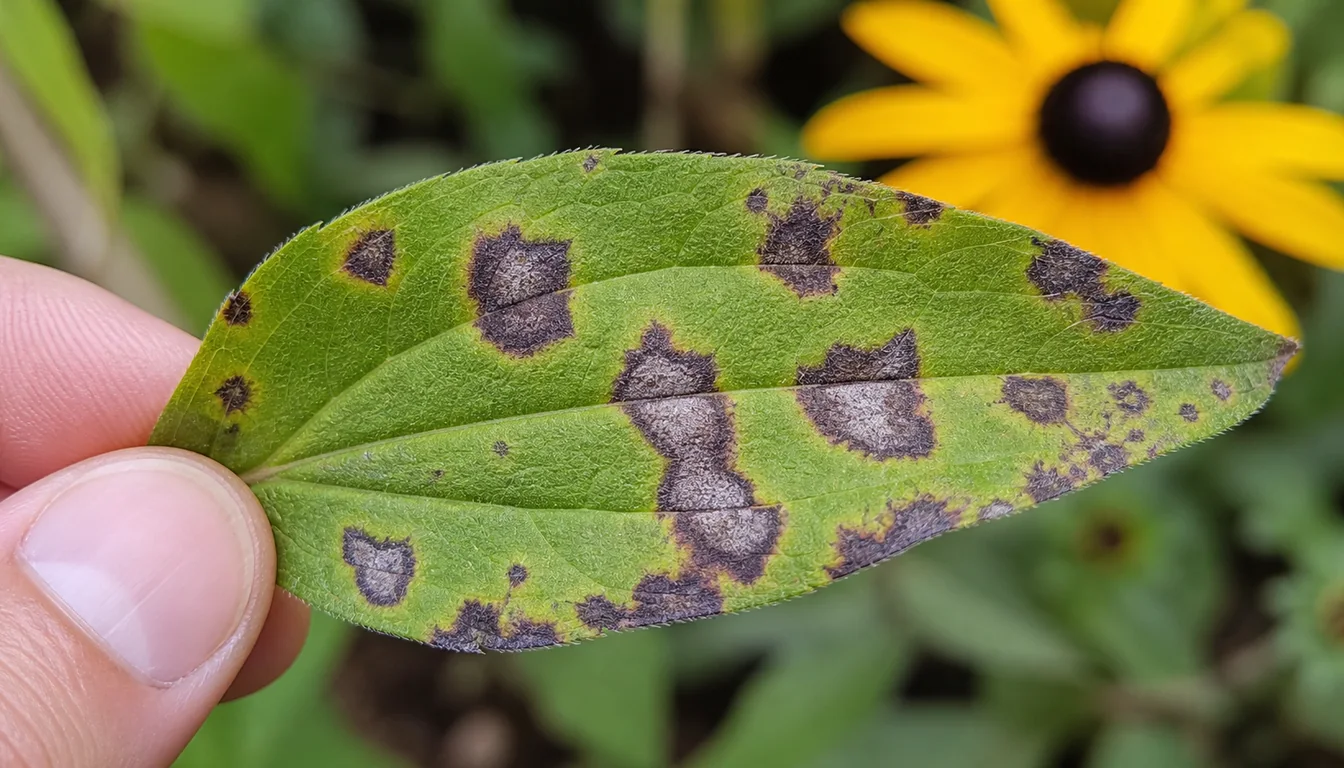
How to identify it
- Small dark lesions appear first on lower or inner leaves.
- Spots are irregular and purplish-brown to black rather than coated with white growth.
- A mature lesion may develop a gray center or a flat edge where a vein stopped its expansion.
- Multiple spots merge, leaving a leaf black, dry, and tattered during wet weather.
What to do
- Remove the most heavily infected leaves while the foliage is dry.
- Collect fallen spotted leaves instead of leaving them below the crown.
- Water the soil without splashing lower foliage.
- Thin crowding around the clump so rain and dew dry sooner.
- Judge progress by the rate of new lesions because old spots remain visible.
02 Important lookalike
Bacterial angular leaf spot
Pseudomonas and Xanthomonas bacteria can spot Rudbeckia foliage. Small veins frequently stop the lesion, creating a sharper angular outline than the irregular rounded areas associated with common fungal leaf spots.
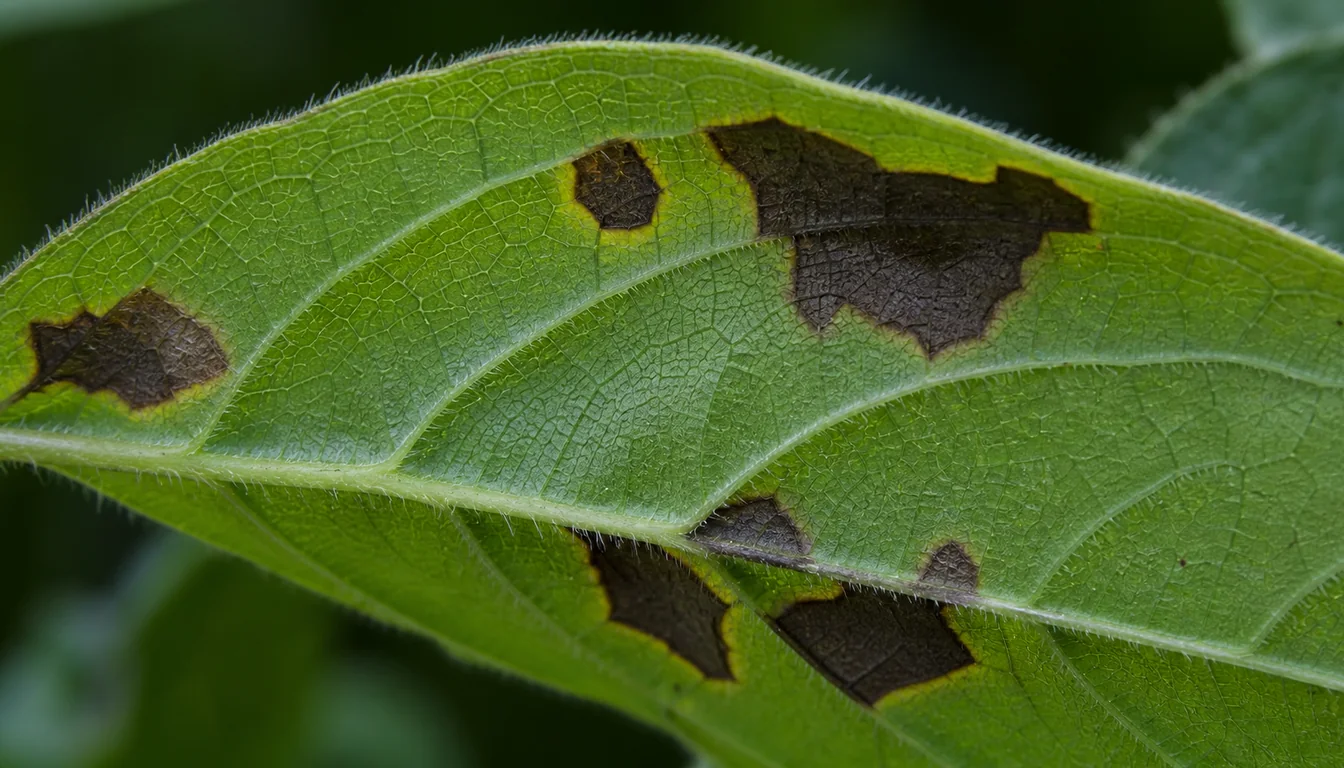
How to identify it
- Dark lesions have straight sides that follow the small vein network.
- Fresh areas may look water-soaked before turning brown or black.
- Some spots develop a narrow yellow halo or tear through at the dry center.
- The cultivar Goldsturm can suffer angular leaf spot along with Septoria.
What to do
- Avoid handling or cutting plants while leaves are wet.
- Remove badly affected leaves with clean tools and disinfect the blades between clumps.
- Stop overhead irrigation and reduce long periods of leaf wetness.
- Use a plant clinic when rapid spread makes a pesticide decision necessary.
- Do not assume a general fungicide controls a bacterial target.
03 Seasonal lookalike
Four-lined plant bug feeding
Four-lined plant bugs puncture leaf cells and leave round, brown, sunken spots that gardeners often mistake for disease. Injury can appear quickly while nymphs or adults are active and does not follow the same lower-to-upper splash pattern as Septoria.
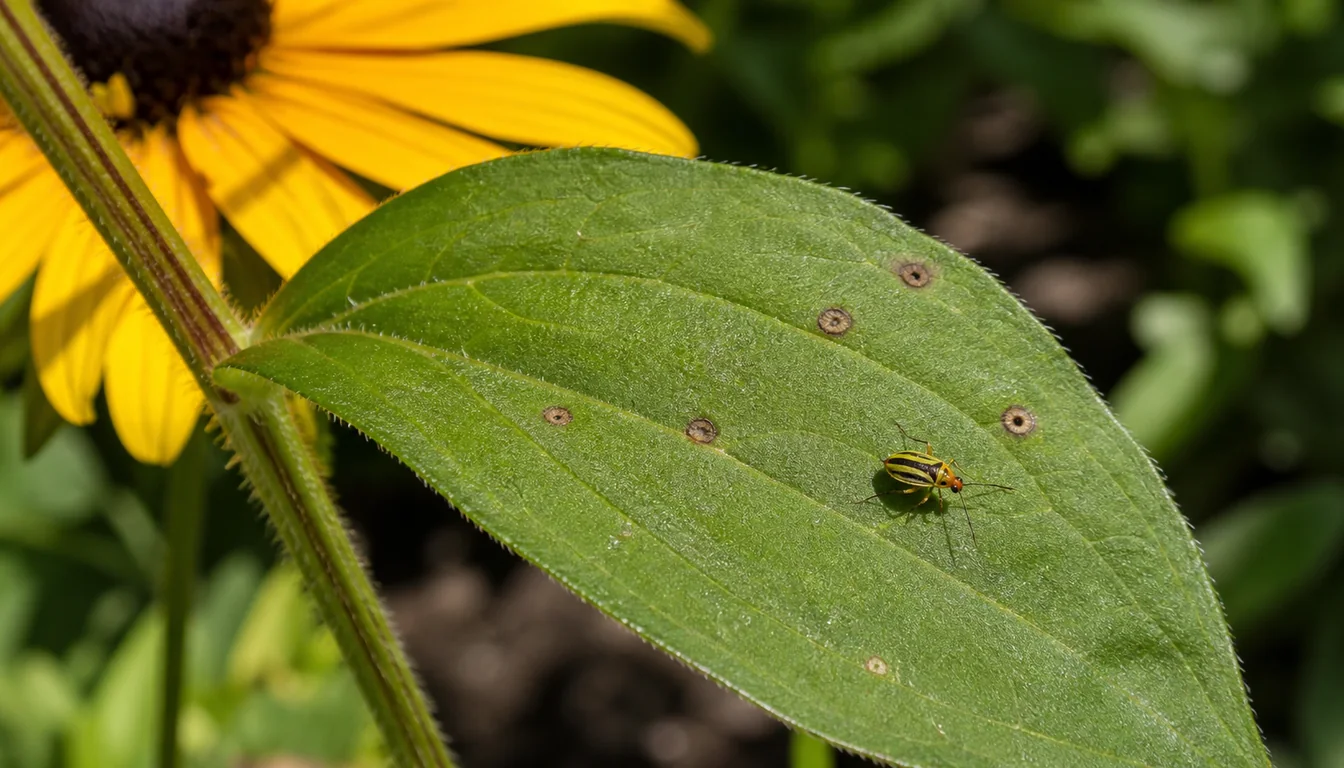
How to identify it
- Marks are discrete, round, and slightly sunken rather than gradually expanding blotches.
- Fresh feeding spots appear on leaves that otherwise look clean and firm.
- Small yellow-green nymphs or yellow-and-black striped adults are present near the damage.
- The marks stop increasing after the short feeding period ends.
What to do
- Inspect the underside and nearby stems early in the day for active insects.
- Knock a small population into soapy water or remove affected shoot tips by hand.
- Protect beneficial insects by avoiding a broad spray after the bugs have disappeared.
- Monitor new leaves before treating old feeding scars as an active disease.
04 Weather dependent
Downy mildew
Downy mildew on Rudbeckia can begin as pale yellow mottling that resembles early leaf discoloration. The decisive evidence is often on the underside, where gray to purplish downy growth may develop during cool, humid conditions.
How to identify it
- Upper leaf surfaces show pale yellow or mottled areas rather than isolated dark circles.
- Corresponding gray-purple growth appears below the leaf during humid weather.
- Young leaves may distort when infection is severe.
- The pattern does not look like loose white powder spread across the upper surface.
What to do
- Check the underside of fresh affected leaves early in the morning.
- Remove heavily affected foliage during dry conditions.
- Increase spacing and keep irrigation off the canopy.
- Submit a sample when symptoms spread quickly because downy mildew requires a different target than Septoria.
05 Easy to separate
Powdery mildew rather than leaf spot
Powdery mildew produces superficial white or gray fungal growth on leaves, stems, and sometimes flowers. Dark pinpoints can develop within an older white coating, but the visible powder distinguishes it from the dead dark lesions covered here.
How to identify it
- White or gray growth lies across the leaf surface.
- The coating can begin in patches and expand over healthy green tissue.
- Leaves may curl or yellow beneath a heavy infection.
- Dark spots appear inside an established powdery patch rather than as the first symptom.
What to do
- Use the powdery mildew diagnosis instead of treating the coating as Septoria.
- Improve light and air movement through crowded foliage.
- Remove only badly affected leaves so the plant retains enough green area.
- Choose any treatment according to the powdery mildew label and timing.
06 Pattern dependent
Spray scorch or sun-linked injury
A foliar product applied in heat or at the wrong concentration can kill exposed patches of leaf tissue. This noninfectious injury appears after one event and stays aligned with sprayed or sun-facing surfaces instead of spreading through wet lower foliage.
How to identify it
- Damage appears within days of a foliar spray or fertilizer application.
- Leaves on the exposed side show a similar pattern at the same time.
- New lesions do not continue appearing after the event ends.
- No fungal growth, bacterial ooze, active insects, or lower-to-upper progression is present.
What to do
- Stop the suspected product and keep its label for review.
- Rinse foliage promptly only when the application has just occurred and the label allows it.
- Protect healthy leaf area from further stress while new growth develops.
- Test any future spray on a small section and avoid applying it during high heat.
A spot records damage but not always active spread
Leaf tissue inside a brown or black lesion is dead and will not regain its green color.
Recovery means that new lesions slow, upper leaves remain functional, and the clump continues to flower and store energy.
The newest edge of the problem gives the best evidence.
A fresh irregular lesion low in a wet clump supports Septoria, a vein-bounded water-soaked lesion raises bacterial concern, and a round sunken mark beside an insect supports feeding injury.
Weather history strengthens the pattern but cannot name a pathogen by itself.
Repeated rain, long dew periods, and overhead irrigation make splash-driven diseases more likely because foliage stays wet and droplets move inoculum upward.
A laboratory diagnosis becomes useful when new growth is being lost quickly or when a treatment choice depends on a fungal versus bacterial target. That distinction matters more than finding a perfect name for a few old cosmetic spots.
Inspect both sides of one fresh lesion
Choose a leaf with one or two new lesions near the advancing edge of the problem. Let wet foliage dry before handling it so your fingers and tools do not move bacteria or spores between leaves.
Use a hand lens in bright indirect light. Note whether the border is irregular or sharply vein-bounded, whether the center is gray or water-soaked, and whether any growth lies on top of or below the leaf.
Turn the leaf over before making a decision. Gray-purple downy growth below a pale upper patch changes the diagnosis, while loose white surface growth directs you to powdery mildew rather than dark leaf spot.
A photo of both surfaces beside an intact fresh leaf is more useful to a plant clinic than a bag of collapsed black tissue. Include the cultivar, recent weather, irrigation method, and the direction in which symptoms moved.
- Select a fresh lesion at the active edge of the symptoms.
- Record its shape, margin, center, and relationship to veins.
- Check both leaf surfaces for powder, downy growth, insects, or residue.
- Photograph the leaf and whole-clump pattern before removing tissue.
Map the clump from the soil upward
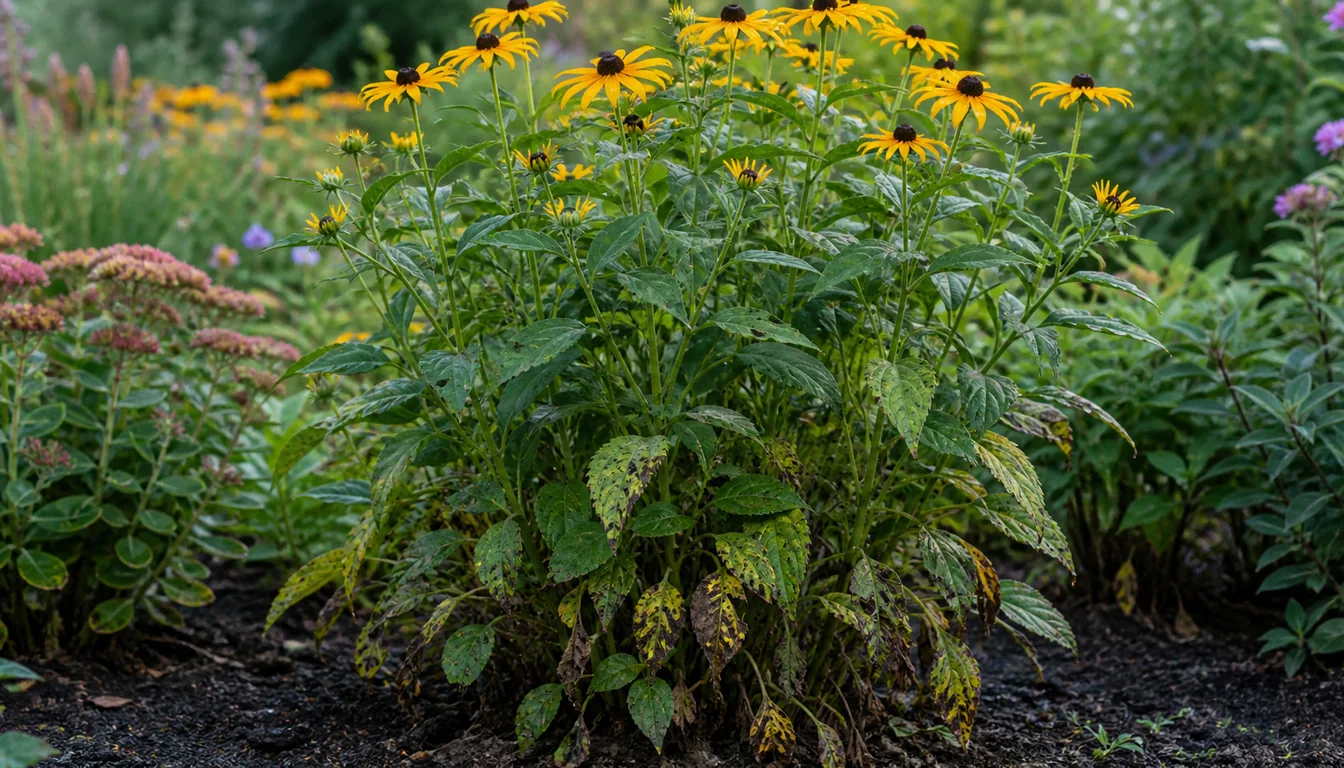
Crouch low enough to see the crown, inner stems, and outer leaves. Mark where the oldest damage sits, where fresh lesions appear, and whether the flowering top remains clean.
Septoria commonly creates a vertical gradient because infected debris and lower leaves supply spores that splash upward. Dense interior foliage stays wet longer, so the center can look worse than the airy edge of the same clump.
Compare the map with recent events. A rise in fresh lesions after several rainy days or overhead watering shows active spread, while unchanged scars followed by clean leaves show that the damaging event has passed.
Check neighboring Black-Eyed Susan clumps at the same height. A pattern shared along an irrigation path supports moisture-driven spread, while marks confined to one sprayed face support a noninfectious injury.
Match the response to lost leaf area
Leave a few old spots alone when flowers are opening and most foliage remains green. Removing every marked leaf can cost the plant more photosynthetic area than a light infection would have taken.
When fresh lesions are climbing, remove the worst lower leaves during dry weather and clear fallen debris. Do not remove more than about one third of the foliage at one time, because the remaining green leaves still support roots and bloom.
A pesticide decision needs a confirmed target and a product labeled for the plant and disease. Protectants work best before or early in infection, they do not erase old lesions, and a standard fungicide may miss a bacterial problem.
Seek local diagnosis when the crown is collapsing, new leaves blacken rapidly, several clumps fail together, or the result will determine whether you spray a valued planting. Those patterns justify evidence beyond a visual guess.
A few old spots
- Keep useful green leaves
- Water below the canopy
- Watch the newest growth
Fresh spots rising
- Remove the worst lower leaves
- Shorten leaf-wetness time
- Photograph the active edge
Rapid or repeated loss
- Confirm fungal or bacterial target
- Check crown and whole bed
- Use only a labeled response
Reduce the first splash next season
Remove heavily diseased foliage after it stops serving the plant, and clear infected material that falls around the crown. Debris left beneath new shoots can carry a leaf-spot problem into another wet season.
Before spring growth closes the canopy, divide congested clumps or move nearby plants that press against them. Keep enough space for lower leaves to dry after rain without opening the bed so aggressively that soil splash increases.
Deliver irrigation at soil level and early enough that any accidental wetting dries quickly. A light mulch can intercept splash, but it should not bury Black-Eyed Susan crowns or hold wet foliage against the soil.
A recurring Goldsturm planting may remain susceptible even after good sanitation. When replacement is already needed, choose a locally suitable Rudbeckia cultivar described as leaf-spot resistant rather than repeating the same vulnerable material.
Recovery Plan
Remove the disease reservoir selectively
Clip the most heavily spotted lower leaves, collect fallen debris, and keep irrigation off the foliage.
Preserve clean leaves and flowers so the clump can continue feeding its roots.
Watch the active edge
Old lesions will stay dark. Look for fewer fresh spots on middle and upper leaves, shorter wet periods, and no new damage on neighboring clumps.
Protect green leaf area
Continue base watering and limited sanitation only when new lesions appear. A flowering clump with stable upper foliage is functioning even if its oldest leaves remain scarred.
Change the starting conditions
Remove infected carryover, reopen crowded spacing, redirect sprinklers, and consider a resistant cultivar where severe spotting returns every year.
Reduce leaf spot on Black-Eyed Susan by shortening leaf-wetness time, watering at soil level, removing infected debris, and preserving air movement through the lower canopy. Diagnose the lesion pattern before using a pesticide because fungal disease, bacterial disease, and insect feeding require different targets.
Sources
- Black Eyed Susan Spots on Leaves, University of Minnesota Extension
- Black-Eyed Susan Beautiful and Beneficial, Penn State Extension
- Bacterial Leaf Spot, University of Illinois Extension
- Rudbeckia hirta Blackeyed Susan, University of Florida IFAS Extension
- Managing Plant Diseases in the Home Garden, University of Minnesota Extension
- Diseases of Rudbeckia, University of Maryland Extension
- Rudbeckia Leaf Spots, University of Illinois Extension