yard
KnowTheYard

databasePlant Database

Browse by category

potted_plant

Houseplants

Indoor & tropical species

nutrition

Vegetables

Edible garden crops

spa

Herbs

Culinary & medicinal

local_florist

Flowers

Ornamental blooms

water_drop

Succulents

Drought-tolerant species

park

Trees

Arboreal species

forest

Shrubs

Bushes & hedges

nature

Perennials

Garden flowers

grass

Lawn Grasses

Turf varieties

local_dining

Fruits

Fruit-bearing plants

Best Indoor Plantsarrow_forwardBest Shade Plantsarrow_forward

menu_bookGarden Guides

Step-by-step guides by task type

grass

Lawn Care

Seasonal checklists and year-round maintenance guides for a championship lawn.

yard

Planting

When, where, and how to plant — from seed to transplant for every garden type.

water_drop

Watering

Deep-watering techniques, schedules by plant type, and drought management.

compost

Fertilizing

Feeding schedules, NPK ratios, and organic vs synthetic options by plant.

pest_control

Pest Control

Identify, prevent, and treat common garden pests without harming beneficial insects.

content_cut

Pruning

Pruning timing, techniques, and tools for trees, shrubs, and flowering plants.

Popular Guides

parkFall Lawn Carelocal_floristSpring Lawn Carecalendar_monthFull Calendar
All Guidesarrow_forwardLawn Care Hubarrow_forward
ToolsCompareRegional GuidesPlant ProblemsPet SafetyAbout
searchPlant Finder
yardKnowTheYard

Published plant profiles, practical care guides, problem diagnosis pages, and side-by-side comparisons for home gardeners.

chatphoto_camera

databaseBrowse Plants

  • arrow_forwardHouseplants
  • arrow_forwardVegetables
  • arrow_forwardHerbs
  • arrow_forwardFlowers
  • arrow_forwardTrees

menu_bookResources

  • arrow_forwardGarden Tools
  • arrow_forwardRegional Guides
  • arrow_forwardPlant Problems
  • arrow_forwardPet Safety
  • arrow_forwardCare Calendar
  • arrow_forwardPlant Finder

infoCompany

  • arrow_forwardAbout Us
  • arrow_forwardOur Team
  • arrow_forwardMethodology
  • arrow_forwardEditorial Policy
  • arrow_forwardContact Us

mailEmail Updates

Join the list for new guides, seasonal notes, and launch updates.

No spam. Request removal anytime.

fact_check

Reviewed Pages

77 pages currently attributed to public review lanes

public

USDA Zone Coverage

Zone-aware recommendations and regional growing context

database

230 Published Plant Profiles

555 public pages across profiles, guides, comparisons, and problem pages

© 2026 KnowTheYard. All rights reserved.

Privacy PolicyTerms of ServiceContactSitemap
Home/shrubs/Arborvitae Privacy Shrub (Thuja occidentalis)/Winter Burn
scienceEditorial DiagnosisUpdated Feb 20, 2026

Arborvitae Winter Burn

Practical guide to diagnosing, treating, and preventing winter burn on **Arborvitae** (Thuja occidentalis). Learn how to tell winter desiccation apart from disease, pests, or nutrient problems, what immediate actions to take, and realistic recovery timelines for evergreen shrubs in ==**Zones 3-11**==.

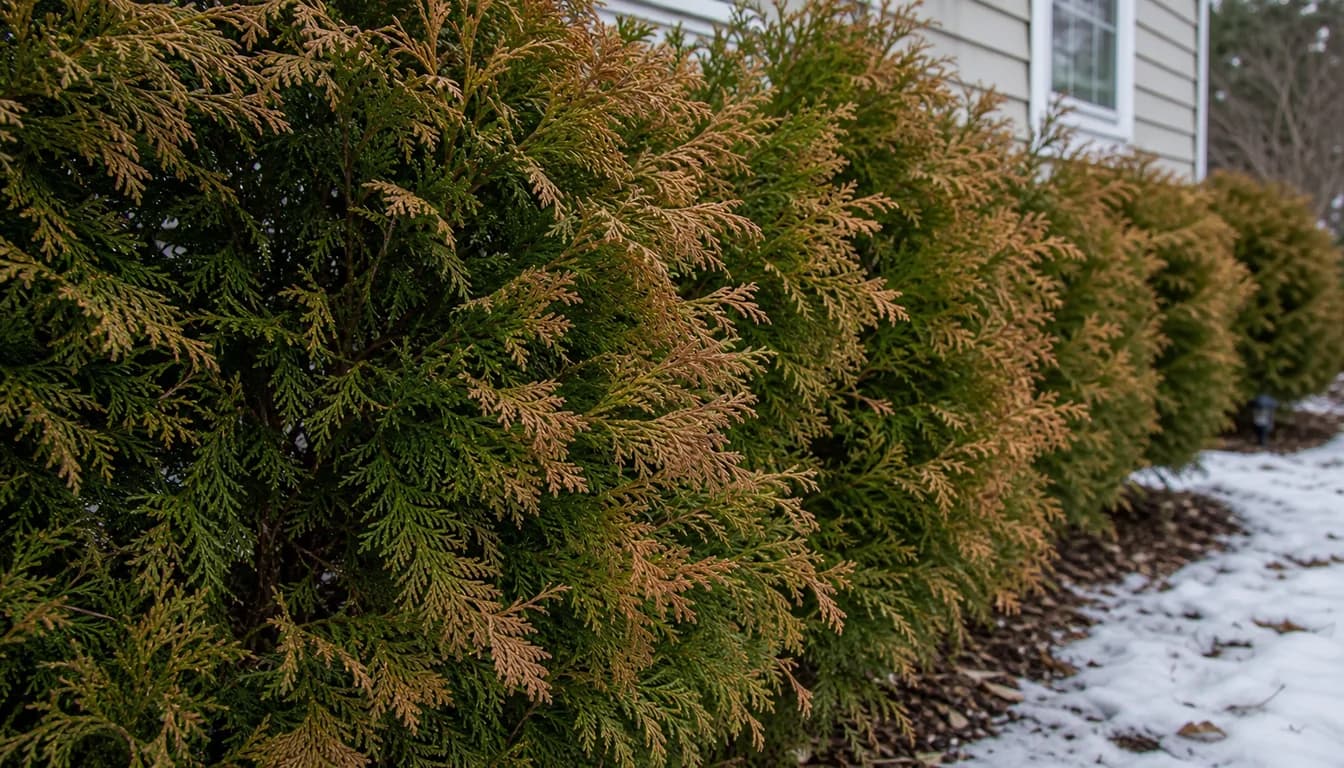
Arborvitae hedge with flat evergreen sprays showing tan-brown winter burn on exposed outer tips while inner foliage stays green beside patches of old snow.

Arborvitae hedge with flat evergreen sprays showing tan-brown winter burn on exposed outer tips while inner foliage stays green beside patches of old snow.

lightbulb
bolt

Quick Diagnosis

Most Likely Cause: Winter burn (desiccation of needles from cold winds and dry air).

Needles turn brown or bronze on south- and west-facing sides or the windward side of the plant after cold, dry spells, a pattern gardeners describe as needle browning patterns rather than isolated spotting. Browning often appears across leaf surfaces rather than in isolated spots and increases during late winter and early spring.

Jump to fix steps arrow_downward

Arborvitae (Thuja occidentalis) are hardy evergreen shrubs used for hedges, screens, and foundation plantings, so basic evergreen shrub care sets the expectation: foliage stays exposed all winter. That year-round foliage is useful, but it also loses water during cold, sunny, windy weather when roots may be locked in frozen soil.

Winter burn is not a fungus. It is a moisture imbalance where exposed sprays lose more water than roots can replace, so the south, west, or windward side turns bronze, tan, or brown first. The pattern usually appears in late winter or early spring as damaged tissue becomes obvious.

Because Arborvitae hedges sit beside houses, drives, and fences, the damage often looks dramatic. Most plants survive mild to moderate burn if you stabilize moisture, wait before pruning, and protect the same exposed side before the next winter.

pest_control
Plant Problem - See AlsoArborvitae Bagworms
chevron_right
psychology

How winter burn affects arborvitae

Winter burn turns sprays brown because dehydration and cold injury break down pigments and tissue. Unlike fungal disease, the discoloration lacks distinct leaf spots, fruiting bodies, or a spreading lesion pattern.

Timing matters. Damage from winter desiccation is most noticeable in late winter and early spring, but pruning too early can remove live tissue that would have recovered once roots warmed.

Assess exposure, soil moisture, salt sources, and recent watering before assuming pests or disease. A hedge with one burned face usually needs moisture and wind protection more than a disease spray.

thermostat

Environmental Baseline

Before diagnosing specific failures, confirm your Arborvitae Privacy Shrub (Thuja occidentalis)'s environment matches its core care requirements.

forestArborvitae Privacy Shrub (Thuja occidentalis) Care Needs

  • Light: ==**full sun to light shade**== (at least **6 hours** sun for dense growth)
  • Water: Moderate, consistent moisture first 2 years
  • Temp: Cold hardy to about -30°F once established

homeTypical Indoor Home

  • Humidity: 30-50% (Low)
  • Temp: 65-72°F variable
  • Light: Often too dim or direct
biotech

Possible Causes

Sorted by likelihood

1. Cold winds and dry winter air

Likelihood: High

Strong, cold winds and low humidity strip moisture from evergreen sprays while roots are cold or frozen. South-facing, west-facing, and exposed hedge ends usually show the worst browning.

Identification

  • remove_circle_outlineBrowning concentrates on windward sides, outer tips, and the top of the shrub rather than random spots.
  • remove_circle_outlineDamage follows cold, dry, sunny, or windy spells in late winter.
  • remove_circle_outlineNearby exposed evergreens show similar scorch patterns.
  • remove_circle_outlineInner foliage remains greener than the outer shell of the hedge.

The Fix

  1. 1Do not shear immediately; wait until spring growth shows which twigs are truly dead.
  2. 2Water deeply during winter thaws when the soil is workable and not frozen solid.
  3. 3Install a burlap screen or temporary windbreak on the exposed side before the next cold season.
  4. 4Use anti-desiccant spray only on labeled plants and only when temperatures match the product directions.

2. Low soil moisture entering winter

Likelihood: Medium

Dry root zones make winter burn worse because the shrub enters cold weather already short on stored moisture. New plantings and shallow-rooted hedges are especially vulnerable.

Identification

  • remove_circle_outlineSoil under the mulch feels dry in late fall or during winter thaws.
  • remove_circle_outlineNewly planted or recently transplanted shrubs show more burn than established neighbors.
  • remove_circle_outlineBrowning is worse on the outside of the canopy, while deeper foliage still has some green.
  • remove_circle_outlineThe site has fast-draining soil, reflected heat, or irrigation that misses the root zone.

The Fix

  1. 1Deep-water the root zone in fall so moisture reaches at least 6-12 inches down.
  2. 2Maintain 2-4 inches of organic mulch, keeping it 2-3 inches away from the trunk.
  3. 3Shift shallow sprinkler habits toward deep watering habits that support roots before winter.
  4. 4Check drip or soaker coverage around the full hedge line, not just the front face.

3. Salt exposure or late nitrogen stress

Likelihood: Low

De-icing salt and late high-nitrogen feeding can mimic or intensify winter burn by damaging roots and pushing soft growth that hardens poorly before cold weather.

Identification

  • remove_circle_outlineBrowning is strongest beside sidewalks, driveways, roads, or salted snow piles.
  • remove_circle_outlineTips look scorched, and spring recovery is weaker than shrubs farther from salt exposure.
  • remove_circle_outlineThe hedge received heavy nitrogen late in summer or fall.
  • remove_circle_outlineDamage appears where snowmelt drains through the planting bed.

The Fix

  1. 1Flush the soil in spring with a slow, deep watering once the ground drains normally.
  2. 2Avoid late-season high-nitrogen fertilizer; feed only if spring growth and soil tests justify it.
  3. 3Use barriers or lower-salt de-icing options near the hedge.
  4. 4Replace repeated salt-stress sections with more tolerant placement or a protective buffer.
compare_arrows
Comparison - See AlsoArborvitae vs Juniper
chevron_right
potted_plant

Root Health Examination

A direct inspection of the root system distinguishes root rot from drought stress - saving weeks of guesswork.

check_circleHealthy Roots

  • Firm to the touch
  • White or light tan color
  • Earthy, pleasant smell

cancelCompromised Roots

  • Mushy or slimy texture
  • Dark brown or black color
  • Sour, rotting odor

Inspection Step: Gently slide the pot off while supporting the base of the stems. The outer root ball gives sufficient clues without disturbing all the soil.

gpp_bad
warning

When to Worry

A few yellow leaves are normal. If more than 20% of foliage turns yellow within a week, or new growth is affected, act immediately - check the roots first.

timeline

Recovery Protocols

Recovery takes time. Once the root cause is corrected, implement a 30-day stabilization window.

0-4 weeksStabilize and wait

Do not heavy-prune. Water deeply in thaw periods and protect the root zone with fresh mulch. Apply anti-desiccant only if damage is expected to continue and follow label rates.

4-12 weeksAssess live wood

As buds swell, scratch-test small branches to find live green cambium. Remove only fully dead twigs and branches to avoid exposing healthy tissue unnecessarily.

12-52 weeksRegrowth and shape restoration

Expect partial visual recovery within one growing season; complete fill-in of denser hedges may take **1-3 years** depending on severity and plant vigor. Supplemental spring fertilization with a balanced slow-release product helps recovery but avoid late-season nitrogen.

menu_book
Guide - See AlsoAir Purifying Plants for Cleaner Indoor Air
chevron_right
shield

Preventing Future Issues

Prevent winter burn by sending Arborvitae into winter hydrated, mulched, and sheltered from prevailing cold winds. Maintain 2-4 inches of organic mulch, water deeply in fall, and use temporary burlap screens on newly planted or exposed hedges. If you are weighing mulch benefits against other soil amendments, mulch is the simpler winter-protection tool. If one exposed face burns every year, compare the site with tougher juniper placement before replacing the hedge. Avoid heavy late-season nitrogen and keep irrigation aimed at the root zone so shrubs recover faster in spring.

menu_book

Related Reads

pest_control
Plant ProblemArborvitae Bagworms
chevron_right
compare_arrows
ComparisonArborvitae vs Juniper
chevron_right
menu_book
GuideAir Purifying Plants for Cleaner Indoor Air
chevron_right
menu_book
GuideBest Herbs to Grow Indoors for Real Harvests, Not Spindly Pots
chevron_right
menu_book
GuideBest Indoor Plants for Every Room and Light Level
chevron_right
Arborvitae Privacy Shrub (Thuja occidentalis) (Thuja occidentalis) - full care guideThuja occidentalis

Arborvitae Privacy Shrub (Thuja occidentalis)

Cupressaceae Family

wb_sunny

Light

==**full sun to light shade**== (at least **6 hours** sun for dense growth)

water_drop

Water

Moderate, consistent moisture first 2 years

thermostat

Temp

Cold hardy to about -30°F once established

yardFull Care Guide

On This Page

boltQuick DiagnosispsychologyUnderstandingthermostatEnvironment CheckbiotechPossible Causespotted_plantRoot ExamwarningWhen to WorrytimelineRecovery PlanshieldPreventionmenu_bookRelated Reads