verifiedSource Reviewed
Air Plant
Tillandsia spp.
Family: Bromeliaceae
wb_sunnyLight
Bright indirect light
water_dropWater
Soaking every 1-2 weeks
heightHeight
2-12 inches
publicZone
Zone 10-12
petsPet Safety
Pet Safe

Native Region
Central and South America, Mexico
biotechBotanical Profile and Growth Habit
Forget everything you know about houseplants. Air Plant species, members of the genus Tillandsia, throw the rulebook out the window. With over 3,000 known species and cultivars, they represent one of the most diverse groups in the plant kingdom.
Unlike almost every other houseplant you'll encounter—whether it's a Snake Plant rooted in its pot or a ZZ Plant growing from a rhizome—Tillandsia are epiphytes. In nature they grow anchored to tree branches, rocks, or even power lines, never putting roots in soil.
Their true magic lies in specialized silver scales covering their leaves called trichomes. These microscopic structures act like biological sponges, absorbing water and dissolved nutrients directly from the atmosphere. You might notice some Air Plants appear dustier or more silvery than others; that's just a heavier coating of these helpful trichomes, not a sign of poor health.
In fact, the silverier varieties tend to be more drought-tolerant and better suited to brighter, drier conditions.
Growth habit varies dramatically across the genus. Some produce long trailing stolons—reminiscent of how Pothos vines cascade—while others form tight, symmetrical rosettes that open dramatically when they bloom. The famous 'caput-medusae' looks like Medusa's head with tentacle-like leaves, while 'xerographica' forms a perfect, wide-spreading silver rosette that can reach nearly two feet across.
Both types thrive in bright, filtered conditions despite looking nothing alike.
Most Air Plants follow a monocarpic life cycle—they flower once, produce offsets (called 'pups'), then gradually die. That flowering event, however, is spectacular. Brilliant tubular flowers emerge from colorful bracts, sometimes lasting months, and attract hummingbirds in their native habitat.
Air Plants are epiphytes, so their roots anchor them in place instead of mining potting mix for water. Moisture and nutrients come through the leaves.
paletteChoosing by Trichomes, Size, and Display
Choosing your first Air Plant can feel overwhelming with thousands of options. Start by considering your light conditions. If you have bright, direct sunlight, drought-tolerant species with heavy silver trichomes like T. xerographica or T. streptophylla will thrive. For lower light spots, greener species like T. brachycaulos or T.
caput-medusae adapt better—though if your space is really dim, a low-light plant like Cast Iron Plant might serve you better.
Size matters too. Tiny species like T. ionantha ('fiery Air Plant') barely reach 2-3 inches and produce stunning red-orange coloration before blooming. Medium-sized options like T. capitata grow to 6-8 inches with broad, velvety leaves. Statement pieces like T. xerographica or T. magnusiana can anchor an entire display.
Consider the growth pattern. Some Air Plants grow tall and upright, making them perfect for wall-mounted containers or vertical gardens. Others sprawl horizontally, ideal for hanging displays or tabletop arrangements. The 'caput-medusae' variety with its bulbous base and curling leaves creates dramatic visual interest on its own.
Don't overlook availability and price. Common species like T. ionantha 'victoriae' or T. capitata are widely available and affordable, making them excellent starting points. Rarer cultivars or large specimens can command premium prices but often require more specific conditions.
Match the plant to the place you can dry it, not just the look you want. A tight rosette in a glass cup is harder to dry than the same plant wired to cork, so beginners should choose an open display before chasing rare forms.
Bright dry roomChoose T. xerographica or T. streptophylla for stronger silver trichomes.
Moderate indoor lightStart with T. caput-medusae or T. brachycaulos before trying rarer types.
Tiny displayUse T. ionantha for small shelves and open terrariums that still get airflow.
Guide — See AlsoAir Purifying Plants for Cleaner Indoor AirLearn how to pick, place, and care for air purifying plants so they help your indoor air instead of just looking pretty.
chevron_rightwb_sunnyLight and Placement
Here's where Air Plant collections surprise many owners: they need significantly more light than most tropical houseplants. Think bright, filtered light, like what a Pothos gets near a window, but even brighter. An east-facing window provides gentle morning sun, while a south or west exposure might need sheer curtains to prevent scorching.
If you're also growing a Spider Plant, your Air Plant will likely want the sunniest spot in the room.
Watch for these light cues. Adequate light produces compact rosettes with vibrant coloring; many species develop beautiful red, orange, or purple tints as they mature. Insufficient light results in elongated, pale green leaves that look stretched and weak. The plant might survive but won't thrive or bloom.
Rotate your Air Plants weekly. Since they lack phototropic responses like rooted plants (they don't bend toward light), only the side facing the light source gets adequate energy. Turning them ensures even growth on all sides.
Some varieties tolerate lower light than others. T. caput-medusae and T. fasiciata handle moderate indirect light reasonably well. T. ionantha and T. xerographica demand bright conditions to maintain their color and form. If your space is dim, consider a grow light—just 12-14 hours daily of full-spectrum light mimics their natural habitat.
If a pothos is happy on a shelf, an Air Plant usually wants the brighter spot closer to the window or under a grow light.
Email Updates
Join the KnowTheYard update list
Zone-specific advice, seasonal reminders, and new plant guides — no filler.
water_dropSoak, Shake, and Dry the Crown
Forget misting as your primary watering method—it simply doesn't provide enough moisture. The gold standard is complete immersion: fill a bowl with room-temperature water and soak your Air Plants for 20-30 minutes every 7-14 days. Adjust frequency based on your environment—hot, dry climates or homes with central heating need more frequent soaking.
Our watering frequency guide covers the principles behind timing any houseplant's drink, and the same environmental cues apply here.
For Tillandsia, timing is only half the job. The plant must be completely dry again within a few hours, because the cup-shaped base can rot even when the leaves look silver and healthy.
Water quality matters tremendously. Chlorine, fluoride, and dissolved minerals in tap water can damage trichomes over time. Use rainwater, filtered water, or let tap water sit out uncovered for 24 hours to dissipate chlorine. If your water is very hard (high mineral content), consider using distilled or reverse osmosis water occasionally.
After soaking, the critical step is drying. Shake off excess water, then place plants upside down on a towel or drying rack for 2-4 hours. Never leave water pooling in the leaf axils—it promotes rot, which starts at the base and can kill the plant quickly. Good air circulation speeds drying; a gentle fan works wonders in humid environments.
Seasonal adjustments are necessary. During winter or in air-conditioned spaces, water less frequently—every 2-3 weeks might suffice. In summer or in naturally humid climates, you might need weekly soaks. Touch the base; if it feels dry and papery, it's time to water. If it feels slightly spongy, wait a few days.
warningDry upside down
After every soak, shake the plant and dry it upside down for several hours; trapped water in the crown is the fastest path to rot.
Guide — See AlsoBest Herbs to Grow Indoors for Real Harvests, Not Spindly PotsChoose indoor herbs that can actually produce in your light, temperature, and container setup, then match each one to th
chevron_right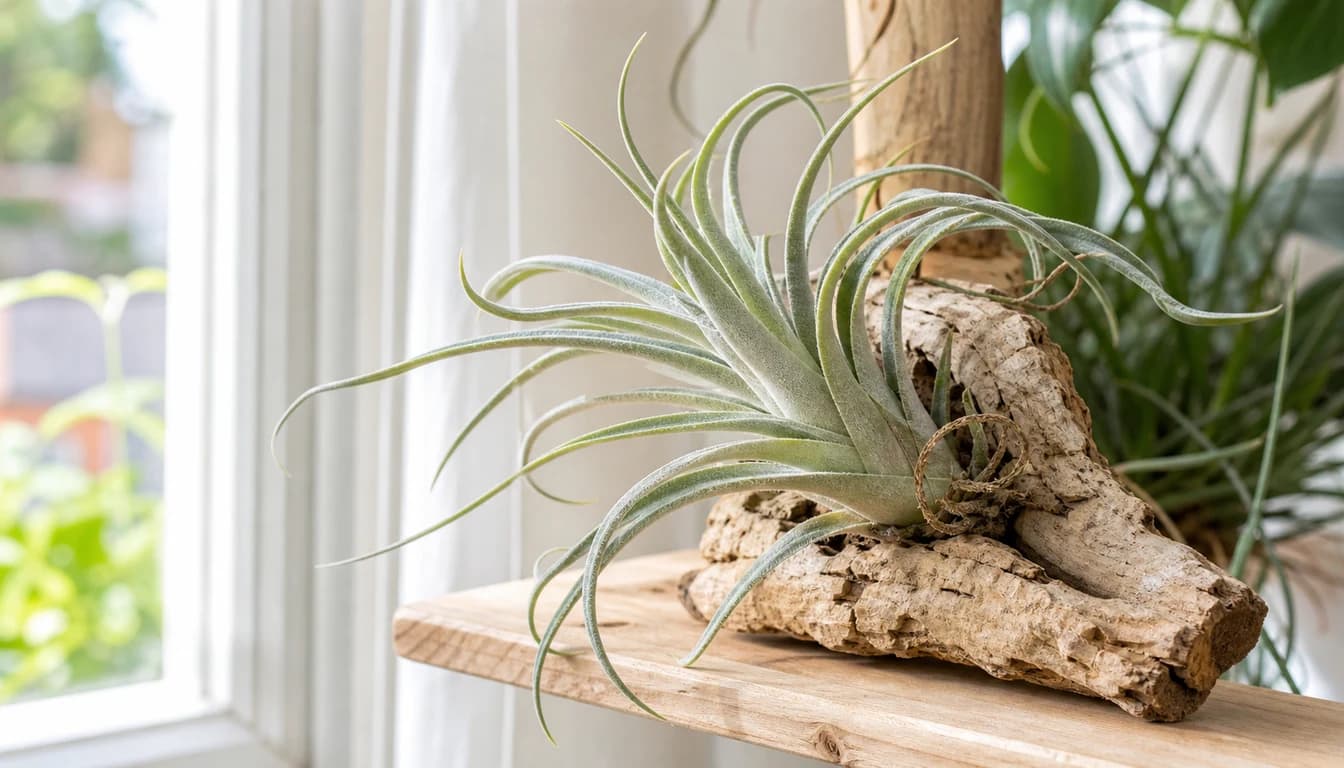
potted_plantSoil and Repotting
The beautiful irony of Air Plants is that they need no soil whatsoever. Their roots, when present, are purely for anchoring—think Velcro rather than drinking straws. You can mount them on driftwood, place them in seashells, nestle them in decorative stones, or simply let them freestyle on a bookshelf.
Other houseplants like Staghorn Ferns also adapt well to creative mounting displays.
When mounting, use only inert materials. Hot glue (low temperature) applied to the base, fishing line, or floral wire secures plants without damage. Avoid soil, moss (unless well-drained), or organic materials that retain moisture against the plant. Orchid bark, cork bark, and cholla wood make excellent natural-looking mounts.
Repotting, in the traditional sense, doesn't apply. Instead, you might 'repot' by moving an Air Plant to a larger display or refreshing its mounting. If roots have grown firmly into bark or wood, don't force them off—instead, mount the entire piece in a new location.
For hanging displays, ensure adequate air circulation around the entire plant. Avoid tight glass containers or terrariums unless they're completely open. Air Plants need moving air to prevent fungal issues; stagnant environments breed problems.
Closed glass traps moisture around the crown and slows drying, which is exactly the environment that leads to rot.
account_treePups After Bloom, Not Leaf Cuttings
Air Plant propagation happens naturally and reliably through offsets, commonly called 'pups.' After flowering, your Air Plant will typically produce 2-6 baby plants at its base. Wait until these pups reach about one-third the size of the mother plant before separating them—this ensures they're mature enough to survive independently.
Separation is simple. Gently twist the pup away from the mother plant; most detach easily once mature. If resistance is strong, use clean scissors to cut the connecting tissue. Allow the cut end to dry for 24 hours before resuming normal watering. The mother plant may continue growing for several months after producing pups, eventually drying out naturally.
If you're new to propagating houseplants, our propagation guide covers the core principles that apply across species.
The key difference is that an Air Plant pup stays attached to a declining mother plant for a reason. Leave that cluster together until the pup is sturdy enough to soak and dry on its own without collapsing at the base.
Seed propagation is possible but extremely challenging and slow. Air Plant seeds require specific conditions: bright indirect light, consistent moisture without soaking, temperatures between 70-80°F, and remarkable patience. Seedlings take 3-5 years to reach maturity, making this method impractical for casual growers.
For best results, propagate during the growing season (spring through early fall). This gives pups the strongest start with favorable light and temperature conditions. Winter propagation is possible but growth will be slower.
Guide — See AlsoBest Indoor Plants for Every Room and Light LevelA practical guide to choosing the best indoor plants for your home, covering beginner-friendly picks, low light champion
chevron_rightpest_controlPests and Common Problems
Air Plants are remarkably pest-resistant compared to traditional houseplants. Their lack of soil eliminates fungus gnats and soil-dwelling pests entirely—something houseplant owners battling gnats can only dream of. However, they're not completely invincible. Mealybugs are the most common culprit, hiding in leaf bases and appearing as white, cottony clusters.
The same mealybug treatment you'd use on a Monstera or Aloe Vera works here.
Scale insects occasionally appear, attaching themselves to leaf surfaces and sucking sap. Treat both mealybugs and scale by dabbing with rubbing alcohol on a cotton swab, then rinsing thoroughly. For severe infestations, submerge the plant in a solution of water and insecticidal soap for 15 minutes.
Rot is the number one killer of Air Plants, not pests. It happens when water sits in the leaf axils or the plant can't dry properly. Prevention is key: always dry plants upside down, ensure good air circulation, and avoid overwatering in cool conditions.
If you catch rot early (soft, dark base), you might save the plant by removing affected leaves and improving drying procedures.
Brown leaf tips usually indicate underwatering or low humidity. While Air Plant species are drought-tolerant, they still need regular moisture. Brown tips won't turn green again, but new growth will be healthy if you adjust your routine.
calendar_monthSeasonal Care
Spring marks the beginning of active growth for most Air Plants. This is when you'll see the most dramatic color changes as plants prepare to bloom. Increase watering frequency and consider a monthly fertilizer boost with a bromeliad-specific or orchid fertilizer diluted to quarter strength.
The general principles in our fertilizing guide apply to Air Plants too. They just need lighter doses than soil-grown plants like bromeliads or Phalaenopsis orchids.
Summer brings peak growth and potential blooms. Many species flower during summer months, producing vibrant red, pink, or purple bracts followed by delicate tubular flowers. Protect plants from intense afternoon sun, which can scorch even sun-loving varieties. Outdoor display is possible if you provide shade during the hottest hours.
Fall signals preparation for dormancy. Reduce watering slightly and stop fertilizing. This resting period is crucial for many species to develop flower buds for spring. If you've kept plants outdoors during summer, bring them inside before nighttime temperatures drop below 50°F.
Winter requires the most adjustment. Heating systems create very dry air; consider a humidifier nearby or group plants together to create a microclimate. Reduce watering to every 2-3 weeks, allowing the base to dry completely between waterings. Avoid cold drafts from windows or doors.
- check_circleIncrease soaks when summer heat dries the rosette quickly.
- check_circleReduce watering in winter when rooms are cooler and growth slows.
- check_circleStop fertilizing during the darkest months unless plants are under strong grow lights.
Guide — See AlsoBest Time to Water Indoor Plants for Healthy GrowthLearn exactly when to water indoor plants during the day, how timing changes by season and light level, and how to avoid
chevron_righthealth_and_safetySafety, Pets, and Ecological Impact
Air Plants earn high marks for pet safety. The ASPCA confirms Tillandsia species are non-toxic to cats, dogs, and horses. This makes them excellent choices for homes with curious pets who might nibble on plants. However, while not poisonous, eating plant material can cause mild gastrointestinal upset in some animals.
From a human perspective, Air Plants pose no toxicity risks. They're safe for children's rooms, kitchens, and offices where people might touch or handle them frequently. Their lack of soil also means no allergens or pathogens from potting mix.
Ecologically, Air Plants play fascinating roles in their native habitats. As epiphytes, they capture moisture from fog and rain, channeling it down to the forest floor. They provide habitat for insects and small invertebrates in their leaf axils. Some species even form symbiotic relationships with ants.
When purchasing Air Plants, choose sustainably harvested specimens. Wild collection has threatened some populations, particularly rare species. Reputable growers propagate plants sustainably, and many species like T. ionantha are now widely cultivated. Browse our best indoor plants roundup for more responsibly sourced houseplant options.
eco
Keep Exploring
Related Plants
 Houseplants
String Of Pearls
Zone 10–12 gardeners can grow String of Pearls outdoors all year, but most of us keep it as an indoor trailing succulent. Those bead-like leaves hold water,
 Houseplants
Areca Palm
Areca Palm is a cane-form indoor palm for bright filtered light and lightly damp soil, especially when you want soft, arching fronds without treatin
 Houseplants
Satin Pothos
Satin Pothos is a Scindapsus vine grown for silver leaves. It needs brighter light than plain pothos to keep that silver from fading.
quiz
Frequently Asked Questions
Do air plants really need no soil at all?expand_more
Correct—they're epiphytes that absorb water and nutrients through their leaves, not roots. In nature, they anchor to trees or rocks purely for stability. You can display them on driftwood, shells, or in decorative containers without any growing medium.
How often should I water my air plant?expand_more
Most need soaking every 1-2 weeks in room-temperature water for 20-30 minutes. Adjust based on your home's humidity and temperature. Dry, air-conditioned spaces need more frequent watering; humid bathrooms might need less.
My air plant is turning red/purple—is that normal?expand_more
Yes, that's often a sign it's about to bloom! Many species, especially Tillandsia ionantha, develop vibrant red or purple coloring as they prepare to flower. It's a natural process and something to look forward to.
Can I keep air plants in a terrarium?expand_more
Only if the terrarium is completely open. Air plants need excellent air circulation to prevent rot. Closed glass containers trap moisture and create humid, stagnant conditions that lead to fungal problems.
What should I do after my air plant flowers?expand_more
The mother plant will eventually produce offsets ('pups') before dying—this is natural for monocarpic plants. Wait until pups are about one-third the mother's size, then separate and grow them independently.
menu_book