verifiedExpert Verified
Kalanchoe
Kalanchoe blossfeldiana
Family: Crassulaceae
wb_sunnyLight
Bright direct light for 6+ hours daily; south or west window ideal; needed for blooming
water_dropWater
Low to moderate; let top inch of soil dry between waterings; reduce after flowering
heightHeight
8-12 inches tall indoors; compact, mounding growth habit
publicZone
Outdoors in Zone 10-12; indoors anywhere
Native Region
Madagascar ( northeastern highlands )
biotechBotanical Profile and Growth Habit
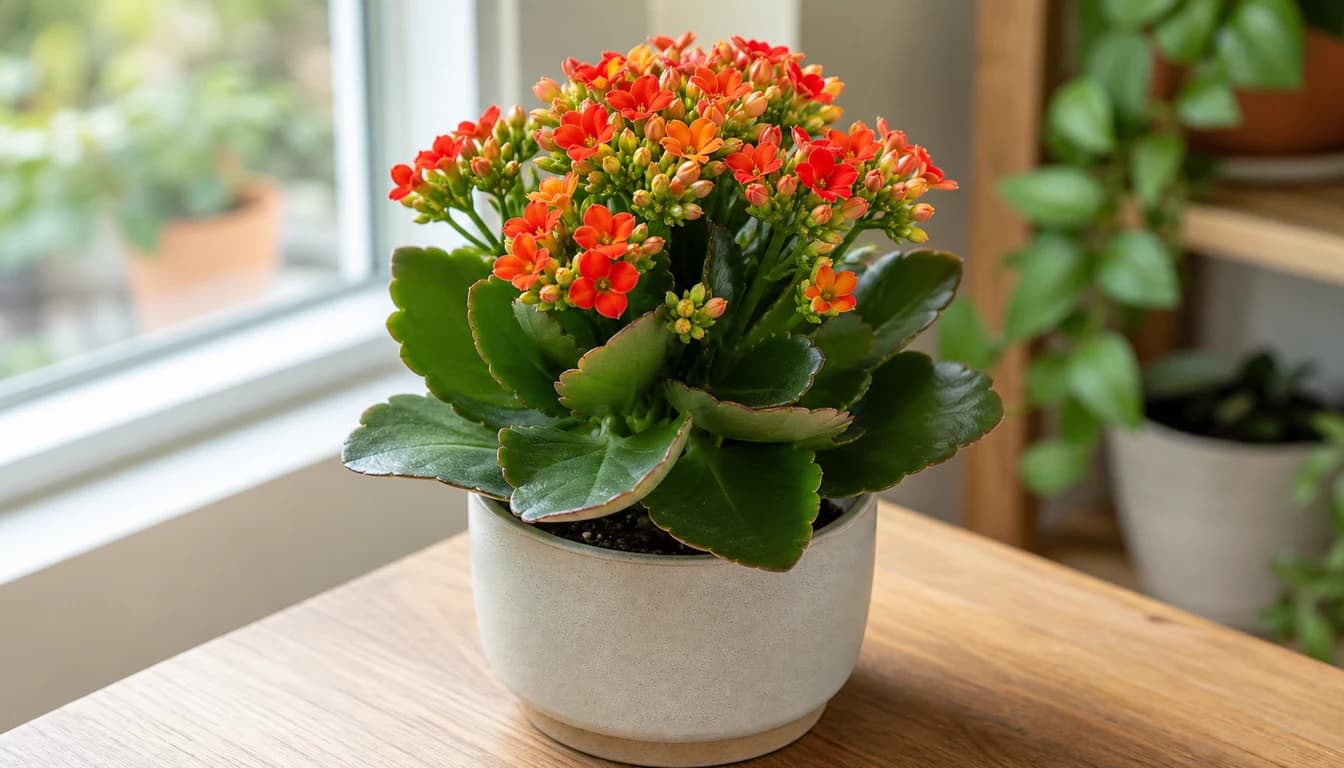
Kalanchoe (Kalanchoe blossfeldiana) is a short-day succulent in the Crassulaceae family, native to the rocky slopes of northeastern Madagascar. In the wild it grows as a low, sprawling groundcover in thin, well-drained soil where intense tropical sun beats down during the day and temperatures drop sharply at night.
That push-pull of bright days and cool nights is baked into the plant's genetics — it is how kalanchoe knows when to bloom.
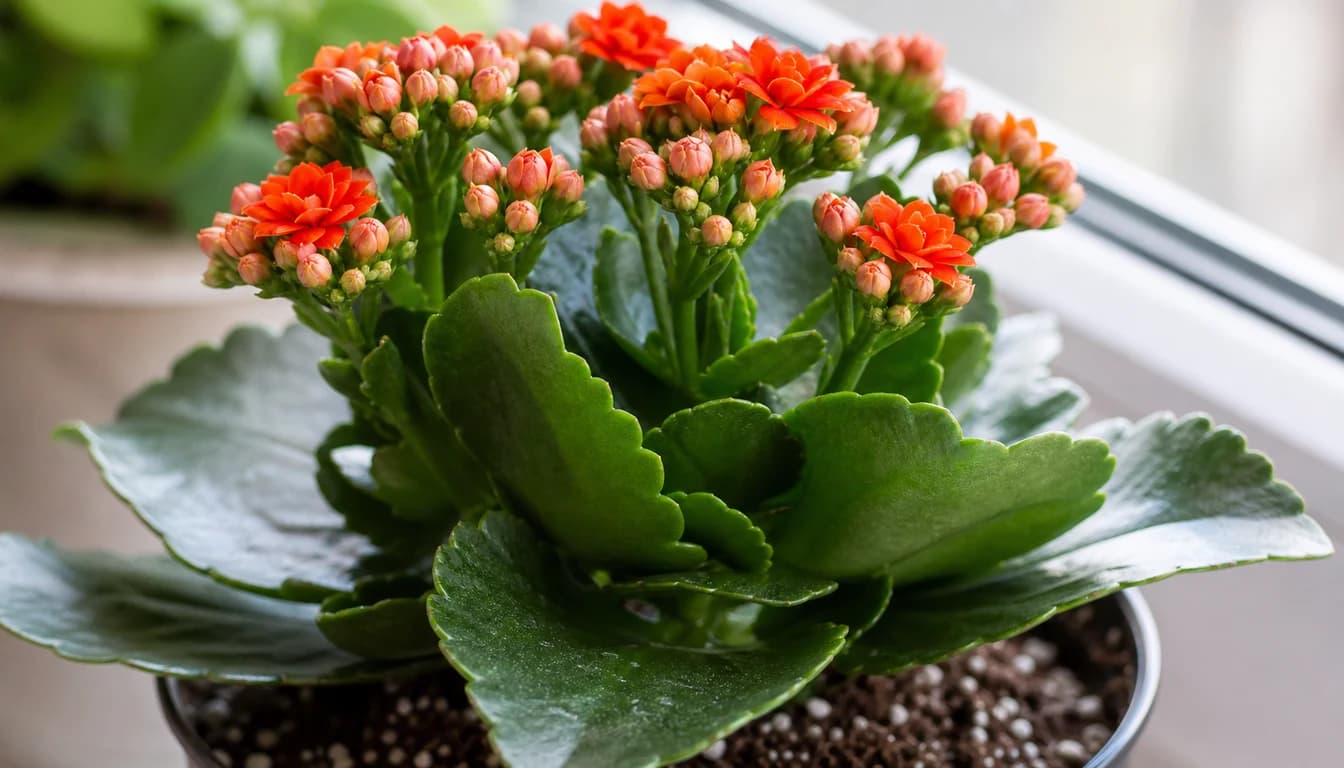
The leaves are thick, glossy, and dark green with scalloped edges, arranged in opposite pairs along short, fleshy stems. Each leaf stores enough water to survive several days of drought, and the waxy cuticle gives the foliage a polished look even outside blooming season.
The plant rarely exceeds 8 to 12 inches tall or wide indoors, forming a dense, mounding rosette that fills a 6-inch pot nicely.
What makes kalanchoe different from most houseplants is its photoperiodism — it is one of the few plants whose blooming is triggered by the length of darkness, not temperature or growth stage. Wild kalanchoe flowers during Madagascar's dry winter when days are short.
Indoors, it needs about 14 hours of uninterrupted darkness per night for six weeks to set flower buds. Without that rest, it will grow green foliage indefinitely and never bloom.
- fiber_manual_recordGrowth habit: compact, mounding rosette from a central stem; bushy and symmetrical in good light
- fiber_manual_recordMature size: 8-12 inches tall and wide; stays small in a 4-6 inch pot for years
- fiber_manual_recordLeaf shape: thick, scalloped, dark green; 2-3 inches long; glossy waxy surface
- fiber_manual_recordFlowers: dense terminal clusters of tiny 4-petaled blooms; red, orange, yellow, pink, or white; last 4-8 weeks
Kalanchoe is photoperiodic — its blooming depends on the length of darkness, not temperature. Commercial growers use blackout curtains to force blooming on schedule, which is why kalanchoe appears in stores year-round.
paletteCultivars and How to Choose One
Most kalanchoe sold in stores are Kalanchoe blossfeldiana hybrids bred for compact growth and vivid flower color. The original species has red-orange blooms, but decades of breeding have produced cultivars in nearly every warm shade. All share identical care requirements — the differences are in flower form, color, and petal count.
If you find a kalanchoe at a grocery store or garden center, the cultivar name is rarely printed on the label. That does not matter — care is the same across all blossfeldiana hybrids.
Look for a plant with tight, compact foliage, no leggy stems, and unopened buds if you want the longest bloom display. A plant that is already in full bloom will still flower for several weeks.
For something unusual, seek out Kalanchoe beharensis (Felt Plant) with velvety, triangular leaves, or Kalanchoe pinnata (Cathedral Bells) with scalloped leaves that produce plantlets along their margins. These species have different growth habits and care needs — they are not covered in this guide, which focuses on the common flowering kalanchoe.
Calandiva seriesDouble-petaled flowers that look like tiny roses; compact, bushy habit; available in red, orange, yellow, pink.
Rocalva seriesSingle-petaled flowers in bright, saturated colors; slightly taller than Calandiva; strong branching.
Winter ThriveBred for reliable reblooming; compact 8-10 inch plants; excellent for gift-giving and windowsills.
Noid (no-ID)Most store-bought kalanchoe — unidentified hybrids with red, orange, or yellow flowers. Care is identical.
wb_sunnyLight and Placement
Kalanchoe needs bright direct light for at least 6 hours daily to maintain compact growth and build the energy reserves it uses for flowering. A south- or west-facing windowsill within 2 feet of the glass is the sweet spot. The leaves will stay thick, dark green, and tightly arranged along the stem when light is充足.
In medium or low light, kalanchoe stretches toward the window, the stems elongate, and the leaves space out — a condition called etiolation. The plant survives, but it will never bloom without bright light and will eventually look straggly.
If your best window is north-facing, a small LED grow light positioned 6-8 inches above the plant for 12-14 hours daily can substitute. Our best indoor plants guide covers other low-light options if kalanchoe is not a fit for your space.
Rotate the pot a quarter turn every week to prevent lopsided growth. Kalanchoe leans aggressively toward light sources, and an unrotated plant will develop a permanent lean within a month. This is cosmetic, not dangerous, but it is easy to prevent.
Bright light alone is not enough to trigger blooming. Kalanchoe also needs 14 hours of uninterrupted darkness per night for 6 weeks. See the Seasonal Care section for the full reblooming protocol.
- fiber_manual_recordIdeal: south or west window, within 2 feet of glass, 6+ hours of direct sun daily
- fiber_manual_recordGrow light: LED at 6-8 inches for 12-14 hours if natural light is insufficient
- fiber_manual_recordMedium light: plant survives but becomes leggy and will not bloom
- fiber_manual_recordRotate: quarter turn weekly to keep growth symmetrical
Guide — See AlsoAir Purifying Plants for Cleaner Indoor AirLearn how to pick, place, and care for air purifying plants so they help your indoor air instead of just looking pretty.
chevron_rightEmail Updates
Join the KnowTheYard update list
Zone-specific advice, seasonal reminders, and new plant guides — no filler.
water_dropWatering
Kalanchoe stores water in its fleshy leaves and stems, so let the top inch of soil dry out between waterings — typically every 7 to 10 days in spring and summer, stretching to every 10 to 14 days in fall and winter.
The plant evolved in Madagascar's dry season, where it might go weeks without rain, and its roots are adapted to brief drought followed by a quick soak.
Water thoroughly when you do water — pour until it drains from the bottom, then empty the saucer within 30 minutes. Shallow sips that only wet the surface encourage roots to stay near the top of the pot where they dry out faster.
A deep soak pushes roots downward and builds a stronger root system. Our drainage holes guide explains why this matters and how to set up pots correctly.
Overwatering shows up as soft, translucent leaves that eventually turn yellow and drop, or as blackened stems at the soil line — both signal root rot. Underwatering is less dramatic: the lower leaves wrinkle and feel papery. Kalanchoe bounces back quickly from a missed watering; it rarely recovers from root rot.
- check_circleCheck soil first: stick your finger an inch into the soil — water only if it feels dry
- check_circleWater deeply: soak until excess drains; empty the saucer within 30 minutes
- check_circleReduce in winter: every 10-14 days is often enough when growth slows
- check_circleAvoid overhead watering: keep water off the leaves to prevent fungal spots
potted_plantSoil and Repotting
Standard potting mix holds water like a sponge, and kalanchoe roots cannot breathe in that environment. You need a fast-draining blend — either a commercial cactus and succulent mix, or a DIY blend of two parts potting soil, one part perlite, and one part coarse sand. The mix should drain within seconds of watering and never stay soggy at the bottom of the pot.
Terra cotta is the best pot material for kalanchoe because the porous clay wicks moisture out of the soil and dries the root zone faster than plastic or glazed ceramic.
If you prefer a decorative pot, use the cachepot method: keep the plant in a plastic nursery pot with drainage holes and set it inside the decorative container. Lift the inner pot to water, let it drain, then return it.
Kalanchoe grows slowly and does not mind being slightly root-bound; repot every 1 to 2 years or when roots push the plant up out of the pot. Go up only one pot size — 1 to 2 inches wider — and always use fresh succulent mix. A pot that is too large holds excess moisture around the roots and is the fastest route to rot.
- fiber_manual_recordSoil mix: cactus/succulent mix, or 2:1:1 potting soil, perlite, and coarse sand
- fiber_manual_recordPot material: terra cotta preferred; plastic or ceramic work with careful watering
- fiber_manual_recordDrainage: at least one drainage hole; multiple holes are better
- fiber_manual_recordRepotting frequency: every 1-2 years, or when roots escape drainage holes
- fiber_manual_recordBest time to repot: spring, right after the blooming cycle ends
account_treePropagation
Kalanchoe propagates readily from stem cuttings and leaf cuttings, though stem cuttings are faster and produce a fuller plant in a shorter time. If your kalanchoe has become leggy from low light, cutting it back and rooting the trimmings is a natural way to rejuvenate the plant while creating new ones.
For stem cuttings, snip a 3-4 inch section of healthy stem just below a leaf node. Strip the bottom pair of leaves, let the cut end air-dry for a day until it forms a callous, then insert it into moist succulent mix.
Place it in bright indirect light — not direct sun — and mist lightly every few days. Roots typically develop within 2 to 3 weeks. For a general overview of propagation techniques, see our propagation guide.
Leaf propagation works too, but it is slower. Pluck a healthy leaf from the stem, lay it flat on moist succulent mix, and cover loosely with plastic wrap to maintain humidity. Tiny roots and a miniature rosette emerge from the leaf base after 4 to 6 weeks. The parent leaf shrivels as the new plantlet grows — that is normal and expected.
- check_circleStem cuttings: 3-4 inch sections, callous 1 day, insert in moist succulent mix
- check_circleRooting time: 2-3 weeks for stems; 4-6 weeks for leaf cuttings
- check_circleLeaf method: lay flat on moist mix, mist, cover with plastic — roots emerge from leaf base
- check_circleLight during rooting: bright indirect; avoid direct sun until roots are established
- check_circleWater during rooting: keep soil lightly moist, not soggy — misting is enough
Guide — See AlsoBest Herbs to Grow Indoors for Real Harvests, Not Spindly PotsChoose indoor herbs that can actually produce in your light, temperature, and container setup, then match each one to th
chevron_rightpest_controlPests and Common Problems
Kalanchoe is not especially pest-prone, but mealybugs and aphids do target it — mealybugs hide in the leaf axils where the scalloped edges create cozy crevices, and aphids cluster on the tender new growth and flower buds.
Wipe mealybugs away with a cotton swab dipped in rubbing alcohol; for aphids, spray them off with a strong stream of water and follow up with diluted neem oil. Our neem oil for houseplants guide covers mixing ratios and application frequency. Isolate the plant until the infestation clears — both pests spread to nearby houseplants.
The more common problems are cultural, not pest-related. Root rot from overwatering is the leading cause of death; the stems turn soft and black at the soil line, and the leaves yellow and drop. Leggy growth signals insufficient light.
Bud drop happens when the plant is moved during its blooming cycle or exposed to temperature swings. None of these require pesticides — they resolve with better light, less water, and stable placement.
- fiber_manual_recordMealybugs: white cottony clusters in leaf axils — dab with rubbing alcohol or apply neem oil
- fiber_manual_recordAphids: small green or black insects on new growth and buds — spray off with water, treat with neem
- fiber_manual_recordRoot rot: soft, blackened stems at soil line — cut away rotted roots, repot in dry soil
- fiber_manual_recordBud drop: flowers fall before opening — caused by drafts, relocation, or inconsistent watering
- fiber_manual_recordLeggy growth: stretched stems with wide leaf gaps — move to brighter light and pinch back
calendar_monthSeasonal Care
Kalanchoe follows a predictable annual cycle: active growth in spring and summer, blooming in late winter to early spring, and a brief rest period after flowering ends. Understanding this rhythm is the key to getting reblooms — the plant's internal clock is set by day length, and disrupting it with artificial light at night can prevent flowering for an entire year.
The reblooming protocol is straightforward. Starting in late September or early October, place the kalanchoe where it receives 14 hours of uninterrupted darkness every night — a closet, a windowless bedroom, or a cardboard box over the plant all work.
During the day, return it to bright light. Maintain this cycle for 6 weeks, then stop. New flower buds should appear within 2-3 weeks. Once buds form, move the plant to its permanent display location and resume normal care.
After the flowers fade, cut the spent flower stalks back to just above the top pair of leaves. The plant will then enter a growth phase where it produces new leaves and stems — this is the time to fertilize lightly and repot if needed. By late summer, the plant should have fresh growth and be ready for the next darkness cycle.
Late September: start 14-hour darkness cycle → Early November: end darkness cycle → Late November: buds appear → December-February: flowers bloom → March: cut back spent blooms → Spring-Summer: growth and recovery.
- fiber_manual_recordSpring (March-May): resume fertilizing; repot if roots are crowded; take cuttings for propagation
- fiber_manual_recordSummer (June-August): bright direct light; water every 7-10 days; no darkness treatment needed
- fiber_manual_recordFall (September-October): begin 14-hour darkness cycle for reblooming; reduce watering slightly
- fiber_manual_recordWinter (November-February): flowers appear; display in bright light; stop fertilizing; enjoy the show
health_and_safetySafety, Pets, and Ecological Impact
Kalanchoe is toxic to cats, dogs, and livestock if ingested; the leaves and stems contain bufadienolide glycosides — cardiac glycosides that affect heart function. Chewing on the leaves can cause vomiting, drooling, diarrhea, and in severe cases, cardiac arrhythmias. The risk is highest for cats, who are more likely to chew on houseplants.
Keep kalanchoe on a high shelf, hanging planter, or in a room where pets do not have unsupervised access. If you have a cat that nibbles on plants, consider pet-safe alternatives like peperomia or spider plant — both are non-toxic and thrive in similar conditions. Our toxic plants guide lists common houseplants by toxicity level.
The sap can cause mild skin irritation on contact, so wash your hands after handling cuttings or pruning a mature plant. This is not a serious hazard, but sensitive individuals may develop a rash. For humans, the bigger risk is accidental ingestion by children — keep kalanchoe out of reach and seek medical advice if any part of the plant is eaten.
Kalanchoe contains cardiac glycosides that are toxic to cats, dogs, and livestock. Symptoms include vomiting, drooling, and cardiac irregularities. Keep out of reach or choose a non-toxic alternative.
eco
Keep Exploring
Related Plants
 Houseplants
Boston Fern
Frizzy, arching fronds look great in hanging baskets, but Boston Fern drop leaves fast if their air and soil dry out. Get the humidity, light, and watering
 Houseplants
Dieffenbachia
Broad, patterned leaves and upright canes make Dieffenbachia a bold indoor plant for warm homes. It handles typical indoor light, needs steady but not soggy
 Houseplants
Calathea
Calatheas are tropical houseplants prized for their patterned, moving leaves and preference for warm, humid rooms. They need steady moisture, soft filtered ligh
quiz
Frequently Asked Questions
How do I get my kalanchoe to rebloom?expand_more
Give the plant 14 hours of uninterrupted darkness every night for 6 weeks, starting in late September. A closet or windowless room works — just make sure no artificial light reaches the plant during the dark period. After 6 weeks, return it to bright light. Buds should appear within 2-3 weeks.
Why is my kalanchoe getting leggy and stretched?expand_more
Insufficient light is the cause. Kalanchoe needs at least 6 hours of direct sunlight daily to stay compact. Move it to a south or west window, or use a grow light. You can also pinch back the leggy stems to encourage bushier growth once the plant is in a brighter spot.
Is kalanchoe safe for cats and dogs?expand_more
No. Kalanchoe contains bufadienolide glycosides that are toxic to cats, dogs, and livestock. Ingestion causes vomiting, drooling, and potentially cardiac issues. Keep it on a high shelf or in a room pets cannot access. For pet-safe options, see our guide to plants toxic to pets.
Can I grow kalanchoe outdoors?expand_more
In USDA Zones 10-12, kalanchoe can grow outdoors year-round in well-draining soil and bright sun. In cooler climates, it thrives outdoors on a sunny patio from spring through fall, then must be brought inside before the first frost. Kalanchoe is not frost-tolerant and will die at temperatures below 40°F.
How long do kalanchoe flowers last?expand_more
Individual blooms last 4-8 weeks, depending on light, temperature, and humidity. Cooler temperatures (around 60°F) and bright, indirect light after buds form will extend the blooming period. Once flowers fade, cut the stalk back to the top pair of leaves to redirect energy into new foliage growth.