
Watering Calculator
Convert weekly water need and rainfall into gallons and estimated runtime.
Watering
Convert a water depth appropriate to your plants into US gallons and estimated runtime.
The practical plan will appear here.
One inch of water, in gallons
One inch over one square foot is 0.623 gallons before any loss, per Iowa State Extension.
| Area | Gallons for 1 inch |
|---|---|
| 25 sq ft | 16 |
| 100 sq ft | 62 |
| 500 sq ft | 312 |
| 1,000 sq ft | 623 |
The numbers behind the gallons
- 0.623gallons per square foot per inch of water
- 1 incha week for most gardens, rain and watering combined
- 5 galbucket fill time gives your hose gallons per minute
Before you use the number
Convert inches into a real watering session
One inch of water over one square foot is 0.623 gallons. The tool multiplies your area by the inches still needed after rain, then divides by delivery efficiency, because some water never reaches the roots. Washington State University Extension puts typical sprinkler efficiency at about 70 percent and drip at 90 to 95 percent.
Runtime follows from your flow rate: gallons needed divided by gallons per minute. Measure the flow with a bucket and a timer instead of guessing.
How to use this result
What it means
The gallons are the water your hose, drip line, or sprinkler must deliver this week after rain is subtracted and delivery losses are added back. The minutes are those gallons divided by your flow rate.
Next action
Run the minutes as one thorough watering when you can, because Iowa State Extension says one thorough watering per week is usually better than frequent light watering. With a soaker hose or drip line, dig a small hole now and then to see how deep the water went.
Risk note
A weekly total is a starting point. Sandy soil can need more water than loam, and Mississippi State Extension says up to 2 inches a week. Check the soil before adding water.
Common mistakes
Guessing the flow rate. A hose, a drip line, and a sprinkler each deliver a different number of gallons per minute. Iowa State times a five-gallon bucket; its example hose filled it in 2 minutes 26 seconds, which is 2.1 gallons per minute.
Using the rainfall from a weather report. Penn State Extension notes that rainfall varies widely across an area: one town might get 3 inches and another none. A rain gauge in your own garden counts what actually fell there.
Watering a little every day. Iowa State says one thorough watering per week is usually better than frequent light watering. NC State Extension says to water deeply and less often.
Leaving efficiency at 1.0. About 30 percent of sprinkler water is lost to wind drift and evaporation, according to Washington State University Extension. Drip loses about 5 to 10 percent.
How to work out your watering time
- Measure the bed. Multiply length by width in feet for each bed and add them. The tool uses 0.623 gallons per square foot for every inch of water.
- Set the weekly target. Most vegetable gardens need about 1 inch a week from rain and irrigation combined. Mississippi State Extension says sandy soil may need up to 2 inches.
- Enter the rain that fell. Read a rain gauge placed in your own garden and enter the inches for the week. The tool subtracts it from the target and never goes below zero.
- Pick your delivery efficiency. Use 0.90 for drip and 0.70 for a typical sprinkler. Lower efficiency means more gallons are needed to put the same depth in the soil.
- Time your flow with a bucket. Run the hose or system into a five-gallon bucket and time how long it takes to fill. Divide 5 by the minutes. Enter that gallons-per-minute number, then read the minutes.
Example: a 100 square foot bed, a 1 inch target, no rain, 0.90 efficiency, and 2 gallons per minute needs about 69 gallons, or about 35 minutes. If a bucket takes 2 minutes 26 seconds to fill, the flow is 5 divided by 2.43 minutes, about 2.1 gallons per minute.
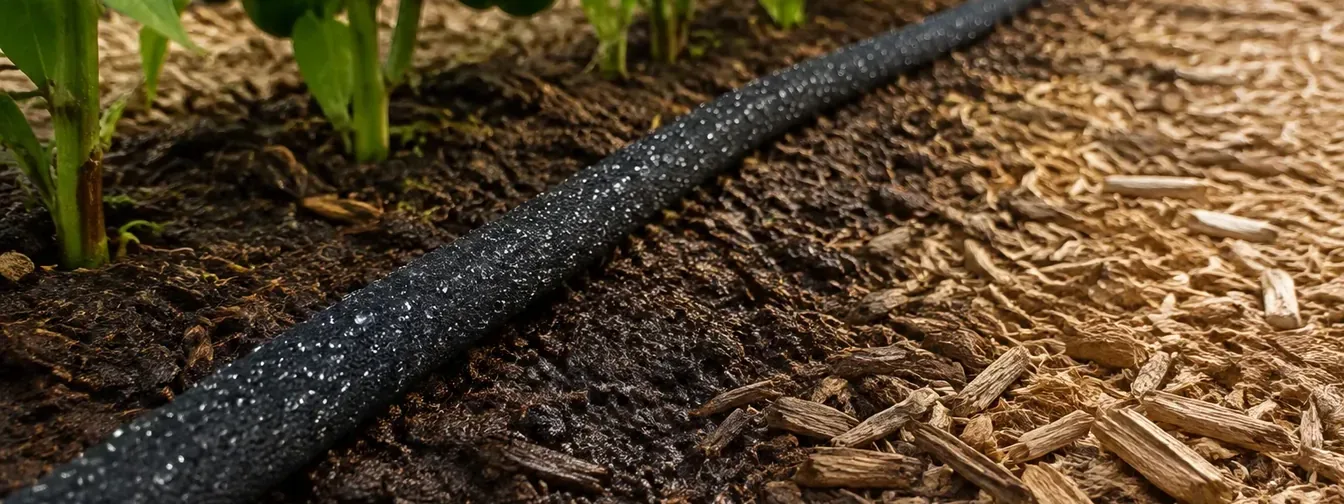
With a sprinkler you can also skip the math for one check. Set straight-sided containers such as tuna cans in the spray area, run the sprinkler, and time how long they take to collect 1 inch of water. Measure the depth in each can with a ruler and average them. With a soaker hose or drip line, water long enough to wet the soil 10 to 12 inches deep, then dig a small hole to check.
What this tool decides
Decides how many gallons and minutes turn a weekly water target into a real watering session.
Conversion: in to gal. Rainfall, delivery efficiency, and flow rate included.
Frequently asked questions
How much water do vegetables need per week?
Iowa State Extension says most vegetable gardens need about 1 inch of water per week from rainfall and irrigation combined. Mississippi State Extension adds that a garden in sandy soil may need up to 2 inches.
How do I measure the flow rate of my hose?
Time how long the hose takes to fill a five-gallon bucket, then divide 5 by the minutes. Iowa State Extension gives the example of 2 minutes 26 seconds, which is 2.1 gallons per minute.
How do I count rain in the calculator?
Put a rain gauge in your garden and enter the inches that fell during the week. Iowa State Extension says a rain gauge shows how much water rain supplied and whether you need to add more, and Penn State Extension says rainfall can differ widely within one area.
Does drip irrigation need less water than a sprinkler?
It needs less to put the same depth in the soil. Colorado State University Extension says drip exceeds 90 percent efficiency while sprinkler systems are 50 to 70 percent efficient, and Washington State University Extension gives about 70 percent for sprinklers and 90 to 95 percent for drip.
How do I know when the garden needs water?
Dig down 2 to 3 inches with a finger or trowel. NC State Extension says that if the soil is still moist at that depth, your plants probably do not need more water yet.
Keep planning
Sources and limits
The 0.623 gallons per square foot figure, the bucket flow test, and the 1 inch weekly rule come from Iowa State University Extension. Efficiency values come from Colorado State University and Washington State University Extension. The rest are linked below.
- Iowa State University Extension, How long does it take to provide the right amount of water when I irrigate?
- Iowa State University Extension, Watering the Home Vegetable Garden
- Colorado State University Extension, Drip Irrigation for Home Gardens (Fact Sheet 4.702)
- Washington State University Extension, Drip Irrigation for the Yard and Garden (FS030E)
- Mississippi State University Extension, How to Obtain Proper Watering in Your Garden
- NC State Extension (Wilkes County), Watering Wisely: How Much Your Summer Vegetable Garden Really Needs
- Penn State Extension, Watering to Beat the Summer Heat
- Purdue Landscape Report, What Is an Inch of Water?
- U.S. EPA WaterSense, Watering Tips